Apple Spas 2026: When Is the Transfiguration of the Lord Celebrated, and What Does This Holiday Mean?
Every year on August 6 according to the New Julian calendar (or August 19 according to the Julian calendar), Christians celebrate Apple Spas, or the Transfiguration of the Lord. It is one of the twelve greatest church feasts, symbolizing the Transfiguration of Jesus Christ and giving thanks to God for the ripe fruits of the new harvest.
The holiday has been known in the Christian world since the 4th century, and today it is celebrated on August 6 by both the Roman Catholic Church and the Orthodox Church of Ukraine. Apple Savior falls during the Dormition Fast, but on this day, believers are permitted to eat fish and drink wine.
In folk tradition, the holiday is also known as the Second Spas and the Great Spas, and the blessing of apples and other fruits of the new harvest has become one of its most famous traditions.
How did the idea of celebrating Apple Spas (the Transfiguration of the Lord) come about?
On this day, churches bless the fruits of the new harvest: apples, pears, plums, grapes, and other gifts of the orchard. At the same time, the Church emphasizes that the main meaning of the holiday lies not in the blessing of the fruit, but in the spiritual transformation of the person.
In the folk calendar, Apple Spas marked the transition between two seasons. Summer was still warm, and the orchards were full of fruit, but the evenings were growing cooler, and the first breath of fall was already in the air. Hence the saying: “When Spas comes, stock up on mittens.”
The Feast of the Apple Savior and the Transfiguration of the Lord is meant to recall episodes from the life of Jesus Christ.
One day, Jesus went up Mount Tabor with three of his disciples: Peter, John, and James. After a long prayer, the Lord’s face and form were transfigured, and they began to shine.
The Feast of the Apple Savior and the Transfiguration of the Lord is meant to recall scenes from the life of Jesus Christ.
One day, Jesus went up Mount Tabor with three of his disciples: Peter, John, and James. After a long period of prayer, the Lord’s face and form were transfigured, and they began to shine.
During his prayer, he revealed to the apostles the union of the divine and human natures: his face shone like the sun, and his garments became white and brilliant as snow. At that moment, Moses and Elijah appeared—representing the Law and the Prophets of the Old Testament—and a voice from heaven declared that Jesus was His beloved Son.
The disciples caught a brief glimpse of this; they were supposed to be praying, but had fallen asleep during their prayer. That is why they were able to behold their Teacher’s heavenly glory for only a short time. On that day, the disciples witnessed that their Teacher was not merely a man, but the Son of God. Incidentally, because Jesus’ Transfiguration took place on a mountain, the feast is often called “Spas on the Mountain.”
Through His Transfiguration on a high mountain, the Savior sought to strengthen His disciples’ faith in Him as the Only Son of God—a faith that would not waver during His arduous journey leading up to the Resurrection.
Ukrainians have always called this holiday “Apple Savior” or simply “Savior.” In popular tradition, August 6 is closely associated with the harvest; people believe that this is when summer comes to an end and fall begins. Nature, too, undergoes a transformation.
The Introduction of Apple Savior
The decision to celebrate the Transfiguration of the Lord was made later, after Jesus Christ’s earthly life had ended. The first historical references to it date back to the early 4th century, indicating that the early Christians were the ones who initiated its observance. Patriarch John Chrysostom of Constantinople and the Venerable Jerome of Sirin wrote about the feast itself, its observance, and its customs in their works.
The first church dedicated to the Transfiguration of the Lord was built on Mount Tabor by Saint Helena—the mother of the first Christian emperor, Constantine the Great. Unfortunately, the building was destroyed by the army of the Muslim commander Saladin as early as the 12th century. The hymns sung during the Liturgy were composed by the Venerable John of Damascus and Cuthbert of Jerusalem, who were also church poets. Since the 6th century, the most solemn celebration of the Transfiguration of the Lord has taken place in the Orthodox Church of the same name.
Dates of the Celebration
The Transfiguration itself was originally celebrated in winter, specifically in February. However, since this solemn feast fell during Great Lent, a time associated with neither joy nor merriment, it was later moved to August.
The Feast of the Apple Savior did not take root quickly in the Christian world. At first, it was observed only by the Eastern Churches, and many of its customs were derived from pagan beliefs related to the harvest. The Catholic Church began celebrating it in the mid-15th century.
Why did apples become the symbol?
The apple was one of the fruits most familiar to Ukrainian peasants. Apple trees grew near almost every farmhouse, bore fruit even in cooler regions, and the fruit could be dried, fermented, baked, and stored until winter.
Therefore, the apple became a folk symbol of abundance, fertility, and the fruits of labor. In the spring, the tree was covered with delicate blossoms; in the summer, it bore fruit; and on Transfiguration Day, the family finally saw the results of their care. In this natural transformation, the very idea of the Transfiguration was clearly evident: that which was small and inconspicuous eventually matures, is filled with light, and bears fruit.
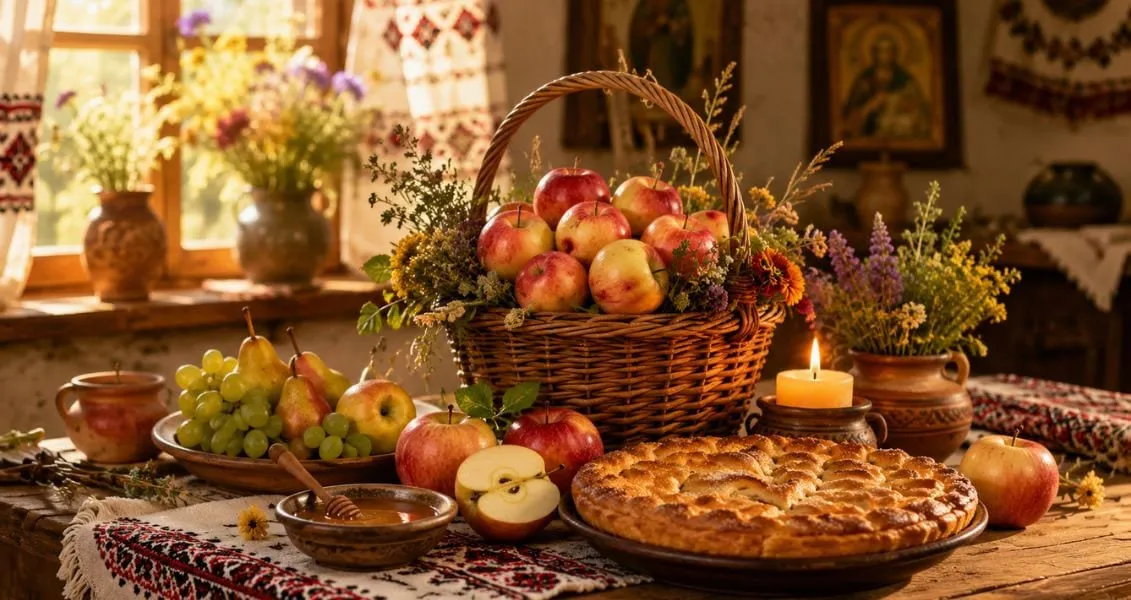
It wasn’t just apples that were brought to the church. The festive basket might also contain grapes, pears, plums, honey, bread, and ears of grain from the new harvest. The blessing of the fruits was first and foremost a sign of gratitude for the earth’s gifts, rather than a magical way to endow them with special properties.
How is Apple Savior Day celebrated?
The First Apple After the Blessing
In many families, people tried not to eat apples from the new harvest until the Feast of the Apple Savior. The first consecrated fruit was eaten solemnly, often while making a wish or saying a prayer.
Particularly touching was a belief associated with deceased children. Mothers who had lost a child refrained from eating apples until the holiday, as they believed that on this day, their children in paradise were given golden or heavenly apples. This custom belongs to folk beliefs rather than church doctrine, yet it illustrates how the joy of the harvest, remembrance, and hope were combined in the holiday.
It was customary to share the first consecrated fruits. Apples were brought to the elderly, the sick, neighbors, and those who did not have their own orchard. Generosity was considered an important part of the holiday: the harvest only gained true value when it was shared. Historical accounts mention that the custom of treating relatives, neighbors, and the needy to fruit was observed with particular zeal.
Greeting cards