
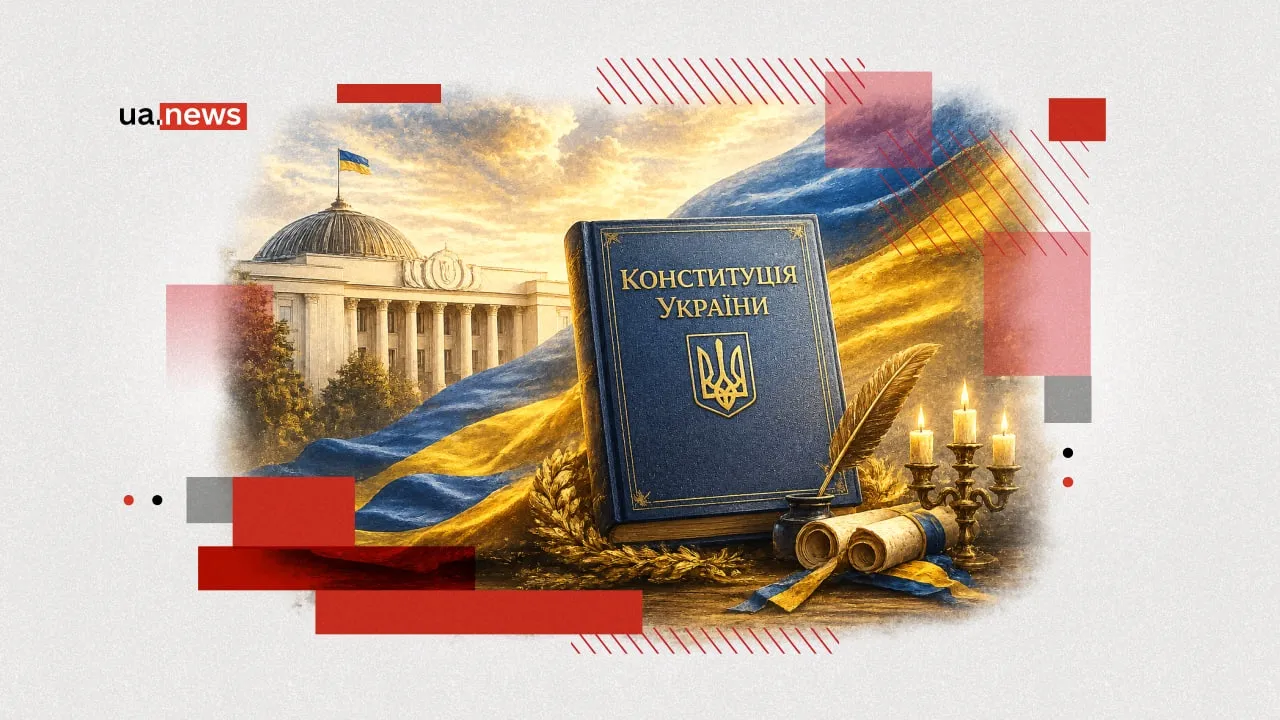
This Sunday, June 28, 2026, Ukraine will celebrate a landmark anniversary. Exactly 30 years ago, in the fifth year of its independence, the country finally adopted a full-fledged Constitution. It was not merely an act of lawmaking, but the culmination of a protracted political standoff—a true drama that unfolded in the parliament’s chamber in June 1996.
That Constitution was born amid the agony of compromises, sleepless nights, and the weight of historical responsibility. Today, as this document is being put to the test by a full-scale war, it is crucial to look back in order to understand: we are dealing not with a formal set of rules, but with a living mechanism that has, for three decades, kept Ukrainian statehood from sliding irrevocably into chaos.
A retrospective look at the adoption of the Constitution tells the story of how a political nation, teetering on the brink of division, managed to agree on its fundamental values. And the current state of the Constitution proves that even in the darkest of times, it does not lose its relevance or its supreme legal force.
So how was the Ukrainian Constitution adopted, and what is its status during the war? UA.News investigated the issue.
Hostages of the Transition Period: Why Ukraine Lived Without a Constitution for Five Years
The paradox of that historical moment lay in the fact that the young state, which gained independence in 1991, continued to operate under the 1978 Soviet Constitution of the Ukrainian SSR for a long time. It was a bizarre legal surrogate, to which hundreds of amendments were made in an attempt to somehow adapt socialist legislation to the realities of a market economy and the struggle between the presidency and parliament. This period could be called “constitutional night,” but in a broader sense—as a time when the state existed without clear rules of the game.

The main source of tension was the question of power: who was the boss—the president or the Verkhovna Rada? The absence of a single founding document turned the political process into a permanent crisis. President Leonid Kuchma insisted on a strong executive hierarchy, while the left-leaning parliament, dominated by socialists and communists, sought to curtail the head of state’s powers as much as possible, reducing him to a ceremonial figure at the head of a government accountable to parliament.
By 1995, the political crisis had reached its peak, forcing the parties to conclude a temporary agreement—the Constitutional Treaty—which was to remain in effect for one year while lawmakers worked on a permanent text. It was this year that proved decisive: under pressure from circumstances and a public weary of instability, the political establishment was forced to move from abstract disputes to concrete work on the Constitution. The realization that further delays threatened to make the country ungovernable prompted the elites to make a historic decision in June 1996.
The Anatomy of a Compromise: The Battle Over Symbols, the Status of Crimea, and the Language Issue
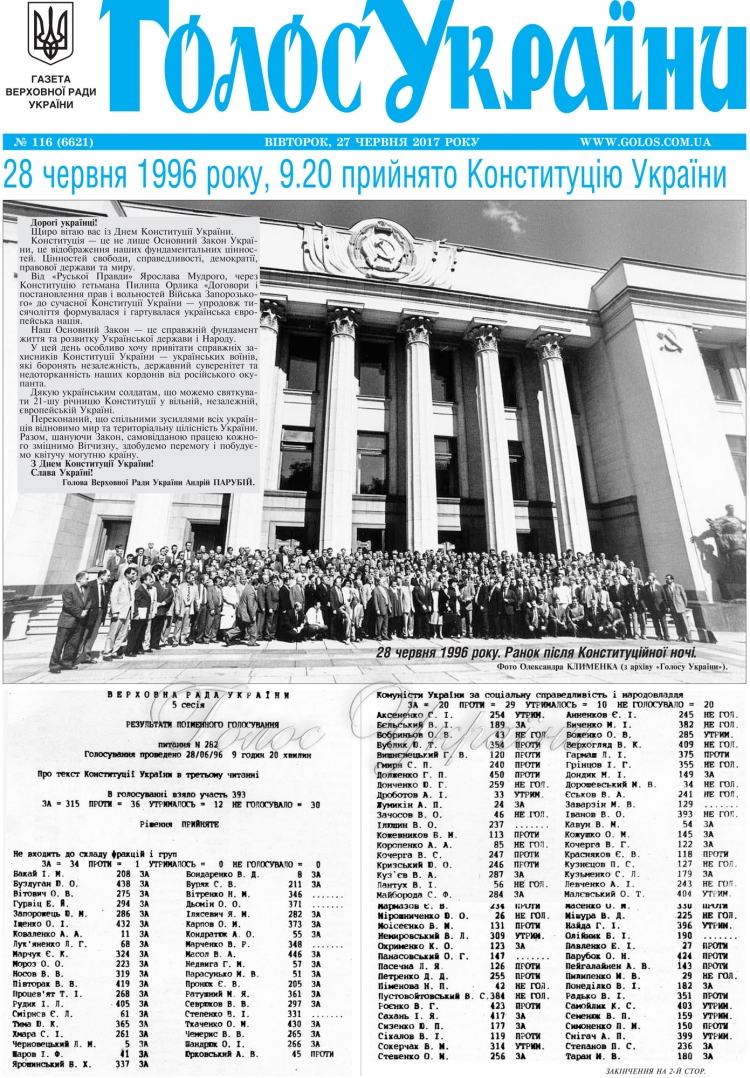
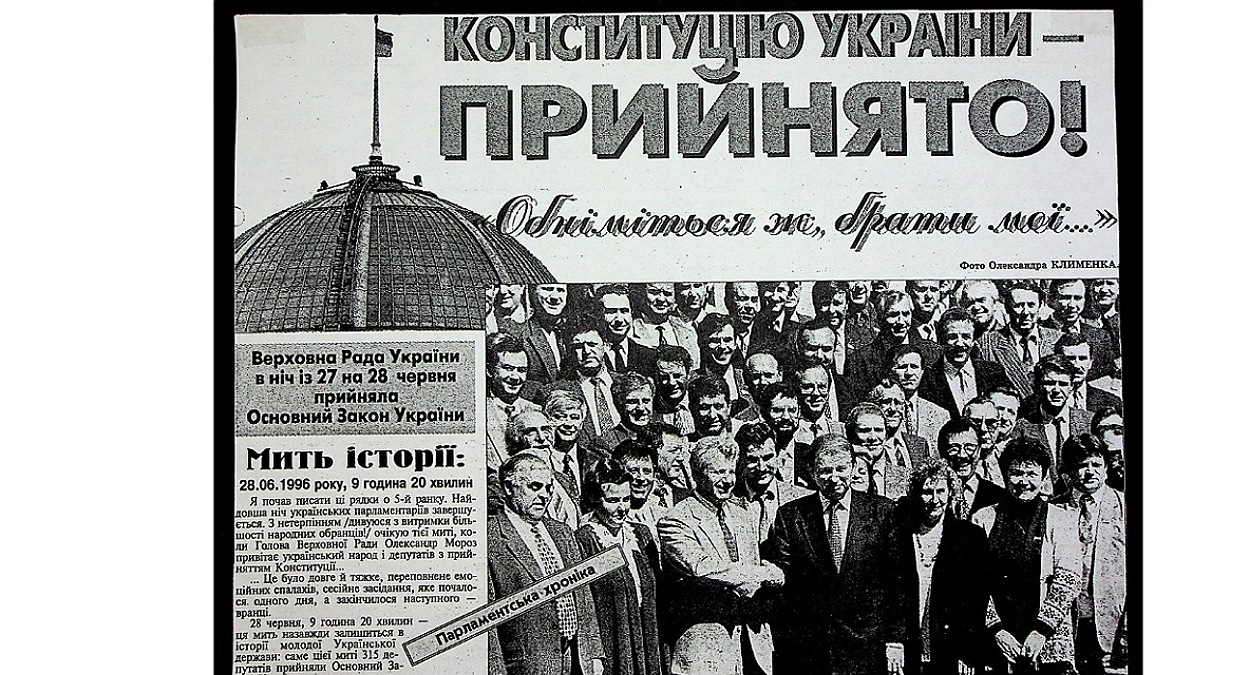
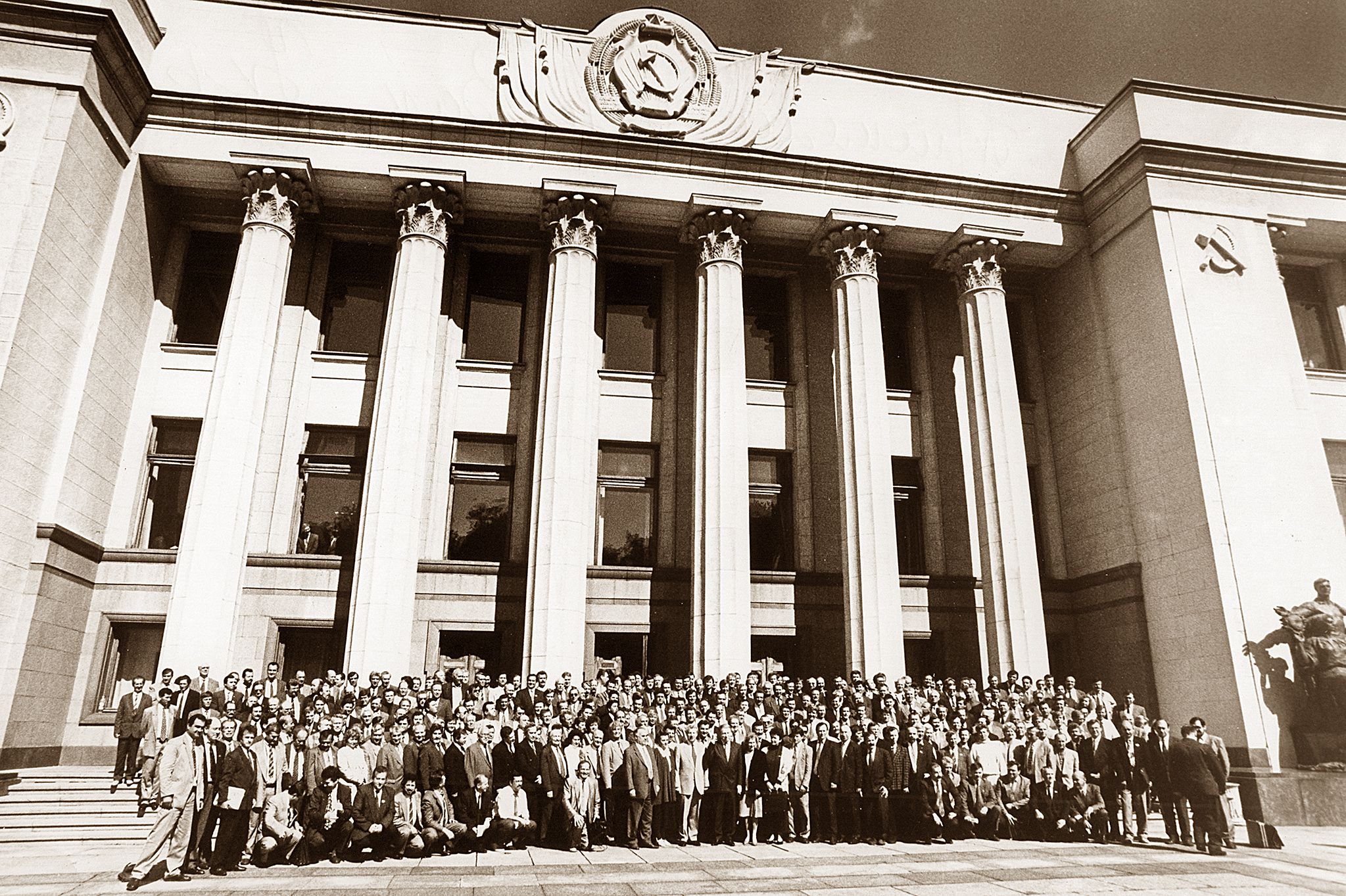
The culmination of the constitutional process was the famous “constitutional night”—in the literal sense: a continuous session of the Verkhovna Rada that lasted from the evening of June 27 to the morning of June 28, 1996. It was more than 23 hours of grueling work, nervous breakdowns, ultimatums, and, ultimately, historic concessions.
One of the most heated debates centered on the status of Crimea. The left-wing factions, which were aligned with Russia, insisted on federalization or granting the peninsula autonomous status, which in practice could have turned Crimea into a quasi-state entity with the right to secede. The National Democrats and the presidential camp advocated for a unitary state. The compromise adopted—the status of the Autonomous Republic of Crimea as an integral part of a unitary Ukraine with its own constitution, which could not contradict the country’s Basic Law—became, albeit a somewhat fanciful one, a solution at the time. However, as subsequent history has shown, this “time bomb” went off 18 years later.
Another battleground was the struggle over language. The draft Constitution, particularly the sections on state symbols and language, sparked a fierce confrontation between the left, which demanded that Russian be enshrined as a second official language, and the center-right, which defended the exclusive status of Ukrainian. The debates were so fierce that they brought the sessions to a standstill several times.
Ultimately, lawmakers found a compromise that remains in effect today in Article 10 of the Constitution (a fact often forgotten today): although Ukrainian is the sole official language, the Constitution guarantees the free development, use, and protection of Russian and other languages of national minorities. This was a typical ambiguity of that era, which helped reassure part of the electorate but at the same time laid the legal foundation for establishing Ukrainian as the sole official language—a principle that was later clarified by decisions of the Constitutional Court and language legislation.
No less fierce was the struggle over the president’s powers and authority. Parliament insisted on retaining the right not only to appoint the prime minister but also key ministers in the security sector. Leonid Kuchma, threatening to put the issue to a nationwide referendum in bypassing parliament, secured for himself powers that were unprecedented at the time: the right to appoint the prime minister with the consent of the Rada (but with the right to independently nominate a candidate), to form the government, and, crucially, to control the security agencies without regard for parliament. This created a presidential-parliamentary model that, with certain modifications, lasted until 2004.
The issue of the death penalty became a drama in its own right. Under pressure from the Council of Europe and thanks to the active stance of democratic forces, the text stipulated that no one could be arbitrarily deprived of life, and that the death penalty—which was still in effect at the time the Constitution was adopted—would be abolished.
In the early hours of the morning, 315 votes “in favor” confirmed the adoption of the Basic Law. Ukraine gained a social contract that, while not perfect, was entirely constructive and democratic.

The Constitution Under Scrutiny: The Application of Law Under Martial Law
Thirty years have passed, and today the Constitution of Ukraine is facing the most severe test in its history—the test of a full-scale war for the survival of the state. In society, especially against a backdrop of fatigue and constant stress, an ironic and destructive narrative sometimes surfaces claiming that during wartime, “the Constitution is on hold.” — this phrase originated from President Zelenskyy’s words, taken out of context, which he addressed to the diplomatic corps back in December 2022, when he meant something entirely different. However, sometimes television commentators state in all seriousness that “human rights are put on hold until the end of the war.”
This view is profoundly flawed from both a legal and a moral standpoint. The Constitution remains fully in force and retains the highest legal authority throughout the territory of Ukraine within its internationally recognized borders. Its provisions remain directly applicable, which is a key guarantee for every citizen, even when sector-specific legislation stalls under the pressure of circumstances. Turning to the courts to defend constitutional rights and freedoms directly on the basis of the provisions of the Constitution is not a theory, but a functioning legal mechanism that did not disappear on February 24, 2022, and is not about to disappear.
Yes, the realities of wartime inevitably bring their own decidedly unpleasant adjustments. Article 64 of the Constitution itself provides for a legal safeguard: under a state of war or a state of emergency, certain restrictions on rights and freedoms may be imposed, with a specified duration for such restrictions.
This is a deliberate legal mechanism that was built into the Constitution by its framers for extreme situations. Unfortunately, the state may indeed restrict freedom of movement, freedom of assembly, the right to the inviolability of the home, or the privacy of correspondence—but only to the extent necessary to repel aggression and ensure national security. At the same time, there is a clear list of absolute rights that cannot be restricted under any circumstances.
These include the right to life, respect for human dignity, freedom of thought and belief, the prohibition of torture and inhuman treatment, as well as the right to legal assistance and judicial protection. Even while fighting for its very existence, the state has no right to turn into a repressive machine devoid of moral compass, for then the very meaning of Ukraine’s existence as a state governed by the rule of law—and thus the war to defend it—disappears.
The narrative of a “Constitution on hold” is dangerous because it erodes the foundation of the social contract. It creates the impression that during wartime, it is permissible to legitimize arbitrariness, disregard basic procedures, or turn state institutions into tools outside the legal framework. This is precisely what the enemy seeks—for Ukraine, in defending itself, to lose its legal identity.
However, it is precisely in times of war that legal certainty and the supremacy of the Constitution take on critical importance. When the front line is blurred and danger lurks everywhere, it is strict adherence to the letter and spirit of the Constitution that separates a civilized state from chaos.

In summary, 30 years is both a long time and a short time for the Constitution. Adopted during the dramatic “constitutional night” of 1996, it was the product of deep compromises that allowed the country—which was then on the brink of political collapse—to be held together. Disputes over the status of Crimea, language, the separation of powers, and the abolition of the death penalty demonstrated that the Ukrainian elites, despite all their differences, were capable of creating a document ahead of its time.
Today, we see that the text proved insufficiently robust to serve as 100 percent legal armor, both before and especially during the war. However, the Constitution of Ukraine is not “on hold.” It is functioning and must continue to function—until such time as it becomes necessary to amend it within the framework of a new social contract. Recognizing that martial law allows for the temporary restriction of certain freedoms, society must vigilantly ensure that these restrictions do not become the new norm.
The 30th anniversary of the Constitution is not merely an occasion for celebration. It is a reminder that the path to freedom lies exclusively through the rule of law, and that the Constitution’s supreme legal authority is the weapon the enemy cannot destroy. This is the very essence of Constitution Day.


