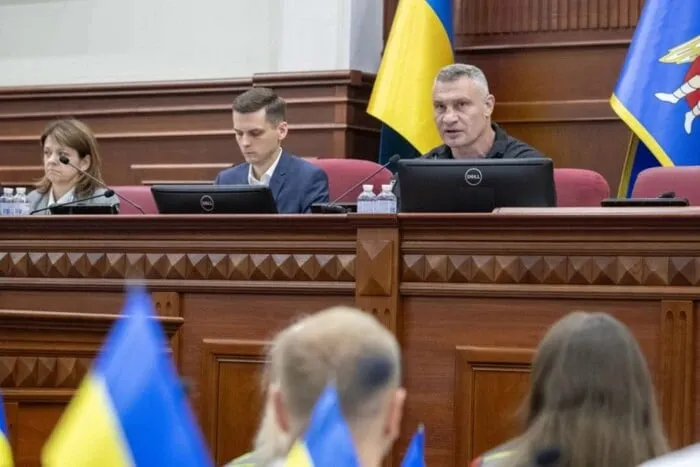
The Kyiv City Council was unable to pass a resolution that would have allowed it to begin negotiations with international partners regarding a loan for the construction of the metro line to Troieschyna. In the council chamber, 58 council members supported the document, while at least 61 votes were required for its adoption. As a result, the draft resolution was not approved.
This was reported with reference to the broadcast of the Kyiv City Council meeting.
The document in question is the draft resolution “On Attracting Funds from International Financial Organizations” (No. 08/261-403/PR dated May 21, 2026). The document was initiated by the capital’s mayor, Vitali Klitschko. However, only 58 deputies voted for it in the session hall, while at least 61 votes are required to pass the resolution. The mayor’s attempt to revisit the issue has failed again.
With this decision, the Kyiv City Council was to instruct the Kyiv City State Administration to conduct negotiations with the European Bank for Reconstruction and Development (EBRD), the European Investment Bank (EIB), and the World Bank. The capital sought to secure a loan and technical assistance for the construction of the Podil-Vygurivska metro line from the Ring Road to the Vygurivshchyna-Troieshchyna residential area, including an electric depot.
Vladimir Repik, Director of the Kyiv City State Administration’s Finance Department, explained that the decision is “mandatory”—it merely authorized the creation of a negotiating group consisting of officials and deputies, while the negotiations themselves typically take years.
According to preliminary estimates, the first section alone (from the “Hlybochytska” station to the “Raiduzhna” station with a branch toward Troieshchyna) will require 68 billion hryvnias. Given the current euro exchange rate (46.16 UAH), this amounts to nearly 1.5 billion euros—a sum equal to two-thirds of Kyiv’s entire annual budget.
The explanatory note stated that the Kyiv Metro municipal enterprise already has the project documentation ready for this section (six stations and two transfer hubs are planned). In addition, the platforms for three stations (“Sudnobudivna,” “Trukhaniv Island,” and “Zatoka Desenka”) have already been constructed as part of the main structures of the Podil-Voskresensky Bridge.
Despite the Kyiv City State Administration’s arguments regarding the importance of this connection for the capital’s largest district, a portion of the city council opposed the plan. The discussion escalated into political accusations.
Foreign business trips during the war: Independent deputy Ihor Kyrylenko (elected from the Opposition Platform—For Life party) stated that during the war, priorities must be set correctly, rather than embarking on astronomically expensive projects. In his opinion, the city should first complete the metro line to Vynogradar. Kyrylenko also sharply suggested that these negotiations are needed by Kyiv City State Administration officials only as an excuse “to go on foreign business trips and take a break there from the explosions in the capital.”
Tram Instead of Metro: Vadym Vasylchuk (Voice faction) noted that connecting Troieschyna with the right bank could be done much more cheaply. He proposed running a high-speed tram from Podil across the Podilsky Bridge—creating a so-called “ground-level metro.” The deputy believes that this cost-effective option should be proposed to international banks.
Procedural violations: Representatives of the “Servant of the People” faction called the very act of bringing this issue to the floor a manipulation, since the Kyiv City State Administration could have created such a working group through its own internal decision. The “Servants” also withheld their votes because the document was not sent for mandatory review by the relevant budget committee of the Kyiv City Council.
As a result, the ambitious launch of the “construction project of the century” funded by European money has been blocked indefinitely.
The KyivMetro lost half of its passengers during the war.
The Lukyanivska metro station has resumed operations following the Russian attack
A petition to rename the “Pochaina” metro station to “Banderivska” did not receive enough votes