
The Ministry of Health explained how to call for emergency medical assistance during shelling
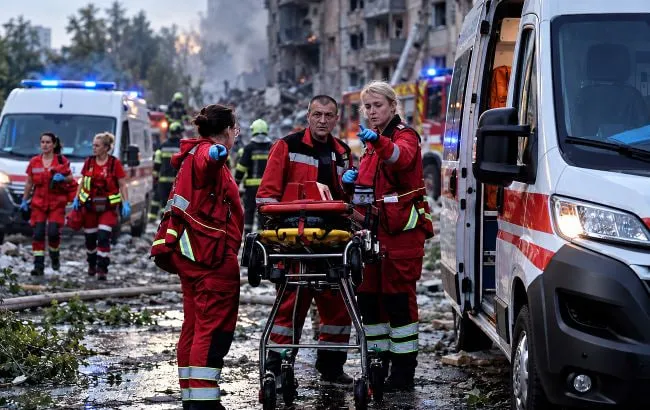
Emergency medical teams in Ukraine are currently responding not only to routine calls but are also regularly dispatched to provide assistance following Russian attacks. At the same time, before heading out, medical personnel assess how safe it is to work in areas that have come under fire.
When Will the Ambulance Arrive?
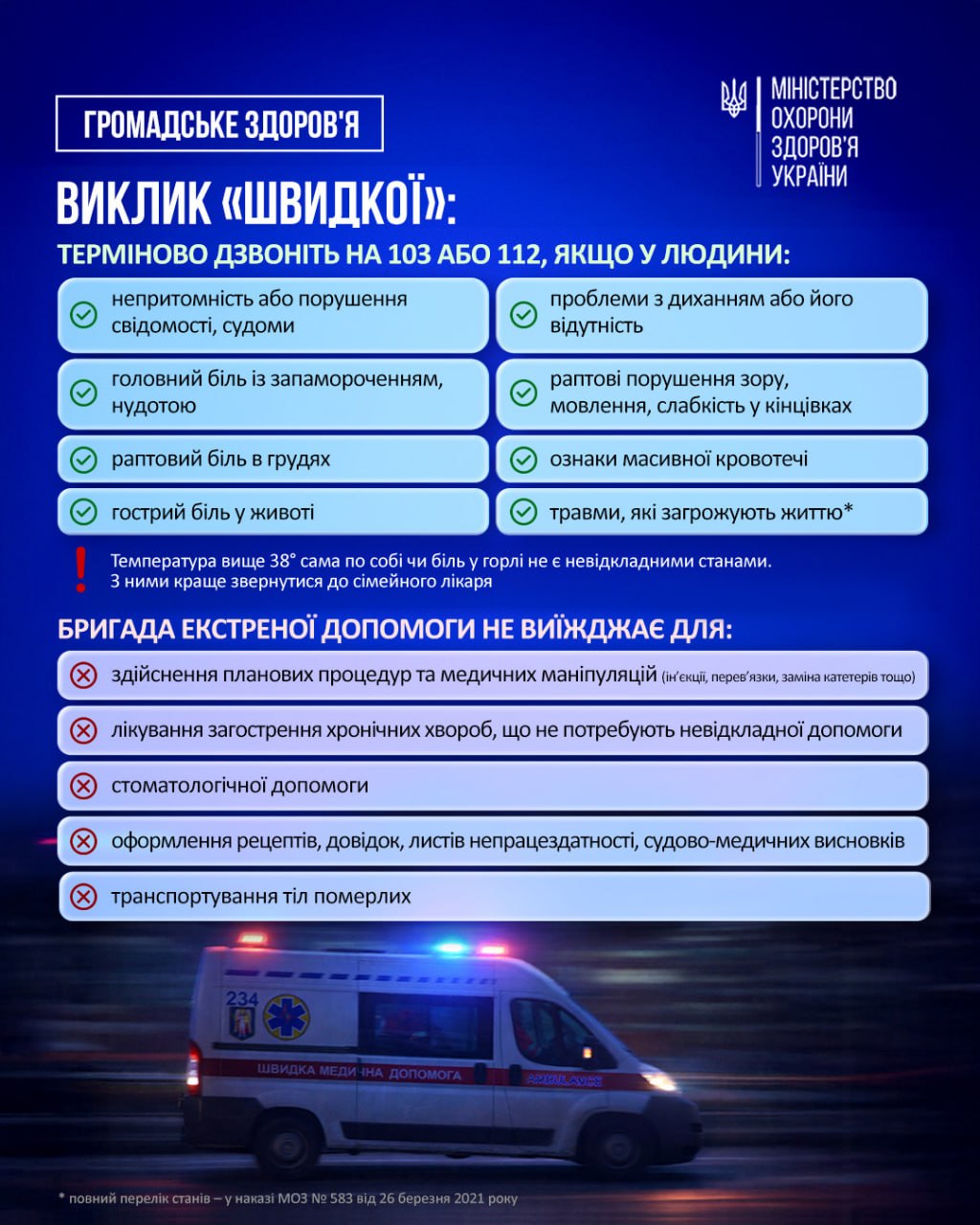
The grounds for dispatching a team are defined by Ministry of Health Order No. 583 dated March 26, 2021. A call can be made by dialing 103, the 112 emergency number, or through other means of communication.
When a person calls, the dispatcher first assesses the situation. If there are signs of a medical emergency, a team is dispatched to the patient. In other cases, the dispatcher may provide recommendations over the phone or advise the caller to go to the appropriate medical facility.
You should call an ambulance, in particular, in the following cases:
the person has lost consciousness or is experiencing impaired consciousness;
seizures have occurred;
breathing has suddenly stopped or is absent;
sudden chest pain has occurred;
a severe headache accompanied by dizziness or nausea;
vision has suddenly worsened;
speech difficulties or weakness in the limbs;
hypo- or hyperglycemic coma;
you have acute abdominal or lower back pain;
there is severe external bleeding, vomiting blood, or coughing up blood;
there are signs of internal bleeding;
pregnancy complications have occurred, including preterm labor or bleeding;
an anaphylactic reaction has occurred;
a person has been bitten by a snake or a spider;
there is a life-threatening injury;
an accident has occurred;
there is a life-threatening case of heatstroke or hypothermia;
asphyxia has occurred, including due to drowning, a foreign object in the airway, or strangulation;
an emergency has occurred;
an acute mental disorder has occurred, resulting in behavior that is dangerous to the person or those around them;
there is another condition that threatens life or health.
The team may also be dispatched at the request of another team leader if additional backup is needed.
What to Tell the Dispatcher
When making a call, you must answer all of the dispatcher’s questions. First and foremost, it’s important to provide the exact address: the town or city, street, house number, and, if possible, the apartment number, floor, building entrance, and door code.
If you cannot provide the exact address, explain how to get to the location and mention any known landmarks.
You should also provide the dispatcher with the following information:
the patient’s first name, last name, gender, and age; if passport details are unknown, provide the gender and approximate age;
the specific symptoms or complaints the person is experiencing;
who is calling and from which number;
any potential threats to the lives and health of the medical personnel.
If possible, ensure the medical team has unobstructed access to the patient, isolate any animals that might interfere with the medical staff, and assist with transporting the person to the ambulance.
If the patient is being transported to the hospital, it is advisable to have a document that verifies their identity.
What to Do During an Air Raid Alert or Shelling
The dispatch centers of emergency medical services receive and process calls continuously, including during air raid alerts.
However, during shelling, the arrival of the emergency team depends on information regarding the safety of access to the scene. In other words, medical personnel can only arrive when the route and location of the call are accessible, taking into account the security situation.
The Ministry of Health also urges drivers to yield to ambulances on the roads. This allows medical personnel to reach patients in need of assistance more quickly.
When Not to Call an Ambulance
Emergency medical services are not intended for routine procedures or non-emergency situations.
The ambulance crew will not respond:
to carry out scheduled appointments with a family doctor;
for injections, IVs, dressings, routine catheter or tube changes, and other routine procedures;
in cases of exacerbation of a chronic condition, if the person’s condition does not require emergency care;
for dental care;
to remove ticks;
to issue sick leave certificates, prescriptions, and various medical certificates, including those regarding health status;
to conduct forensic medical examinations;
to transport the deceased to pathology departments or forensic medical examination offices.
In such cases, the dispatcher may redirect the call and advise which medical facility to contact.
How a dispatcher can help before medical personnel arrive
If necessary, the dispatcher can remain on the line and provide the caller with recommendations on first aid and basic life support until the emergency team arrives.
If the situation is unusual or a dispute arises regarding the call, the caller may contact the senior medical officer on duty at the operations and dispatch service of the Center for Emergency Medical Care and Disaster Medicine.
In the event of aggressive behavior by the patient or those nearby—particularly due to alcohol, drug, or toxic intoxication, or an acute mental disorder—medical personnel may provide care and transport the patient under police escort.
This was reported by the Ministry of Health of Ukraine.
The Ministry of Health explained how to protect oneself from air pollution.
The Ministry of Health does not maintain a registry of medicines destroyed as a result of attacks.
The Ministry of Health has published a list of the initial members of the Supervisory Board for the restoration of “Okhmatdyt.”




