
A rare bird from Siberia was spotted for the first time in Volyn
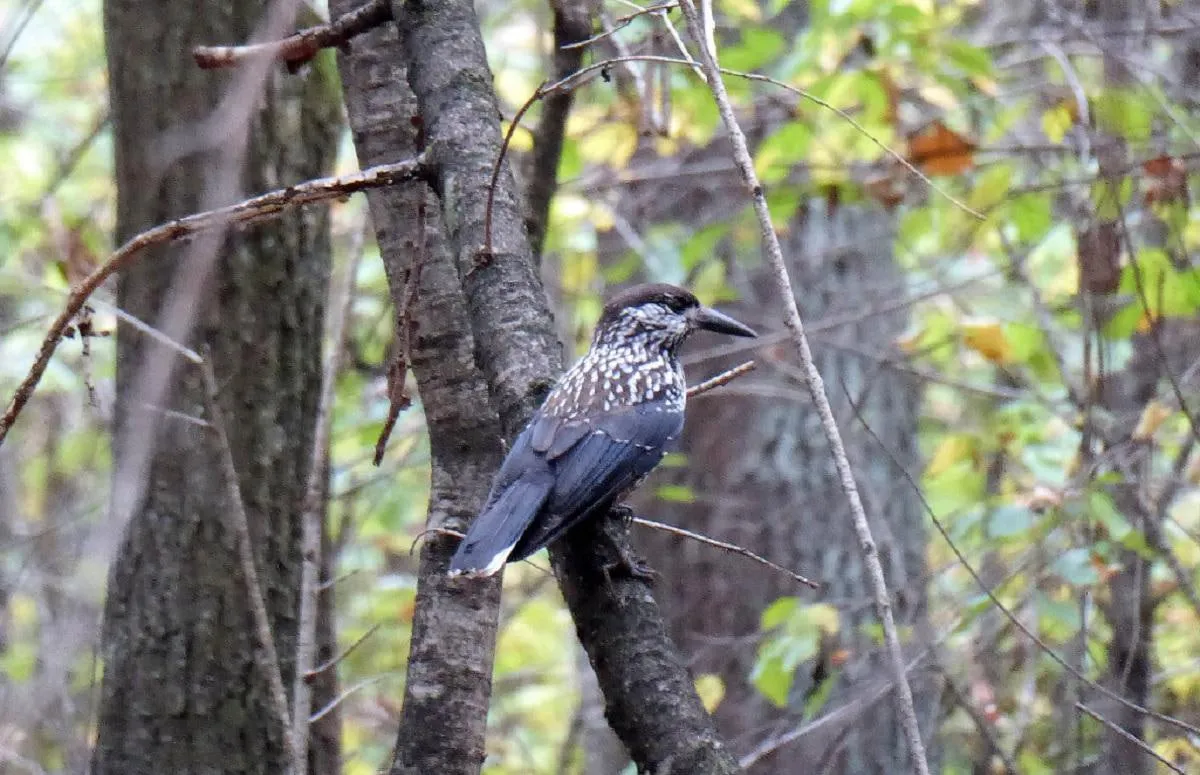
The spotted nutcracker (Nucifraga caryocatactes) was spotted for the first time in the Kivertsi National Nature Park “Tsumanska Pushcha” in Volyn. This bird is native to Siberia, among other places, and in the past, individuals have even been known to fly as far as Western Europe.
According to the national park, the bird may belong to the Siberian population, whose members travel thousands of kilometers during mass migrations. It is noted that park staff spotted this bird in the forest near the village of Dibrova.
At first, the bird was feeding on the ground, then it flew up into a tree and began moving from branch to branch. The nutcracker allowed the observers to get quite close, so they were able to photograph it.
Interestingly, this encounter took place against the backdrop of a mass invasion of Eurasian nutcrackers currently being observed in various regions of Ukraine. In this case, “invasion” does not refer to the appearance of an alien or invasive species. It refers to a natural phenomenon in which, in certain years, large numbers of birds leave the boundaries of their usual range or significantly expand the territory of their movements.
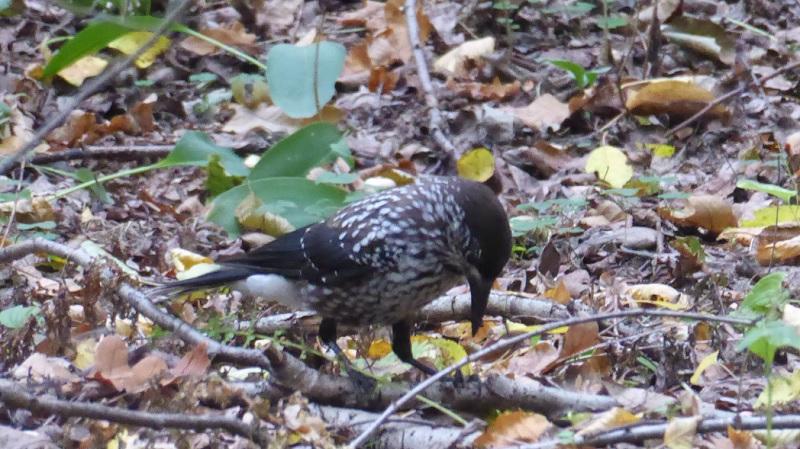
“In the case of the spotted nutcracker, such mass movements may be linked, in particular, to a poor harvest of conifer seeds—the birds’ primary food source,” the researchers explain.
The spotted nutcracker is predominantly a sedentary species; however, northern and eastern populations—particularly the Siberian subspecies N. c. macrorhynchos—are capable of extremely long-distance migrations. It is this subspecies that is known for its mass migrations from Siberia far into western Europe.
The Siberian nutcracker is also known in Ukraine as a subspecies that arrives during such invasions. Therefore, it is possible that the bird spotted in Volyn belongs to this very population and has traveled thousands of kilometers. During large-scale invasions, Siberian Nutcrackers have even reached Western Europe.
“In the past, during large-scale invasions, Siberian Nutcrackers have even reached Western Europe—movements spanning several thousand kilometers have been recorded,” the report states.
For the “Tsumanska Pushcha” Nature Reserve, this discovery was significant, as the spotted nutcracker has been added to the list of bird species recorded within the park’s territory.
What is known about the spotted nutcracker
It reaches a total length of 30–36 cm and weighs 125–200 g. It has a moderate-sized head, a long, slender beak, and an elongated tail. It is colored dark brownish-gray with white spots, which are absent only on the top of the head. There is a light-colored border at the tip of the tail.
It favors forested areas, particularly spruce and cedar forests. It leads a sedentary lifestyle, undertaking only local migrations. It skillfully jumps along the branches of coniferous trees and hangs from cones, eating while suspended from them. According to open sources, it feeds mainly on the seeds of Siberian pine and spruce, as well as insects; it also eats various berries, and occasionally small birds and their eggs, amphibians, and reptiles. When stockpiling food, the nutcracker collects nuts in a special pouch located under its tongue. Up to 50, 100, and even 120 cedar nuts have been found in this pouch.
This was reported by the Kivertsi National Nature Park “Tsumanska Pushcha.”
In Finland, a 32-year-old emu escaped from a farm.
A rare bearded owl was spotted near Chernobyl.
Grisha the stork has become a star in Kremenchuk: the bird visits fishermen for their fresh catch.




