
Occupiers in Chersonesos have discovered rare Roman-era burial urns
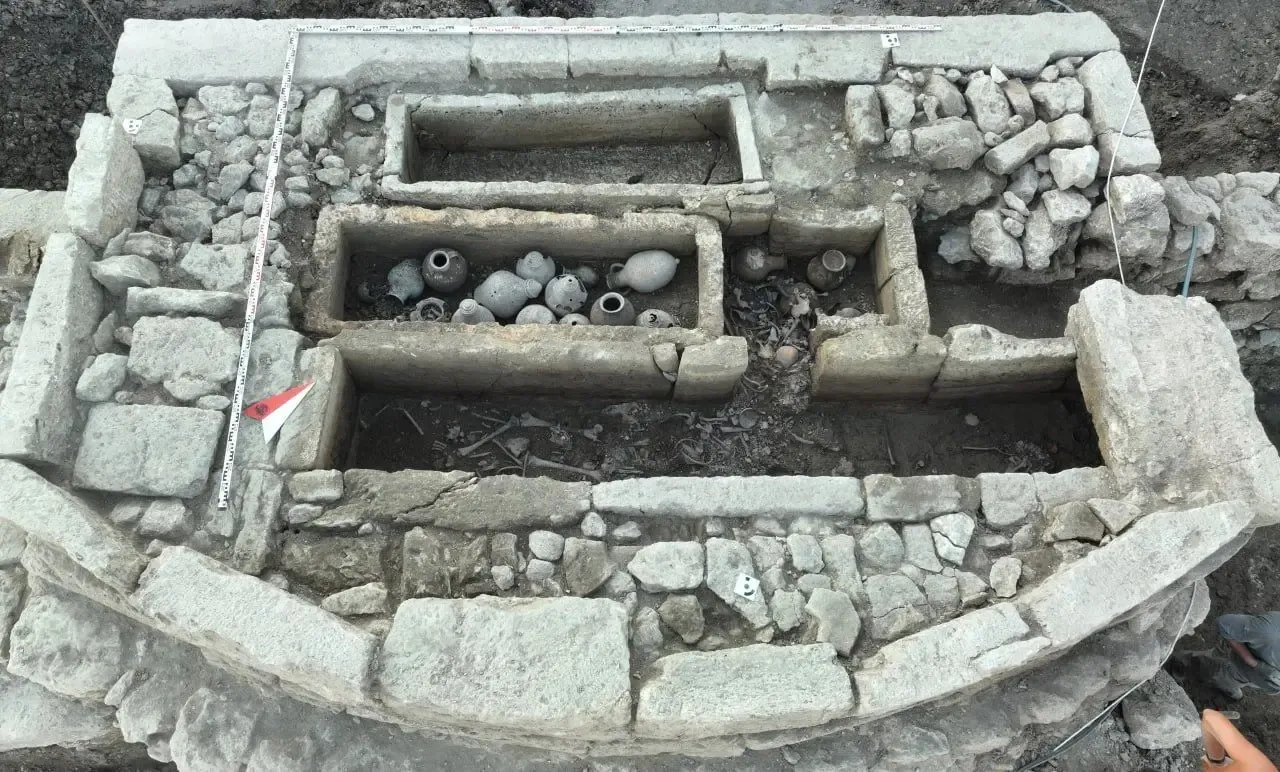
In the temporarily occupied city of Sevastopol, Russian archaeologists discovered rare Roman-era burial urns during illegal excavations in Chersonesos. The finds date back to the Roman Empire and are of historical value.
“During illegal excavations at a necropolis in the southern suburbs of Chersonesos Taurica in the temporarily occupied city of Sevastopol, Russian archaeologists discovered four lead burial urns bearing inscriptions. The finds date to the late 1st to mid-2nd century CE,” the statement reads.
According to the occupiers, such artifacts are extremely rare throughout the Northern Black Sea region. Prior to this, only six similar urns were known to exist on the territory of Chersonesos.
Bones and burial goods have been preserved inside the graves, including an intaglio, an iron strigil, gold mouthpieces, eye ornaments, and elements of wreaths.
Inscriptions on the urns made it possible to identify the names of some of the interred individuals. These include residents of ancient Chersonesos named Dioscurides, Antisthenes, Nanon—the son of Antisthenes—as well as another Chersonesian whose name began with the letters “Nik.”
The excavations are being conducted on the territory of a site of global significance under Russian occupation of Crimea. Ukraine and international organizations have repeatedly declared the archaeological work to be illegal, as it is being carried out without the consent of the Ukrainian side and in violation of international law, according to QIRIM.News.
Archaeologists in Cairo have discovered a unique burial hoard belonging to the elite of Ancient Egypt
In Italy, during the construction of a highway, workers stumbled upon the remains of an ancient sanctuary dating back to the 5th century B.C. The unique discovery was made near the town of Pons, located approximately 72 kilometers from Venice. After the artifacts were discovered, large-scale archaeological excavations began immediately at the site.


