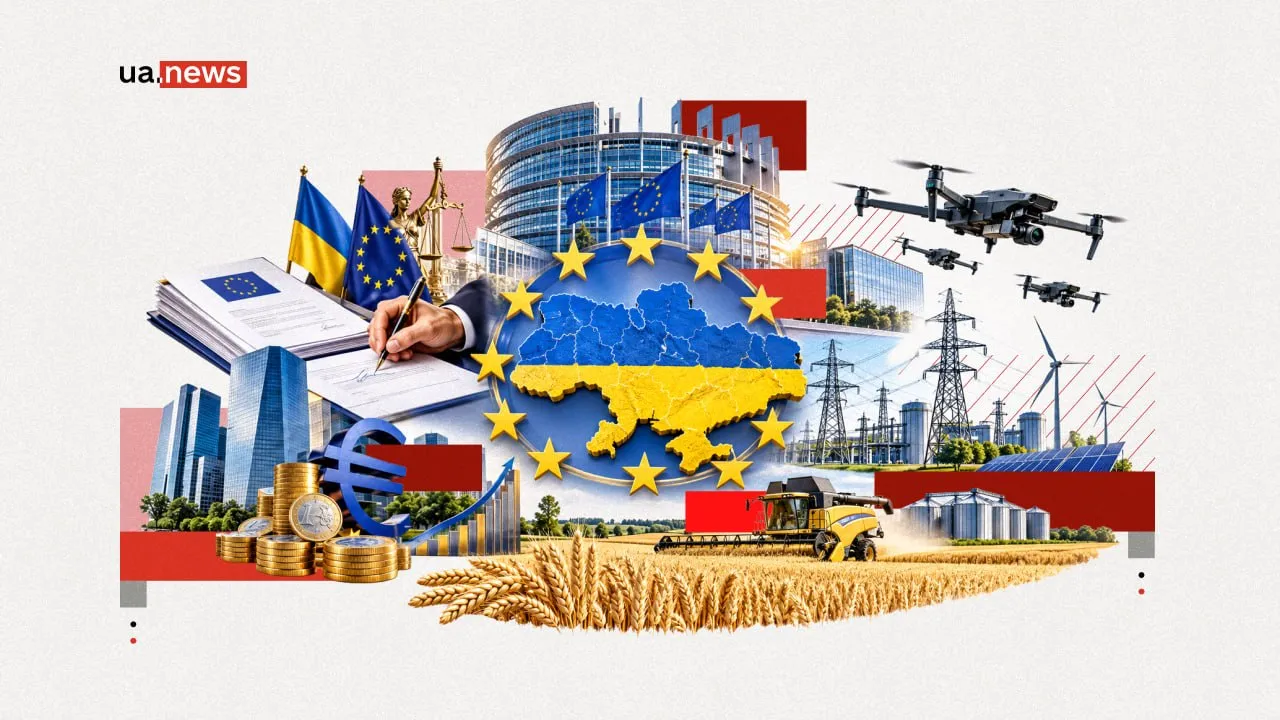
There’s a lot of talk about Ukraine’s accession to the European Union. In the news, it’s all about negotiations, clusters, reforms, and Brussels’ demands. But for someone who doesn’t follow politics on a daily basis, the term “European integration” often remains a mystery. What does it mean for Ukraine? What will change for people and businesses? And will both sides truly benefit from this process?
I decided to look at European integration from a practical perspective: what it offers Ukraine, what we’ve already done, what else we need to change, and how we can be of use to Europe.
Starting January 1, 2026, Ukrainians will be able to use mobile services in EU countries without additional roaming charges. This is one example of European integration that you can notice during an ordinary trip.
European integration means that Ukraine is gradually aligning its laws and the operations of its government agencies with European Union regulations. The goal of this process is to join the EU. For people and businesses, the changes begin sooner: they include the protection of rights, clearer conditions for work and trade, and the same rules for everyone.
I often travel to Brussels with Ukrainian delegations. As vice president of the Association of Ukrainian Banks, I also monitor how the rules for the financial sector are changing. That’s why I see European integration from both the perspective of negotiations and from the perspective of businesses that will have to operate under new requirements.
What the EU Expects from Ukraine
To join the European Union, a country must meet three basic requirements. It must have democratic institutions and respect human rights and the rule of law. Its economy must be ready to compete in the single market. Government agencies must be able to apply European rules in practice.
These rules cover the courts, public procurement, banking, agriculture, environmental protection, energy, and many other sectors. Ukraine must adopt the necessary laws and ensure their enforcement.
Ukraine completed the review of its legislation for compliance with EU standards in September 2025. Negotiations on the “Fundamentals” cluster began in June 2026, and on the “External Relations” cluster in July. Of the six clusters, two have been opened. According to the KSE Institute as of September 16, negotiations covered seven of the 33 chapters.
The “Fundamentals” cluster covers the judiciary and fundamental rights, justice and security, public procurement, statistics, and financial control. It is precisely in these areas that it is particularly evident whether state institutions are capable of operating according to the rules that Ukraine has committed to implementing.
According to government data, as of mid-September, 114 bills related to European integration were at various stages of consideration in the Verkhovna Rada. Judicial reform, the work of the prosecutor’s office and anti-corruption agencies, and the rights of national minorities remain among the priorities. For accession, it is important that the adopted regulations take effect in government institutions and influence day-to-day decisions.
Courts and Corruption: The Ultimate Test
The European Union expects Ukrainian courts to be independent, and the selection of judges and prosecutors to be conducted openly and according to clear criteria. It is also necessary to reduce delays in the courts and ensure the enforcement of court decisions.
Anti-corruption agencies must be independent and have sufficient authority. The EU expects results in high-level corruption cases, as well as better oversight of public procurement, customs, the tax sector, and state-owned companies.
When the courts are not independent, the risk falls on citizens, entrepreneurs, and the banks that lend to businesses. When anti-corruption agencies cannot operate freely, the equal application of the law to all is called into question.
According to an assessment by analysts at the KSE Institute, as of September 16, Ukraine had fulfilled only one of the ten identified priorities in the area of the rule of law. This assessment shows why the mere start of negotiations is not enough: progress depends on concrete changes in the work of the courts, the prosecutor’s office, and anti-corruption agencies.
During my trips to Brussels, I have heard more than once that corruption scandals complicate discussions about support for Ukraine. The main problem for European politicians is that people representing Ukraine at the highest levels repeatedly appear in corruption cases. Today, European officials shake their hands, negotiate with them, and listen to arguments about Ukraine’s need for funding. Tomorrow, they learn that NABU has notified these individuals that they are under investigation. For European politicians, such interactions pose a reputational risk. The question arises: who can be trusted, and how should relations with the Ukrainian government be built moving forward?
One such example is Andriy Yermak. He headed the Office of the President and was one of the key figures in the Ukrainian negotiating team, but in May 2026, NABU and the Special Anti-Corruption Prosecutor’s Office (SAPO) notified him that he was under investigation in a case involving the laundering of over 460 million hryvnias.
During a meeting in Brussels, I discussed this with Member of the European Parliament Michał Kobosko. He supports Ukraine and helps advance its interests. However, the more such corruption scandals emerge, the more ammunition politicians who oppose aid to Ukraine gain. At the same time, Michal Kobosko and other supporters of Ukraine have to make ever-greater efforts to convince their constituents and taxpayers—whose contributions fund the European Union’s budget—of the need for continued funding for Ukraine.
Banks and Insurance: Stability Remains, Changes Continue
My work in the financial sector allows me to discuss European integration using concrete examples. For banks and insurance companies, European regulations have long been part of their daily operations. In June 2026, National Bank Governor Andriy Pyshnyy estimated that banking regulations were approximately 78 percent compliant with EU rules, while insurance regulations were 55 percent compliant.
Along with its alignment with EU rules, Ukraine already has its own experience that is useful to its European partners. After the start of the full-scale war, the banking system did not grind to a halt. Banks ensured the continuity of payments during the first, most difficult months, and subsequently continued to operate amid blackouts, shelling, and cyberattacks. People had access to their funds, businesses were able to pay their employees and partners, and the government made the necessary payments. The resilience of the banking system helped Ukrainian businesses and the economy weather the crisis. Ukraine can also share this experience with Europe.
Work on these changes is underway across the entire financial sector. The National Bank is updating its requirements, and banks and insurance companies are adapting their operations accordingly. Industry associations are also involved, representing the business community’s position and helping to establish a dialogue with European institutions.
Business and the Agricultural Sector: Market Access Along with Standards
European integration opens the door for Ukrainian companies to the single market, but requires them to meet its standards. In 2025, trade in goods between Ukraine and the EU totaled 68.2 billion euros. The updated free trade agreement entered into force in October of that year.
For the agricultural sector, this means the opportunity to sell products in a large market and gradually align production standards. This includes, in particular, animal welfare, the use of pesticides, and veterinary drugs. The agreement provides for safeguard mechanisms in case a sharp increase in imports causes serious harm to producers.
At meetings in Brussels, I discuss the practical aspects of these changes with business representatives: how to prepare companies, find partners, and understand the requirements of the European market. It is important for entrepreneurs to know in advance what rules will apply and how much time they will have to prepare.
Energy and Defense: Europe Already Needs Ukraine’s Experience
The Ukrainian power grid connected to the European network in March 2022. Now, the rules governing the operation of electricity markets are being harmonized. Ukraine’s energy sector is under pressure, and the experience of its recovery and support is important for European partners as well.
In June, the European Council emphasized the need to draw on Ukraine’s experience in new technologies and to develop cooperation with the Ukrainian defense industry. In July, the European Commission launched the Ukraine–EU Drone Alliance. Nine of the 18 founding companies are Ukrainian. The goal of this cooperation is to combine Ukraine’s experience in the deployment and rapid improvement of drones with European research and manufacturing capabilities.
Ukraine needs its partners’ support and is grateful for it. At the same time, this support contributes to the security of Europe itself. The fifth year of full-scale war has shown that Ukraine’s defense has become an integral part of Europe’s security. Ukrainians are containing a threat that affects European countries.
Our contribution to Europe’s security does not replace the reforms required for membership. It demonstrates the experience and capabilities Ukraine can bring to the EU.
Ukraine still needs to meet challenging requirements, particularly regarding the judiciary and the fight against corruption. At the same time, Ukrainian business, the financial sector, and our experience in protecting critical infrastructure can already be of use to Europe. Ukraine is capable of strengthening common security and helping the EU better prepare for crises.