
The fifth egg in Odarka and Hrytsyk's stork nest exploded due to the heat
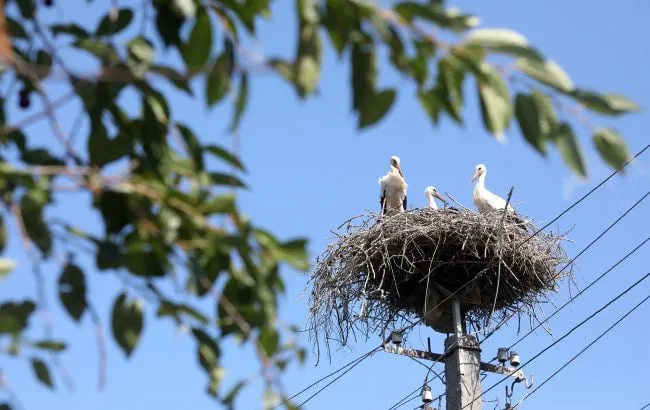
In the nest of the famous stork couple, Odarka and Hrytsyk—whose lives are followed by thousands of Ukrainians—the fifth chick did not hatch. The egg, which the birds had been incubating since April, could not withstand the intense heat and exploded right in the nest.
Officials at the Pyriatyn National Nature Park explained that the chick inside the egg never developed, and the high temperature merely accelerated the natural process. The moment was captured by an online surveillance camera.
According to Sarazhynska, the egg exploded on June 28 at 4:04 p.m. It had been in the nest since the second half of April. For over a month, Hrytsyk and Odarka took turns incubating it, but the fifth stork chick never hatched.
After the incubation period ended, the egg remained in the nest for over a month, rolling around inside it from time to time.
“This egg’s stay in the nest turned out to be quite long. We were expecting a fifth stork chick to hatch from it, but that didn’t happen,” noted Sarazhynska.
She explained that in hot weather, gases accumulate inside old, unfertilized, or dead eggs, causing the pressure to rise until the shell cannot withstand it.
A similar situation had already occurred in this pair’s nest. In 2024, an egg from which a chick also failed to hatch exploded around the same time—on June 30.
This year, Odarka laid five eggs, but four chicks survived. Based on a vote by viewers of the live stream, they were named Lelovich, Mahagon, Mriya, and Nika.
This was reported with reference to the park’s co-founder, Anatoliy Podobaylo, and bird researcher Iryna Sarazhynska.
We previously reported that two chicks were born to the stork family of Odarka and Hrytsyk.
Storks have begun returning to the Chernobylzone.
Previously, scientists at the Chernobyl Reserve discovered another nest of Ukraine’s largest bird of prey—the white-tailed eagle. This confirms the stability and growth of the population of this rare species within the Exclusion Zone.
Extreme weather conditions prevail in the Chernobyl Radiation-Ecological Biosphere Reserve.


