
Ukraine is restructuring its energy sector to adopt a new sustainable model
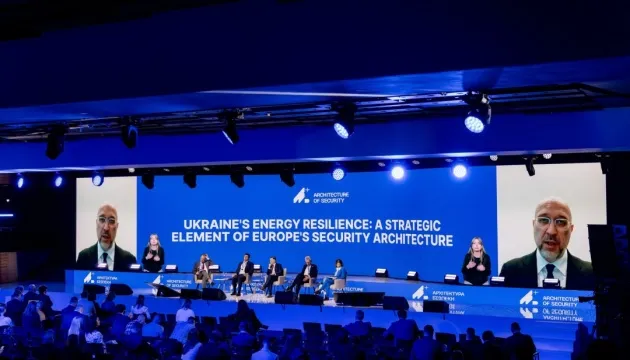
In Ukraine, alongside the restoration of the damaged power grid, a new energy model is being developed that is intended to be more decentralized, resilient, and shock-resistant; it is being built on the principle of “energy honeycombs,” where responsibilities and resources are shared among the state, regions, communities, and the private sector. This was stated by Denys Shmyhal, who emphasized that the main focus now is not simply on reconstruction, but on the system’s ability to recover quickly after attacks.
Ukraine is effectively working in two directions simultaneously—restoring what was destroyed by Russian strikes on the energy sector, and, in parallel, building a new system architecture that is less vulnerable to concentrated attacks and more flexible in management, as First Deputy Prime Minister and Minister of Energy Denys Shmyhal explained during his speech at the “Security Architecture” forum.
He explained that the war clearly exposed the weakness of the old model—where large energy facilities serve simultaneously as both critical power supply points and primary targets for attacks—so the new approach involves dividing the system into several levels—from the state to the business sector—where each has its own tools and area of responsibility. “Therefore, our task is to build a system that is harder to destroy and easier to restore. For Ukraine, this means four levels of energy resilience: the state, regions, communities, and business. Each level has its own responsibilities and its own tools for ensuring energy security,” Shmyhal noted.
He also emphasized that the protection of the power grid must be incorporated as early as the design phase, including physical security, air defense, cybersecurity, backup solutions, and rapid repair capabilities, since the key indicator of effectiveness is not only operational stability but also the speed of recovery after damage.
According to the minister, Ukraine also sees itself as a future regional energy hub that could become an important part of the European energy architecture, and is already laying the technical and organizational foundations for this. “Russia has tried to use the energy sector as a tool to wear us down. We must make it a tool of our resilience,” Shmyhal concluded, emphasizing that the main goal of the new energy model is to withstand shocks and quickly return to operation. This was reported by the Ministry of Energy.
Energoatom stated that it is fully cooperating with law enforcement in the case regarding possible abuses during the construction of the Tashlyk Pumped Storage Power Plant, which is one of the key energy facilities in the Mykolaiv region.


