
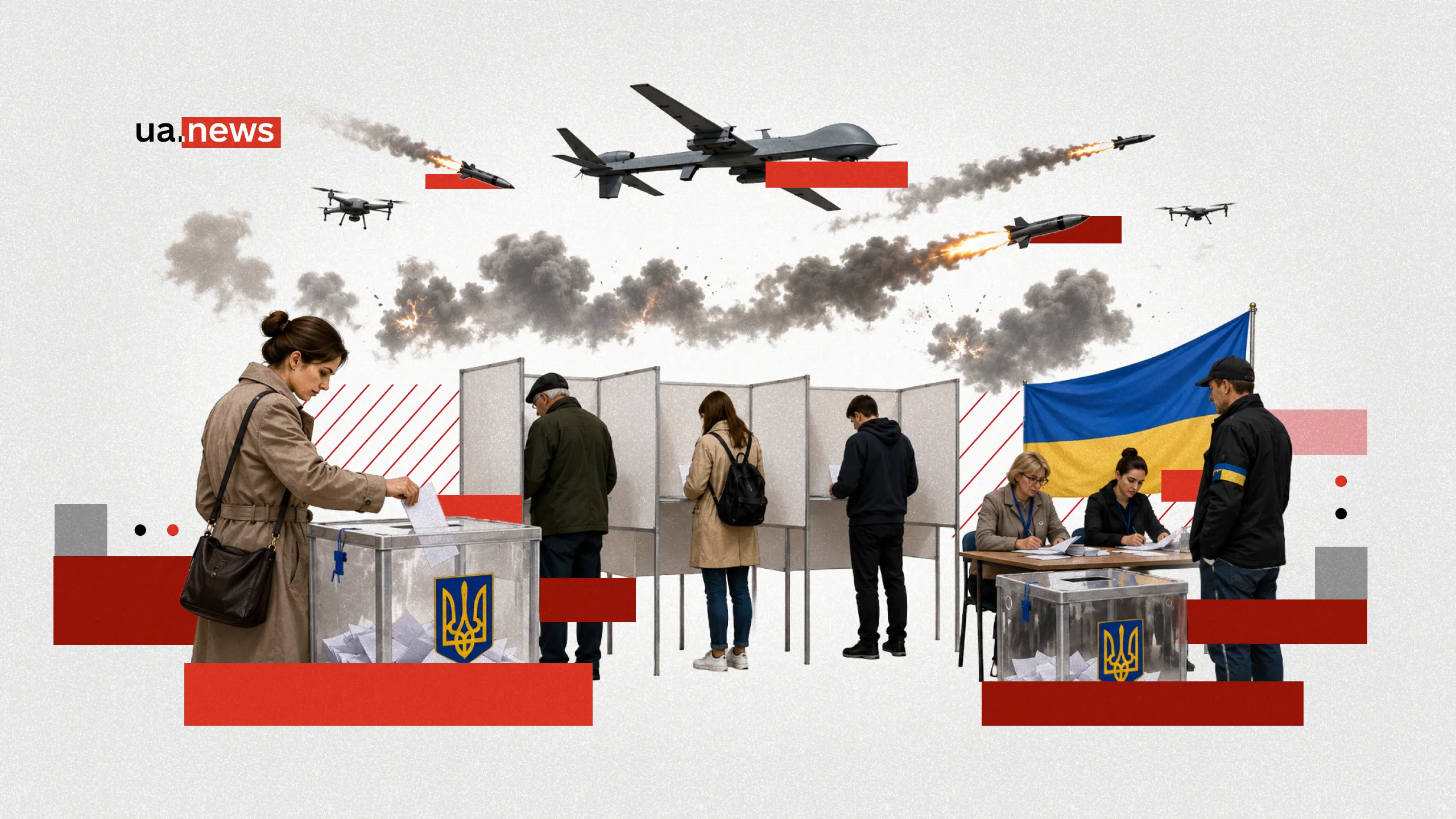
Recently, former Defense Minister Mykhailo Fedorov, who is now in the opposition, made a sensational statement: Ukraine needs elections even during the war. His argument is quite simple: democratic mechanisms must function even amid combat operations and shelling so that Ukrainian democracy “does not become a hostage to Russia.”
But the government clearly does not want to hold elections and has no plans to do so. It regularly makes this clear. Although President Zelenskyy has repeatedly said he is ready for an electoral contest, no real steps have been taken in this direction, and most likely none will be. Many Ukrainians are also convinced that elections cannot be held during wartime.
In general, the phrase “elections are not held during wartime” has long since become something of an axiom. People also frequently cite the Constitution, which supposedly prohibits elections during martial law. But in reality, this is less about legal facts and more about a general political and ideological narrative. It suits some and serves as a “reassurance” for others, but the reality is much more complex.
So what does the Constitution actually say about all this? What prevents elections from being held during wartime, and is it possible to hold them in 2026? UA.News political analyst Mykyta Trachuk looked into the issue.
What the Constitution Says, and What the Law Says
The most common claim goes like this: “The Constitution prohibits holding elections during martial law.” But that’s not true. If you take the text of the Constitution literally, there isn’t a single phrase to that effect. It does not state anything along the lines of “elections during wartime are prohibited.” However, from the perspective of constitutional law, this statement is also not entirely accurate, because the prohibition arises not from a single word, but from a system of interrelated provisions.
The situation is most severe with regard to parliament. Article 83 of the Constitution explicitly states that the powers of the Verkhovna Rada shall continue until the end of the war, and new elections shall be scheduled after its conclusion. This is not merely a description of the process; it is an imperative—that is, a mandatory—legal prohibition on holding elections for deputies until martial law is lifted. In other words, the Constitution does indeed create a barrier to parliamentary elections, but it does so not through the word “prohibited,” but through the mechanism of extending the term of office. Legally, this means that as long as the war continues, the Rada is legitimate, and its re-election is impossible without amending the Constitution. Amending the Constitution under martial law, by the way, is expressly prohibited—this is where the word “prohibition” does indeed appear.
But with the president, it’s a different story. Article 108 of the Constitution states that the President of Ukraine exercises his powers “until the newly elected head of state takes office.” In other words, it does not contain a similarly detailed provision that would prohibit the election of a new president during wartime. The only question is how and when this will happen. The same, by the way, applies to local elections.
However, there is Part 1 of Article 19 of the Law of Ukraine “On the Legal Regime of Martial Law.” This provision clearly states that under martial law, it is prohibited to hold elections for the president, the Verkhovna Rada, and local self-government bodies. It is precisely this law that all opponents of the elections usually cite. And at first glance, it sounds ironclad. But there are two important nuances here.
First, the Constitution is, a priori, superior to any law. In other words, if the Constitution does not create a direct barrier to presidential or local elections, this means there is no purely constitutional prohibition against them.
Second, an ordinary law can always be amended. All it takes is a vote on amendments in the Verkhovna Rada. In other words, the legal framework that currently prohibits elections is not some kind of untouchable tablet of stone. It is based not on the Constitution, but on a specific law that Parliament itself enacted—and which it can rewrite itself if the need arises.
So, when people say that “the Constitution prohibits elections,” this is, to put it mildly, legally incorrect. For Parliament, the threshold is indeed entirely constitutional, although it is expressed through the provision on the extension of terms of office. For the president and local authorities, however, the barrier is purely legislative in nature. And the law—just like the elections themselves—is always a matter of political will. If there were no such will, the law would not have been passed. Should that will emerge, the law will be amended, and elections will be held.
What Really Hinders Elections During Wartime
However, even if we imagine that all legal barriers have been overcome, large-scale organizational and technical problems still arise. The first and most obvious is the physical safety of citizens. Holding elections involves large gatherings of people at polling stations, the work of tens of thousands of election commission members, the secure transportation of ballots and election records, and so on. Ensuring adequate protection across the entire country, including frontline regions, is impossible both technically and financially.
There is, however, the option of online voting. But this immediately raises a multitude of new questions regarding cybersecurity and the very real possibility of “falsifying” the desired results. It is extremely difficult to monitor this process. However, this does not mean there is no solution: remote voting by mail is actively used in Germany and the United States, and for Ukrainians abroad, polling stations could be set up at embassies and consulates, or a secure online identification system could be created for electronic voting. The question is not whether this is possible. The question is whether the state is willing to invest in it and whether there will be trust in the results.
The second problem is electoral fragmentation. Millions of Ukrainian citizens are in the temporarily occupied territories, where holding any Ukrainian elections is out of the question. Millions have fled abroad as refugees, and by no means all of them have access to consular offices or the opportunity to cast their vote. Hundreds of thousands more have been mobilized and are serving in the Armed Forces of Ukraine, where access to polling stations or mobile election commissions is extremely difficult or impossible. How can their right to vote be ensured? There are no ready answers to this question today, but there are various ideas.
For Ukrainian Armed Forces soldiers, for example, there is the option of organizing mobile election commissions. This approach is used in Israel: mobile teams travel to military bases and give soldiers the opportunity to vote. It is also possible to vote electronically via secure military communication systems. The situation with the occupied territories is much more complicated: it is physically impossible to conduct the electoral process there. But let’s be frank: since 2014, elections have been held without including Crimea and part of the Donbas, and all of them have been recognized both domestically and by the international community—and even, incidentally, by the aggressor country!

It is also necessary to involve as many foreign observers as possible from independent organizations—such as the OSCE. This, of course, does not guarantee perfect elections, but it can at least ensure some balance. Furthermore, elections do not necessarily have to be held on a single day. They can be spread out over several days or even weeks. For example, the 2024 elections in India lasted 44 days, and in some U.S. states, citizens can vote early—nearly a month and a half before Election Day. This ensures that everyone who wants to vote has the chance to do so.
The third problem is political. Democracy is not just the technical act of voting, but also a process of free and competitive competition between ideas and platforms. This requires freedom of speech, freedom of assembly, freedom of the press, equal access for candidates to the media, etc. Martial law, in one way or another, restricts all these freedoms. Conducting a genuine, competitive election campaign under such conditions seems doubtful, although even here it may be possible to find some new balance.
Finally, there is a risk—albeit not a very obvious one—that the final result will lack legitimacy. Elections held under restricted conditions, excluding a significant portion of the population, may be called into question. At the same time, however, canceling the elections also comes at a cost, and if elections are not held for many years to come, that cost will only increase.
In other words, the situation is indeed complex, but there are no insurmountable challenges. Security and, more or less, universal suffrage can be ensured through online voting and/or a multi-day, “stretched-out” voting process. Service members can cast their votes online or through mobile voting teams. A balance can also be found regarding equal access to the media and political competition. Only the issue of the temporarily occupied territories (TOT) seems intractable—but this has not prevented Ukraine from moving forward since 2014.
After all, there is a wealth of international experience to draw upon. Israel has held—and continues to hold—elections amid ongoing armed conflicts and even full-scale wars with its neighbors. The United States and Canada also did not neglect elections during past wars (though it’s worth acknowledging that their territories were, after all, relatively safe). Croatia, not so far from Ukraine, held full-fledged presidential and parliamentary elections in 1992, right in the midst of the active phase of the war for independence and the breakup of the former Yugoslavia. Iraq, Syria, and Afghanistan held parliamentary and presidential elections in the 2000s and 2010s amid ongoing internal conflicts and the presence of foreign troops (although the legitimacy and security of these processes are questionable). Denmark held elections in 1943, right in the midst of the Nazi occupation (although the political space was extremely limited at the time). There are, in fact, quite a few similar examples.
Of course, potential elections in wartime would still be strikingly different from the usual electoral process in peacetime. But for the stability of the political system, some form of renewal is better than none at all—this is a basic principle from any political science textbook. The main obstacle here is not technical, but purely political.
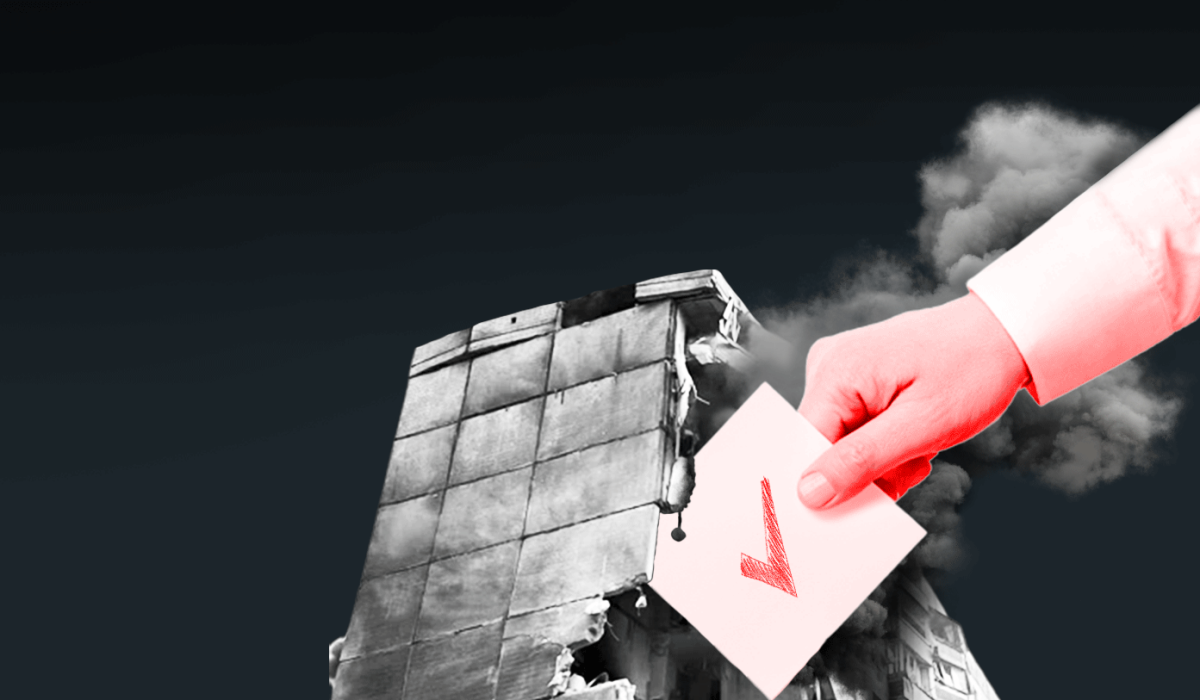
Is it possible to hold elections in 2026?
The key practical question is this: if, purely hypothetically, the government were to decide tomorrow to hold elections—would it be able to do so by the end of 2026? The answer is likely no.
First, the timeline. Under Ukrainian law, a full-fledged presidential campaign requires at least 90 days from the date of the official nomination to election day. Even in an ideal scenario—where the Verkhovna Rada passes all necessary amendments tomorrow, announces the election, and launches the process—voting could not take place until late November or early December 2026 at the earliest. But even this is very rough math.
Second, there’s the issue of money. A full-scale election campaign costs billions of hryvnias. According to the Central Election Commission, no funds for the 2026 election have been allocated in the state budget.
Third, the state of the electoral infrastructure itself raises serious questions. Millions of people have changed their place of residence or left the country altogether. Hundreds of thousands, unfortunately, have been killed. Voter rolls require a thorough audit, and across much of the country, polling stations have been destroyed or are under constant threat of shelling.
None of this means that elections are impossible in principle. It means they require extensive preparation. Therefore, the honest answer to the question “Can elections be held in 2026?” is this: even if a political decision were made right now, it would be nearly impossible to fully prepare for and conduct elections by the end of the year, even with the best of intentions.
To
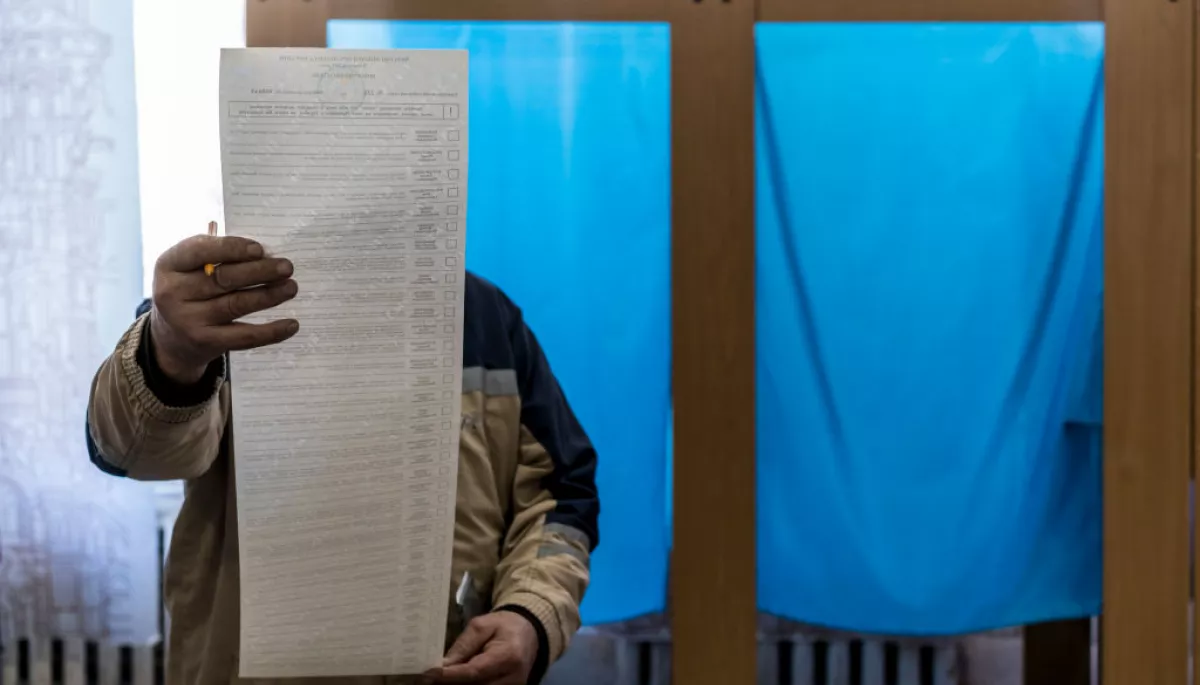
summarize, is it possible to hold elections in Ukraine during wartime? Legally—yes, it is entirely possible provided a number of conditions are met. The Ukrainian Constitution does not contain an explicit ban on presidential and local elections, and the law on martial law can be amended by the Verkhovna Rada. For parliamentary elections, however, the barrier is indeed constitutional. Organizationally, it is also possible, though very difficult. But as for whether it is politically feasible, or whether the political will exists—the answer is unequivocally “no.”
This is the main conclusion. The entire discussion about the “impossibility of holding elections during wartime” mistakenly (whether consciously or unconsciously) focuses on legal and technical grounds. In reality, however, the issue boils down solely to a lack of political will. So, in closing, one can only recall a wonderful Ukrainian proverb that sums up the entire situation in a single phrase: “He who does not want to reap has a dull sickle.”


