
Russia is intensifying its missile strikes on Kyiv amid a stalemate in the war — NYT
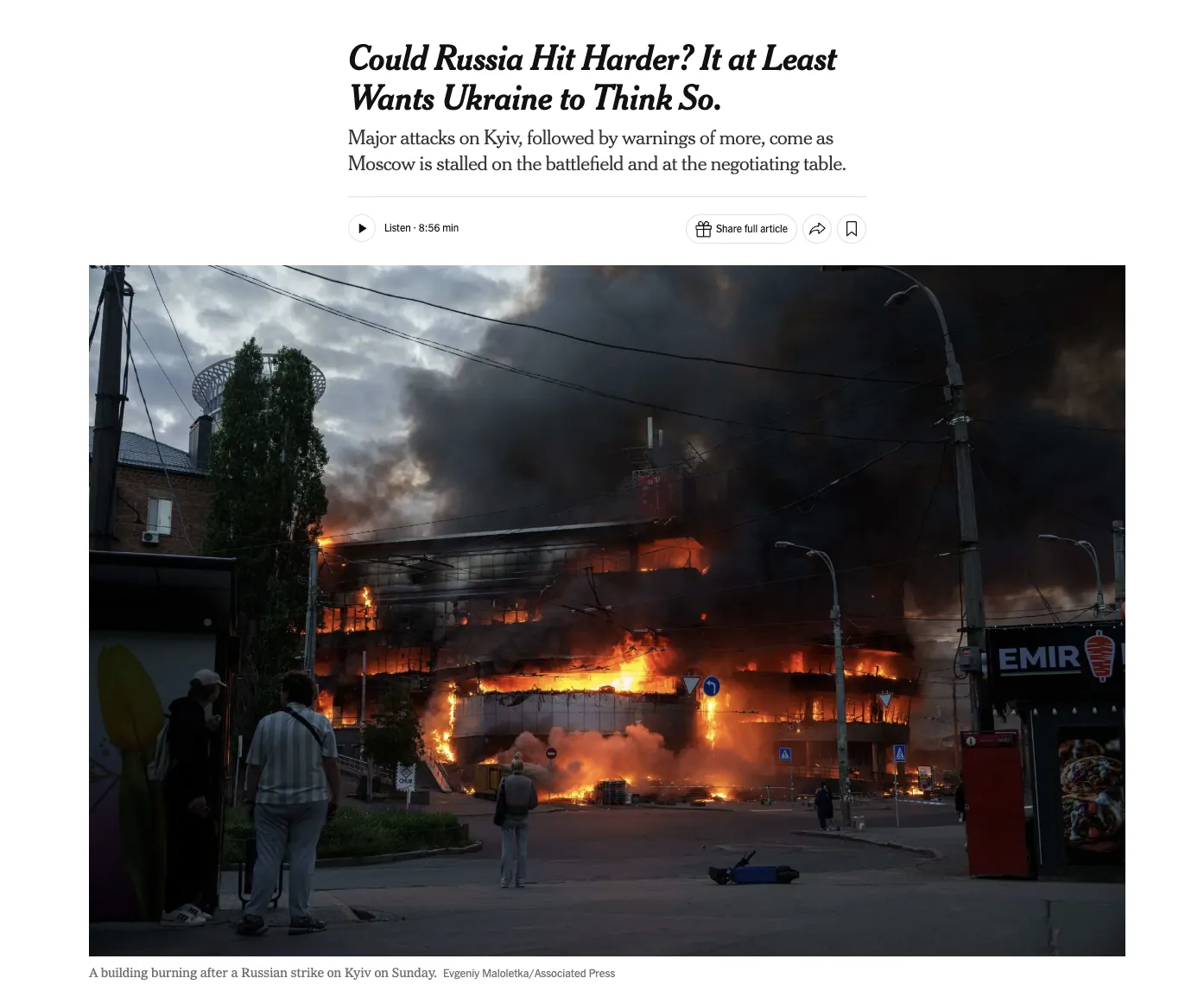
Russia is ramping up its missile attacks on Kyiv amid setbacks on the front lines and in negotiations. According to The New York Times, the Kremlin is attempting to demonstrate its readiness for further escalation and to project strength, as it finds itself in a difficult position both on the battlefield and in the diplomatic process.
This week, the Russian Foreign Ministry stated that the country’s patience has finally “run out.” According to Russia, the cause of its outrage was a strike by a Ukrainian drone late last week on a college dormitory in the Russian-controlled Luhansk region in eastern Ukraine. Russia claimed that 21 students were killed in the strike, which it called deliberate. The Ukrainian government called this claim disinformation, but Ukrainian media identified civilian casualties, including students.
The Kremlin seized on this strike just as it was losing momentum in the war. The proliferation of drone technology has made movement on the battlefield increasingly slow and costly. Although May was typically the time when Russia launched a major offensive, its advances this month have been minuscule. Russia is on track for its worst month of territorial gains in over a year, according to DeepState.
This slowdown has raised questions about whether Russia, despite its threats, has already done all it can with conventional weapons. “The military advantage that Russia has maintained over the past few years is likely beginning to gradually diminish,” said Tatyana Stanova, a senior fellow at the Carnegie Russia Eurasia Center. “And in this context, the question arises: isn’t it time for us to raise the level of escalation?” The goal of a nuclear Russia, she added, is to “create psychological pressure on the entire elite, on society” in Ukraine.
Moscow has also felt pressure because the Trump administration, preoccupied with the war in Iran, has lost interest in mediating the conflict in Ukraine—a diplomatic process that at times favored Russia but came to a complete standstill in late February. Analysts note that Moscow’s threats to attack Kyiv were partly a warning of how far Russia might go if the United States does not resume engagement. Among the Russian people, stalled diplomacy and minimal gains on the front lines have intensified fatigue over what is increasingly perceived as a fruitless conflict with no end in sight.
On the Ukrainian side, where threats of escalation from Russia have become routine, the mood remains defiant, just as Ukraine’s position in the war has strengthened in recent weeks. In Kyiv, these warnings were widely interpreted as intimidation tactics aimed at regaining the world’s attention, which had been distracted by the war in the Middle East. Cafes in Kyiv have reopened after sustaining damage during Sunday’s strikes. Residents helped each other board up windows. Ukrainian lawmaker Kira Rudik wrote on X: “Russia wants to break our spirit. They will fail.”
European countries have rallied around Ukraine. Several countries, including Poland and Germany, summoned Russian diplomats over threats against foreigners. European officials insisted they would remain in Kyiv. “Russia wants fear. Panic. Isolation of Ukraine. It won’t work,” wrote Katarina Mathernova, the European Union’s ambassador to Kyiv, on Facebook. She added: “Threats against diplomats and international organizations are not a sign of strength. They are a sign of desperation.”
Ukrainian President Volodymyr Zelenskyy has shown new confidence as the country’s military has repeatedly struck Russian oil infrastructure and held back its forces on the front lines.
Another positive development for Zelenskyy was the ousting in the elections of Viktor Orbán, the pro-Russian Prime Minister of Hungary, who had been the biggest obstacle to European unity in support of Ukraine. Ukraine’s European partners, who last month approved a $106 billion loan for the country, insist they will not succumb to Russia’s attempts to turn them into neutral mediators in the war.
However, even despite Ukrainian public resistance to Russia, fears of another round of widespread destruction in Kyiv remain palpable. Russian shelling has once again raised concerns that Kyiv may be running out of ballistic missile interceptors, which are currently even scarcer than usual due to the war in Iran. Zelenskyy sent letters to President Trump and Congress requesting an increase in air defense weapons.
In an apparent attempt to refocus Washington’s attention on the conflict, Russian Foreign Minister Sergey Lavrov called Secretary of State Marco Rubio to warn of the possibility of further attacks on Kyiv. According to the official Russian account of the conversation, Lavrov expressed regret over what he called attempts by Ukraine and its European allies to undermine the agreements reached between Moscow and Washington during last year’s summit in Alaska. These agreements were never made public, but they are believed to include a demand that Ukraine withdraw its troops from Donbas.
On Tuesday, speaking after the call, Rubio said: “The danger of all these wars that go on and on is that they always carry the threat of escalation, of spreading to something new.” Last week, Rubio stated at a press conference that no “productive” negotiations were taking place, and that “over the last few months, we’ve just felt that not much progress has been made.” He added that the United States would help in any way it could.
According to Ilya Graschenkov, a political analyst from Moscow, Russian rhetoric is partly aimed at a domestic audience. Following Ukrainian strikes on targets in Russia and Russian-controlled territories, he said, “the authorities must demonstrate that the response will not be symbolic, but harsh and systematic.” Most importantly, according to Graschenkov, the Kremlin is shifting the conversation from Ukraine to the United States—not only by promising new strikes but also by notifying Washington in advance and effectively demanding that it take their consequences into account for the U.S. diplomatic presence.
“Russia is trying to show that it is ready to escalate pressure on Kyiv while simultaneously sending a signal to Washington: further distancing on the Ukrainian issue will not relieve the U.S. of the need to participate in finding a solution,” Graschenkov said. “And if they fail to find a solution regarding the security architecture,” he added, “sooner or later Russia will have to use heavier weapons, including tactical nuclear weapons.”
As a reminder, the U.S. plansto reduce its military involvement in NATO — Spiegel.


