
The Kremlin is once again promising a "quick victory" that it cannot achieve
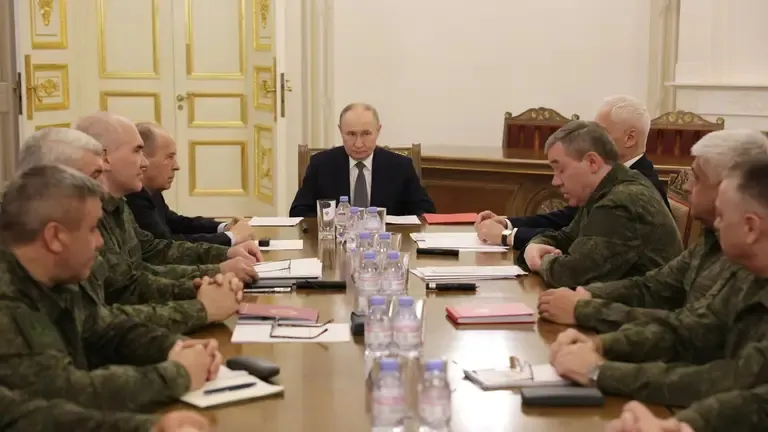
Putin has once again received a promise from his generals to “capture the Donbas by the fall of 2026,” even though the Russian army has repeatedly failed to meet previous deadlines. The meeting with military leaders only highlighted the gap between the Kremlin’s rhetoric and the actual situation on the front lines. Experts say that Russia is increasingly resorting to excuses and defensive logic.
Another meeting between Vladimir Putin and representatives of the Ministry of Defense and the General Staff took place in Moscow, during which Russian generals once again voiced ambitious plans for the complete occupation of Donetsk Oblast, claiming that Russia is supposedly capable of taking the Donbas by the fall of 2026, even though such predictions have been made many times before and have not come true.
The Russian military leadership systematically reports on “successes” at the front, but the reality often looks different, and even within Russia itself, criticism of such reports is growing, particularly from so-called “war correspondents,” who publicly accuse the generals of exaggeration and disinformation.
Scott Lucas, an American professor of international politics, noted in an interview that recent statements by the Russian General Staff regarding alleged breakthroughs in northeastern Ukraine, particularly near Kupiansk, do not correspond to reality but are part of an information campaign aimed at a domestic audience. “But for some reason, the Russian military command believes it can convince a sufficient number of Russians that this is actually the case. Narratives matter. Ultimately, the narrative about a Russian breakthrough on the front lines has now shifted to the question of what damage Ukraine is inflicting,” said Scott Lucas.
According to him, the shift in the Kremlin’s rhetoric indicates that Russia is increasingly forced to explain not its offensive, but its losses and problems on the battlefield, which effectively points to a shift toward a more defensive position, despite official statements about “advancing forward.”
Experts also view recent statements from the Kremlin regarding a possible resumption of negotiations as an additional signal, since until recently Moscow had publicly rejected any diplomatic scenarios, but now the rhetoric has shifted and there are signs of a willingness to return to the negotiating table.
Analysts also point to Vladimir Putin’s statements about the “approaching end of the war,” which, according to Western military experts, are likely intended to conceal Russia’s massive losses and the lack of significant breakthroughs on the front lines.
Despite new deadlines and public statements about “successes,” the situation around Donbas remains complex and demonstrates that a significant gap persists between the Kremlin’s political promises and the Russian army’s actual capabilities.
As a reminder, Russia attacked a substation in the Kramatorsk district with an FPV drone.
In the Zolochiv community of the Kharkiv region, a Russian drone attacked the Hryhorii Skovoroda National Literary and Memorial Museum.


