
With its strike on the Omsk oil refinery, Ukraine has extended the range of its attacks to 2,400 km, according to the WSJ
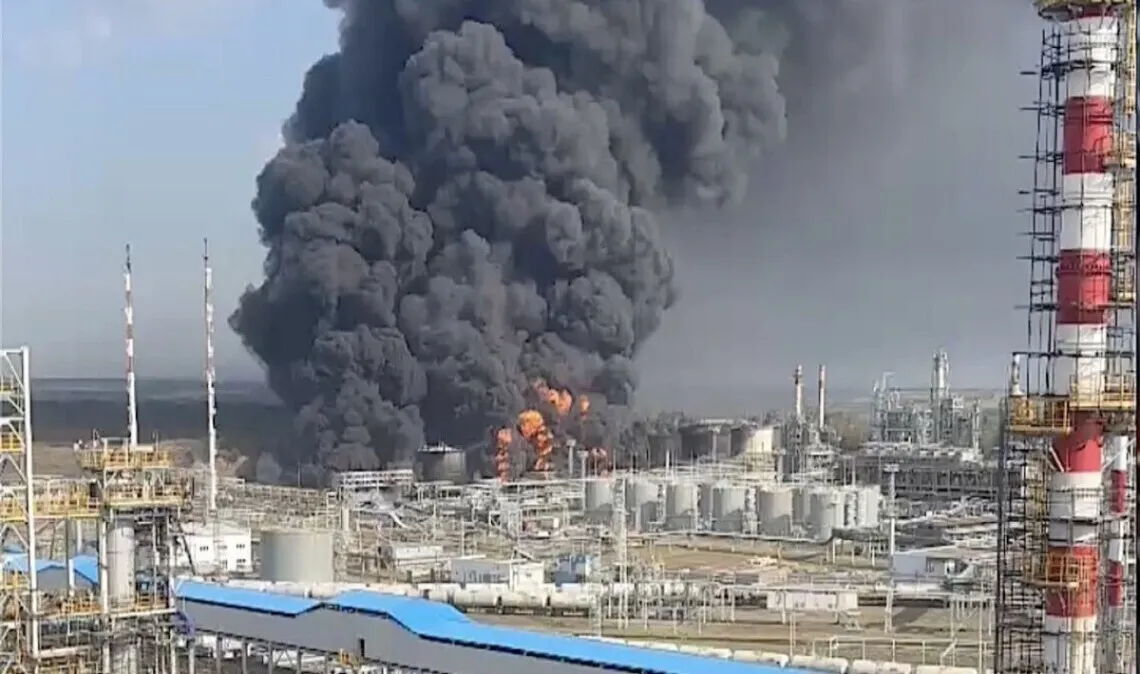
The successful attack by Ukrainian drones on Russia’s largest oil refinery in Omsk marked an important milestone in the campaign of deep strikes against Russian territory.
According to the publication, air defense systems in the Omsk area were minimal, as the facility was considered out of reach for Ukrainian drones.
At the same time, according to estimates by Fire Point, the maximum flight range of the drones used in the operation is up to 3,400 kilometers.
“This means that a large additional area of Russia, including the heart of the oil and gas industry in Western Siberia and hundreds of key military facilities, will also need protection from Ukrainian airstrikes—at a time when Russia’s air defenses are already stretched thin by Kyiv’s relentless campaign using drones and missiles,” notes The Wall Street Journal.
The publication emphasizes that previously, Ukrainian long-range strikes were largely limited to the European part of Russia, but now strategic facilities deep in Siberia are under threat.
According to experts, virtually all major oil refineries in the European part of Russia have been hit this year, leading to a reduction in gasoline production of at least 25%, fuel shortages, lines at gas stations, and restrictions on diesel fuel exports.
“In a sense, the strike on Omsk could very well be the last straw. This is certainly of great significance, and the further the Ukrainians strike, the more serious the situation becomes for the Russian energy system,” said James Henderson, an expert at the Oxford Institute for Energy Studies.
According to retired Royal Air Force Marshal Edward Stringer, Russia no longer has a secure rear, as it is forced to spread its air defense systems across a much larger territory.
“Russia has now lost both its operational and strategic depth. Russia has only a limited number of air defense assets, and they cannot all be stationed on the front lines. The more of Russia’s territory it now has to defend—which is, in essence, the entire route to Vladivostok—the more porous the front line becomes, meaning it will be even easier for Ukraine to transport ammunition through Russia’s rear,” he noted.
According to the WSJ, key oil and gas facilities in Western Siberia, Russia’s main LNG terminal on Yamal, pipeline infrastructure, and enterprises of the Russian military-industrial complex are now within range of Ukrainian drones.
Economists also emphasize that oil refineries remain one of the most vulnerable links in the Russian economy, as a fuel shortage could negatively impact not only the civilian sector but also the army’s supply chain.
“A fuel shortage will also lead to a shortage of fuel for the military, disruptions in the supply of consumer goods—particularly food— and we are already seeing farmers facing fuel problems,” said Russian energy expert Mikhail Krutikhin.
The article notes that Ukrainian and Western officials believe that increasing pressure on the Russian economy and military infrastructure could force the Kremlin to reconsider its position on continuing the war.
The Wall Street Journal reports this, noting that Russian authorities did not expect a strike on a target located nearly 2,400 kilometers from Ukrainian-controlled territory.
On the night of July 10, Taganrog in Russia’s Rostov Oblast came under a massive drone attack. According to local sources, fires broke out in the port area and near an aviation college, while Russian authorities reported that air defense forces were engaged.
As a reminder, a Russian strike destroyedthe office of a Kyiv-based children’s book publisher.
Russian troops struck Kharkiv and the surrounding region; four children were among the wounded.


