
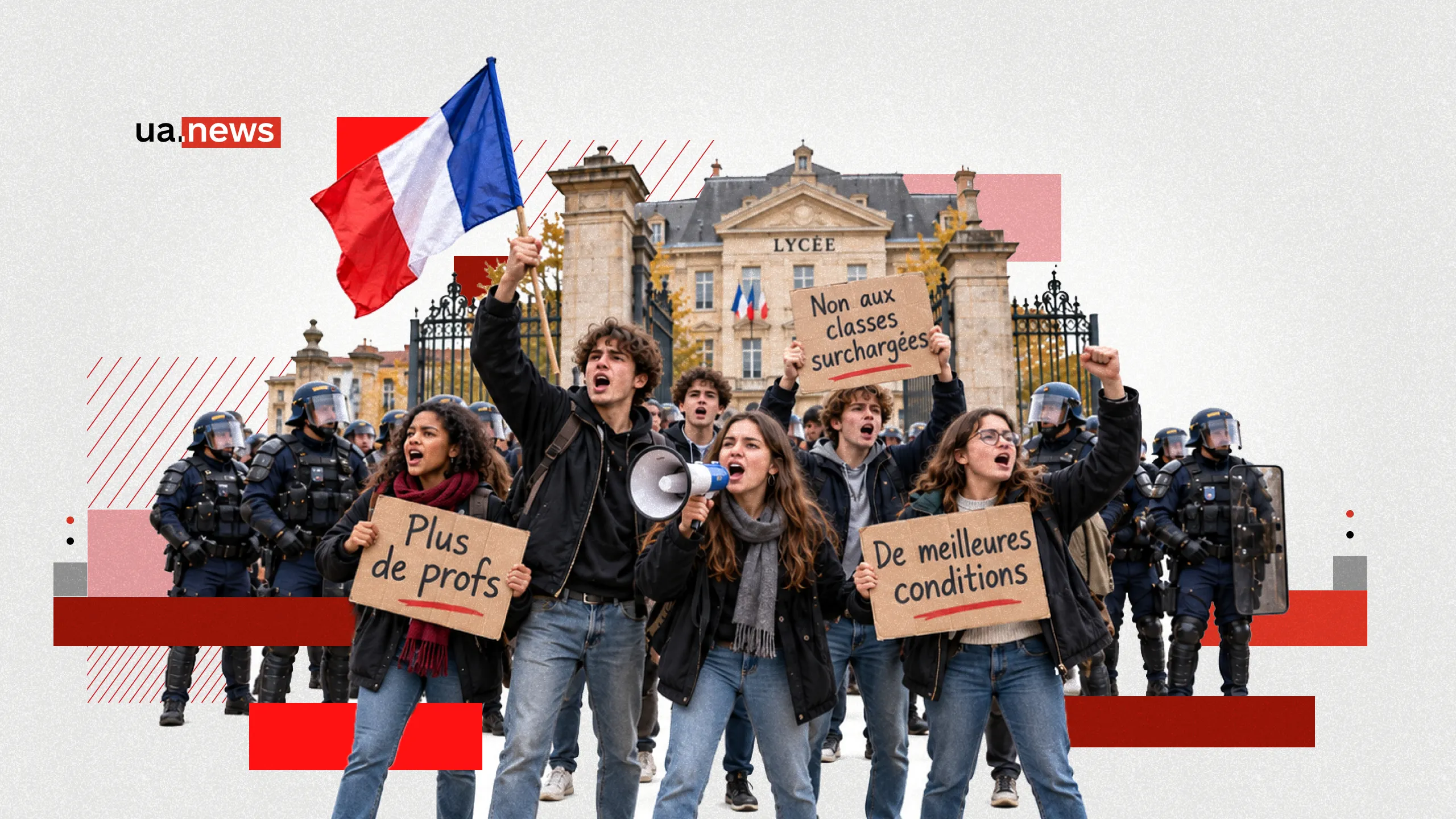
Gates blocked by barricades made of trash cans, crowds of teenagers holding homemade signs, and acrid white smoke from tear gas—this is what the courtyards of French high schools look like this fall, from Paris to Marseille. What began in September as a local show of solidarity with teachers in a small town near Paris has, in a matter of weeks, grown into a nationwide uprising that has brought hundreds of thousands of people into the streets.
French high school students openly declare that they are tired of being held hostage by a chronic crisis. Schools simply don’t have enough teachers, classrooms are bursting at the seams, and school buildings have been falling into disrepair for years without even basic repairs. Added to this everyday chaos is anxiety about the future: digital admissions to universities through the Parcoursup system have turned higher education into a confusing lottery, where graduates from poorer neighborhoods feel like outsiders even before their final exams.
The protest rapidly lost its peaceful tone when special police units moved in at the school gates, and chilling reports of injured minors came in from hospitals. Clashes with law enforcement became the catalyst for a new wave of public unrest, drawing university students, teachers’ unions, and the country’s opposition politicians into the conflict.
UA.News explains why the teacher shortage in schools sparked a nationwide protest, how admission algorithms and overcrowded classrooms are widening the inequality gap, how much funding is needed to modernize education, and whether Sébastien Lecornu’s government faces a major crisis on the eve of the presidential election.
From empty teacher positions to the hunt for chairs: how school life has tested students’ patience
The spark that ignited a nationwide flame flared up on September 21 at the Saint-Exupéry high school in Créteil, a suburb of Paris. Teachers went on strike to protest the catastrophic staff shortage, and instead of attending their usual classes, students decided to block the entrance to the building.
As the educational platform Planète Grandes Écoles later analyzed, the students quickly realized that their problems were not unique: unfilled teaching positions in math, French, and foreign languages had become the norm for high schools across the country. Within a week, solidarity protests had spread to dozens of schools in the capital and southern regions.
For students, the absence of a teacher isn’t just a free period in the schedule that can be spent at a coffee shop. The French school curriculum is extremely rigorous and demanding, and no one adapts the high school graduation exams to account for unforeseen circumstances at a particular school.
When classes are systematically canceled for several months in a row, teenagers are forced to either hire expensive tutors or try to figure out the difficult sections of the curriculum on their own. Families who cannot afford private lessons find themselves trapped, watching their children’s chances of earning a decent diploma dwindle day by day.
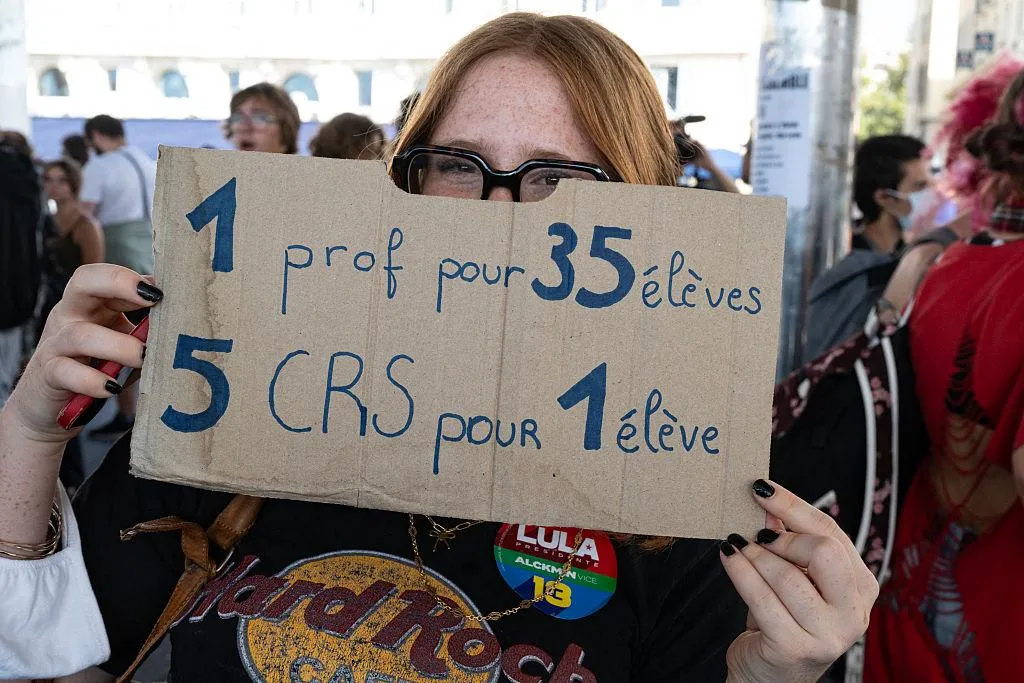
Chronic overcrowding in classrooms makes the situation unbearable. Instead of the 25–30 students stipulated by standards, teachers have to work with groups of nearly forty teenagers.
As reported by Reuters, Diana Di Shullo, a teacher at one of Marseille’s high schools, emotionally described the daily routine in her class of 37 students during a mass demonstration. According to her, lessons often begin with a scavenger hunt—searching neighboring classrooms for extra chairs and desks—and in such cramped conditions, the teacher is physically unable to give each child individual attention or help those who are falling behind in a timely manner.
Added to the staffing problems is the physical deterioration of the school’s infrastructure. Protesters are posting photos of their classrooms en masse on social media: cracked walls, peeling plaster, puddles on the floor due to leaky roofs, and broken restrooms.
The problem of temperature control has become particularly acute, as the prolonged September heat waves have turned the concrete boxes of old high schools into veritable saunas, where the air temperature reaches 35 degrees. Students are right to ask the authorities how they can possibly concentrate on formulas and philosophical texts in rooms where the ventilation doesn’t work and there is no access to drinking water.
Under French law, the maintenance, equipping, and major repairs of high schools fall under regional budgets, while the central government is responsible for educational programs and paying teachers’ salaries. For years, this bureaucratic division of authority has led to a back-and-forth shifting of responsibility between Paris and local authorities.
As a result, cosmetic repairs were postponed for decades, until the physical condition of dozens of high schools reached a critical point, prompting minors to take direct action.
Why the Parcoursup platform is causing panic and outrage
The second fundamental trigger for the uprising was Parcoursup, the national higher education admissions system. This digital platform, introduced to automate the application process for prospective students, has remained the primary source of anxiety for French families for several years running.
Teenagers call it a “black box” because the criteria by which a complex computer algorithm allocates spots and screens out applicants remain completely opaque and disconnected from real human aspirations.
The main criticism raised by high school students is that the system artificially widens the social divide. When thousands of applicants compete for prestigious majors at universities and preparatory classes (CPGE), even the slightest difference in scores becomes decisive.
A graduate of an elite Parisian high school with a full faculty and renovated laboratories is, a priori, in a different league than a student from an ordinary school in the suburbs or the provinces, where physics or philosophy classes have not been held for half a year due to a lack of teachers.
As a result, the protesters’ demands quickly evolved from pleas to “fix the radiators and find a teacher” to political ultimatums calling for a comprehensive overhaul of the admissions system. Students are insisting on an increase in the number of spots in popular departments at public universities, a guaranteed right to pursue their chosen profession, and a public review of the Parcoursup criteria.
How the protest spread to hundreds of schools and brought people onto the streets
While at the end of September there were only isolated incidents of school entrances being blocked in the Île-de-France region, in the first days of October the movement gained momentum. High school students turned to a tried-and-true French tactic—the “blocus.”
In the morning, barricades made of trash containers, fences, wooden pallets, and metal benches sprang up at the main gates, blocking access for teachers and students trying to get to class. Banners were hung on the facades of the buildings: “Education Is in Danger,” “We Want to Learn, Not Just Survive,” and “Schools Without Money—A State Without a Future.”
Events unfolded at an incredible pace. By September 29, disruptions caused by pickets and blockades had already affected hundreds of educational institutions, and teachers took to the streets of Lille, Nantes, Marseille, Lyon, and Paris alongside their students. Students from major universities began actively joining high school students, blocking the entrances to a number of Sorbonne faculties and regional campuses to express solidarity with the younger generation.
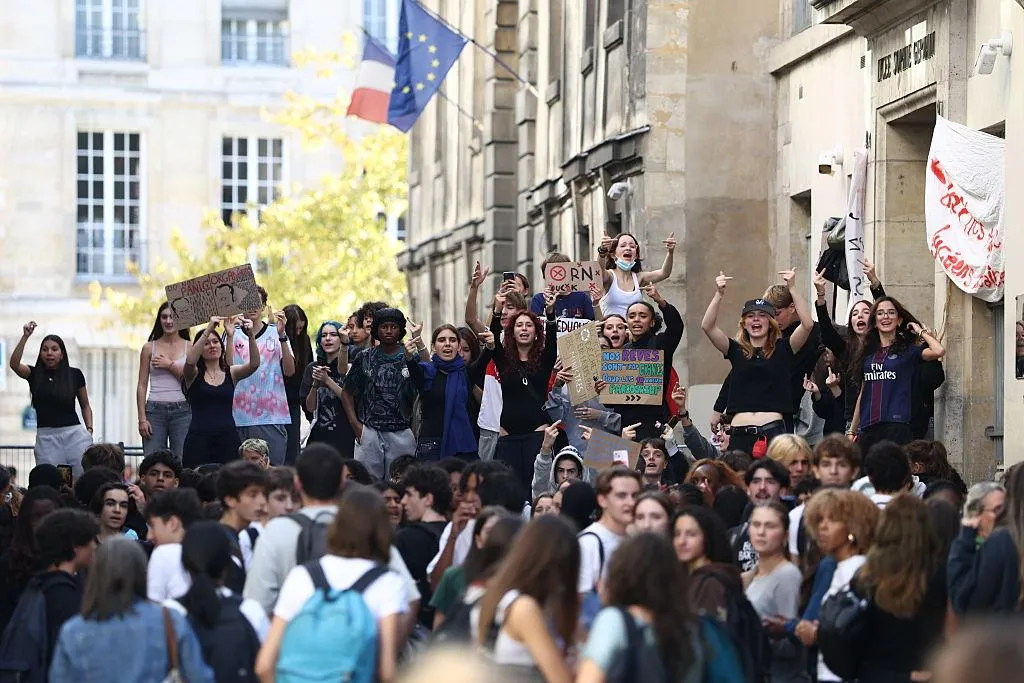
The first phase of mobilization culminated in a nationwide demonstration on October 6. The scale of the street protests proved unprecedented for youth protests in recent years: according to official data from the French Ministry of the Interior, the protest marches drew approximately 266,000 people nationwide. At the same time, union coordinators and independent youth groups estimated the number of demonstrators at over 450,000, noting the massive participation of parents and teachers.
This march finally dispelled government officials’ illusions that these were merely marginal groups of teenagers simply looking for an excuse to skip exams. A generation that was born during a time of constant reforms and financial “optimization”—and has borne the full brunt of the deterioration of public services—took to the streets. The youth demonstrated a high level of self-organization, coordinating their actions through private chat rooms on messaging apps, forming mobile support groups for the blocked high schools, and putting forward coordinated lists of demands.
Smoke over high schools, rubber bullets, and a dangerous political showdown
The mass scale of the protests inevitably provoked a harsh response from law enforcement. Since blocking educational institutions violates French law, police prefectures received clear directives to forcibly clear the blockades.
The schoolyards turned into battlefields: law enforcement officers used tear gas, flash-bang grenades, and special water cannons to clear the way. In response, radicalized groups of teenagers threw rocks, firecrackers, and smoke bombs, setting trash cans ablaze in front of school windows.
The situation reached a point of no return after the first reports of serious injuries to minors. Human rights organizations, including the French branch of Amnesty International, urgently issued a statement condemning the police’s excessive use of force against teenagers.
The public was shocked by specific tragic incidents: in the city of Lens, a 15-year-old high school activist lost his hand as a result of a tear gas grenade exploding near the Lycée Béale, and in Tours, a student suffered irreversible eye damage after being struck by a rubber bullet fired by law enforcement officers at close range.
These bloody incidents sent shockwaves through the highest echelons of power, definitively politicizing the student uprising. With little time remaining before the 2027 presidential election, key political players immediately rushed to capitalize on the tragedies.
Jean-Luc Mélenchon, leader of the left-wing opposition party “Unbowed France” (LFI), declared the high school students the vanguard of the people’s struggle and called for an expansion of the strikes, accusing the regime of waging war against its own youth.
On the opposite side, Marine Le Pen and her party, the National Rally, spoke out. The far right focused exclusively on the issue of security, calling the demonstrations “organized leftist barbarism” and demanding that the police crack down even more ruthlessly on any attempts to disrupt public order.
The Cabinet found itself caught in a crossfire: the left accuses the government of police brutality and dismantling the welfare state, while the right criticizes it for its helplessness in the face of street unrest.
54 billion at stake: Can online polls stop the revolt against austerity?
Prime Minister Sébastien Lecornu is aware of the danger: historically, any French high school student revolt has the potential to escalate into a massive nationwide upheaval capable of toppling the government. In an effort to defuse tensions, the Ministry of National Education urgently announced the launch of an unprecedented dialogue program.
Starting October 7, high schools have set aside half a day for open discussions about school issues, and a nationwide youth survey has been launched on the government’s Agora platform, which will run until October 23.
At the same time, on October 8, the prime minister convened an emergency meeting with regional leaders in an effort to find common ground on investments in school renovations. The government noted that it provides regional educational institutions with subsidies totaling over 700 million euros annually, and the prime minister even announced the launch of five priority construction projects.
However, department heads stated outright that the current funding is categorically insufficient to adapt school facilities to the heat and completely renovate 45 million square meters of school space.
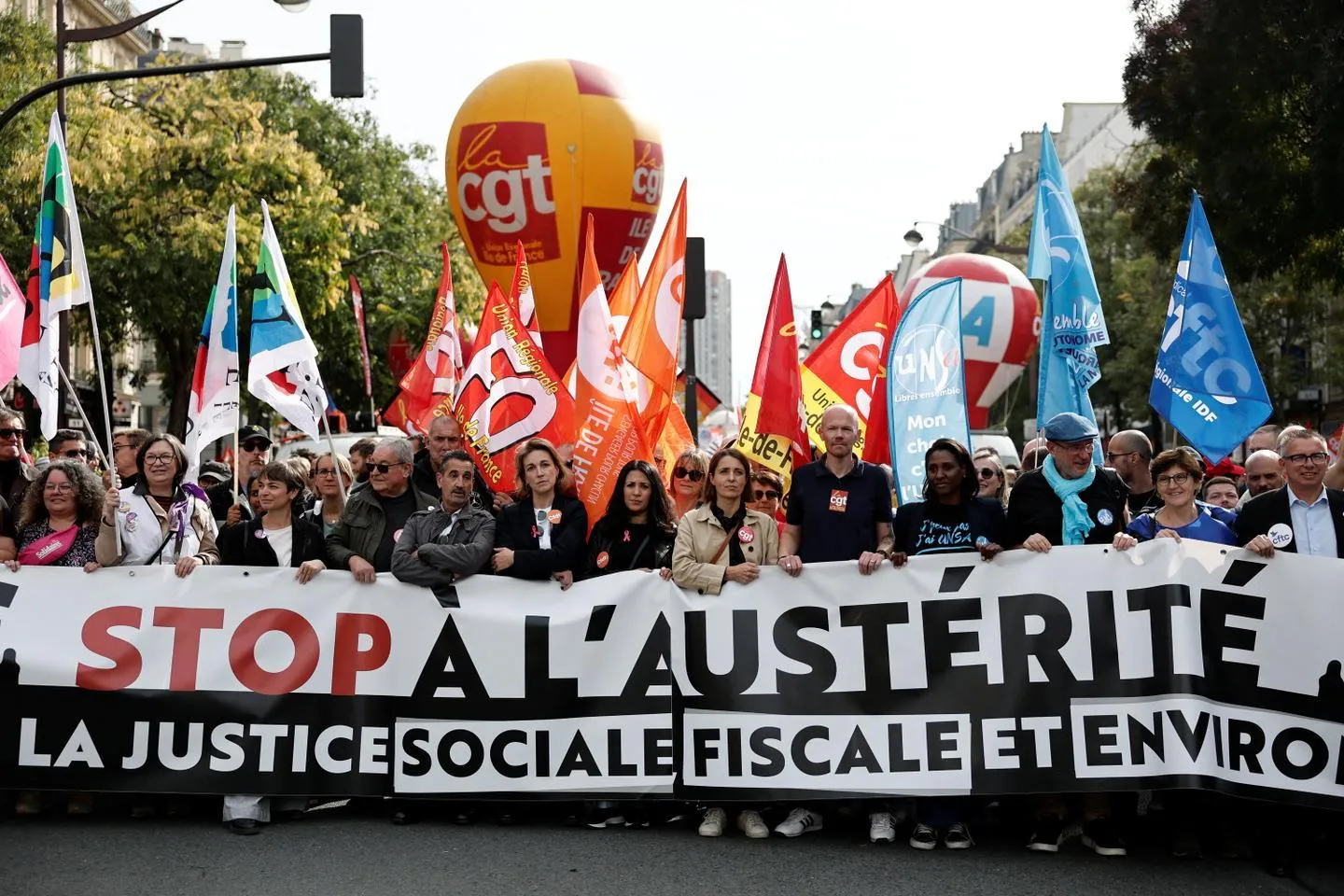
The main problem is that the ministers’ generous promises are at odds with France’s actual economic situation. Just a few days before the protests erupted, Sébastien Lecornu presented a draft of the new national budget, which calls for a massive cut in government spending of 54 billion euros to reduce the deficit to meet EU requirements.
The budgets of most civilian ministries have been frozen, tax revenues are falling, and international rating agencies are demanding financial discipline from Paris.
Under these circumstances, creating tens of thousands of new teaching positions, significantly raising teachers’ salaries, and allocating billions for school renovations is a task that borders on financial impossibility. Young people are well aware of this gulf between officials’ lofty declarations and actual budgets. If, based on the results of a poll on the Agora platform, the government offers only cosmetic changes to Parcoursup and yet another round of working groups, the lull will prove to be temporary.
French teenagers have already proven they know how to build barricades—and they are unlikely to leave the streets until they see concrete changes in their own diaries and class schedules.




