
The U.S. military demonstrated the AMP-HEL combat laser mounted on a vehicle
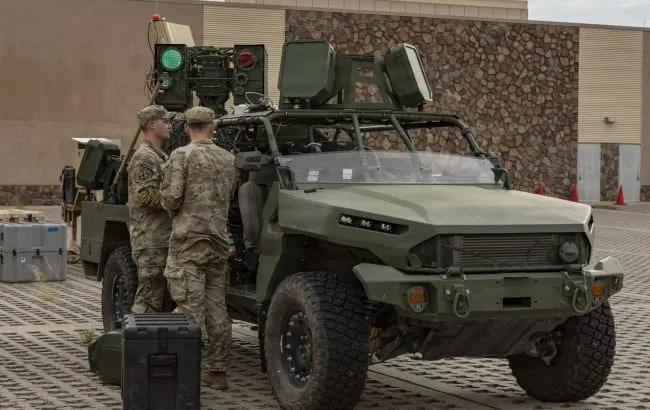
The U.S. Army tested the AMP-HEL laser system, mounted on a light Infantry Squad Vehicle, during military exercises at Fort Bliss in Texas. The U.S. military released new photos of the system on September 22.
The laser was mounted on an Infantry Squad Vehicle
On September 16, service members from the 1st Armored Division and Joint Task Force-Southern Border (JTF-SB) prepared the Army Multi-Purpose High Energy Laser (AMP-HEL) system for testing at the Fort Bliss training range.
The laser is mounted on an Infantry Squad Vehicle (ISV)—a light tactical vehicle used by the U.S. Army. During the exercises, military personnel assessed the system’s capabilities and its interoperability with other assets used for operations along the U.S. southern border.
According to Army Recognition, the AMP-HEL is a 20-kW-class system. Its purpose is to counter drones.
Mounting the laser on an ISV should enable the military to deploy the counter-drone system alongside units, rather than using it solely to defend stationary targets.
Photos of the system were published on September 22. In the photos, service members are preparing the AMP-HEL for evaluation during exercises.
The AMP-HEL has already been used against drones
This is not the first time the AMP-HEL has been tested in real-world conditions.
In late August, the “Southern Border” Joint Operational Group reported that on the night of August 26, U.S. military personnel used the AMP-HEL to shoot down three drones.
According to the U.S. military, the drones posed a threat to U.S. service members and partners from the Customs and Border Protection agency. They were linked to cartel activities.
Thus, the current tests at Fort Bliss are no longer just about demonstrating the technology, but also about verifying how a mobile laser can work in conjunction with other counter-drone measures.
What Is Known About AMP-HEL
AMP-HEL is a mobile directed-energy laser system that the U.S. Army is considering as a means of countering small drones.
In the configuration presented at Fort Bliss, the laser is mounted on an Infantry Squad Vehicle. According to Army Recognition, the system combines AeroVironment’s LOCUST laser system with a vehicle from General Motors Defense.
The concept calls for a relatively lightweight and mobile platform that can accompany units and provide them with protection against drones.
Mobility is one of the key features of the AMP-HEL. It is important for the military to test not only the laser’s ability to engage targets but also how easily it can be transported, deployed, and integrated into the overall counter-drone system.
This was reported with reference to Army Recognition and DVIDS, the official resource of the Pentagon and the U.S. Army.
As a reminder, the U.S. Army has ordered the production of laser systems to counter drones.
The U.S. Army has signed a $48.1 million contract with Palantir for ammunition tracking—Defense News.
The U.S. will disband an attack drone battalion modeled after the Ukrainian experience.
Shares of drone manufacturers rose after U.S. President Donald Trump announced the imposition of import tariffs on drones and their components. According to CNBC, Unusual Machines’ stock rose 10%, while Red Cat’s rose about 5%. Shares of AeroVironment and Kratos also rose.




