
Archaeologists have deciphered the name of an astronomer from the Maya civilization for the first time
For the first time, archaeologists have identified the name of a mathematician and astronomer from the Maya civilization who lived in the 8th century. His name was Sak Tan Vaash, which translates to “White-chested Fox.” The name was deciphered during a study of inscriptions in the ancient city of Shultun in Guatemala.
Alongside the signature, researchers discovered complex mathematical calculations related to calendar cycles and the movements of Venus and Mars. The discovery marks the first known instance in which a scientific work by a member of the Maya civilization was signed with his own name.
The discovery is based on an analysis of 11 hieroglyphs found among more than 50 barely visible mathematical “microtexts” inscribed on the wall of a small room known as Structure 10K-2. Researchers believe that the equations describing the motion of Venus and Mars were either written by Sak Tan Waash himself or recorded on his behalf. This is the first known instance in which a Maya astronomer and mathematician has been identified as the author of a scientific work.
David Stuart, an archaeologist and epigraphist at the University of Texas at Austin who participated in the study, noted that Maya astronomers had remained unknown for centuries.
According to the researchers, the last two hieroglyphs in a group of eleven were crucial to deciphering the text. The first contains the phrase “che-he-na,” meaning “thus says…,” and the second records the name SAK-TAHN-wa-xi—Sak Tan Waash (“White-chested Fox”).
“We’re essentially looking at an old ‘whiteboard’ in someone’s abandoned office. And the fact that a specific name is associated with it is simply incredible and makes Mayan science much more ‘human,’” said Stewart.
Heather Hurst, director of the San Bartolo-Xultun archaeological project, noted that thanks to this discovery, Sak Tan Waash can now take his place among the famous astronomers and mathematicians of the past.
“An entire scientific tradition comes to life thanks to one specific person,” she said.
At the same time, researchers cannot yet say for certain whether Sak Tan Vaash personally wrote down the discovered formulas. Perhaps they were written by another scribe who attributed the authorship to him, or perhaps he supervised the work of other scholars. Regardless, the discovery attests to the existence of professional astronomers and mathematicians in Maya society.
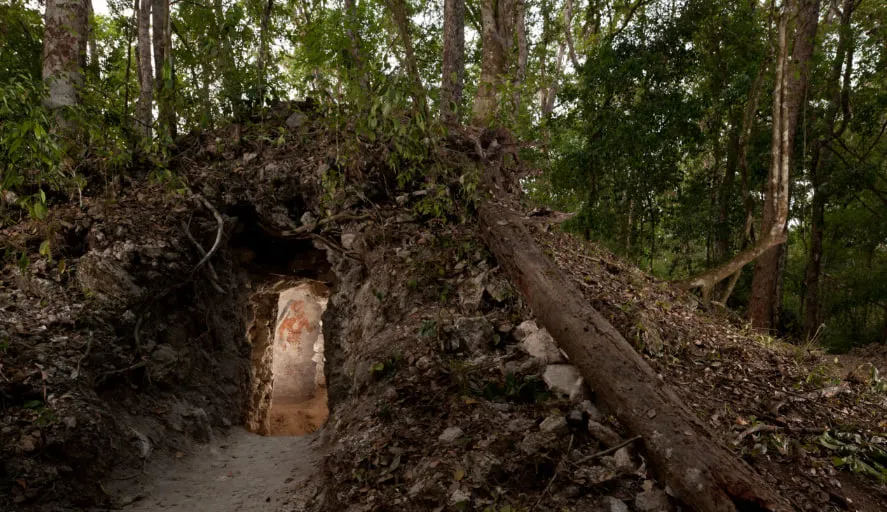
The story of the discovery began back in 2010, when Boston University student Maxwell Chamberlain, while working at the site, peered into a tunnel dug by looters. He discovered a small rectangular room with well-preserved wall paintings. Archaeologists later determined that the room had been deliberately filled with earth and stones, and new structures had been built on top of it.
Further excavations uncovered well-preserved frescoes depicting royal scribes at work.
Shultun is an ancient Maya city located approximately 40 kilometers northeast of Tikal. It flourished during the Classic Period of Maya civilization, between 250 and 900 CE. Although the site has been known since 1915, large-scale archaeological research did not begin until 2008.
“This is one of those great cities that almost no one has heard of,” noted the study’s lead author, Franco Rossi, an archaeologist at the Massachusetts Institute of Technology.
Materials from Structure 10K-2 date to the second half of the 8th century. This means that its inhabitants were active even before the so-called decline of the Maya civilization, which was accompanied by a significant population decline and migrations.
It was Rossi who later drew attention to a barely visible inscription on the eastern wall of the room. After extensive image processing using specialized software, he hypothesized that the text might contain someone’s name.
“You can look at some texts forever and still not understand a thing. And then one day, everything just falls into place,” he said.
After identifying the name, the researchers set out to decipher the rest of the inscriptions. They discovered that the text contains mathematical equations that combine the orbital cycles of Mars and Venus—one of the main objects of observation for Maya astronomers.
The calculations were aimed at determining a 2,920-day cycle, which corresponds to five orbits of Venus around the Sun. Based on the dates in the formulas, the researchers determined that they were composed in the year 781 CE.
“There were no nouns or verbs—no narrative about events. It was pure mathematics,” said Hurst.
Scientists emphasize that astronomy held significant practical and religious importance for the Maya civilization. They tracked the movement of the planets, oriented their temples according to the equinoxes and other celestial phenomena, and created calendar systems that allowed them to calculate dates thousands of years in advance.
“They did this without telescopes, without computers, and without modern technology,” the researchers noted.
Scientists speculate that the room where the equations were found was a kind of workshop where Maya astronomers performed calculations, verified them, and prepared materials for inclusion in the codices.
According to Gerst, archaeologists have long known that the Maya systematically observed celestial bodies, but this is the first time they have been able to link this knowledge to a specific individual.
Source: National Geographic.
In Crete, at the Sanctuary of Apollo, archaeologists have discovered more than 450 mouse skeletons.
In the Odesa region, archaeologists have uncovered Roman burials containing unique artifacts.
Previously, archaeologists discovered that the kings of Urartu used bronze bowls for propaganda purposes.
As a reminder, gold jewelry made before the Bronze Age Catastrophe was found in Cyprus.
Near Halych, archaeologists have discovered unique medieval artifacts.




