
Astronomers have detected an atmosphere on a rocky planet in the habitable zone for the first time
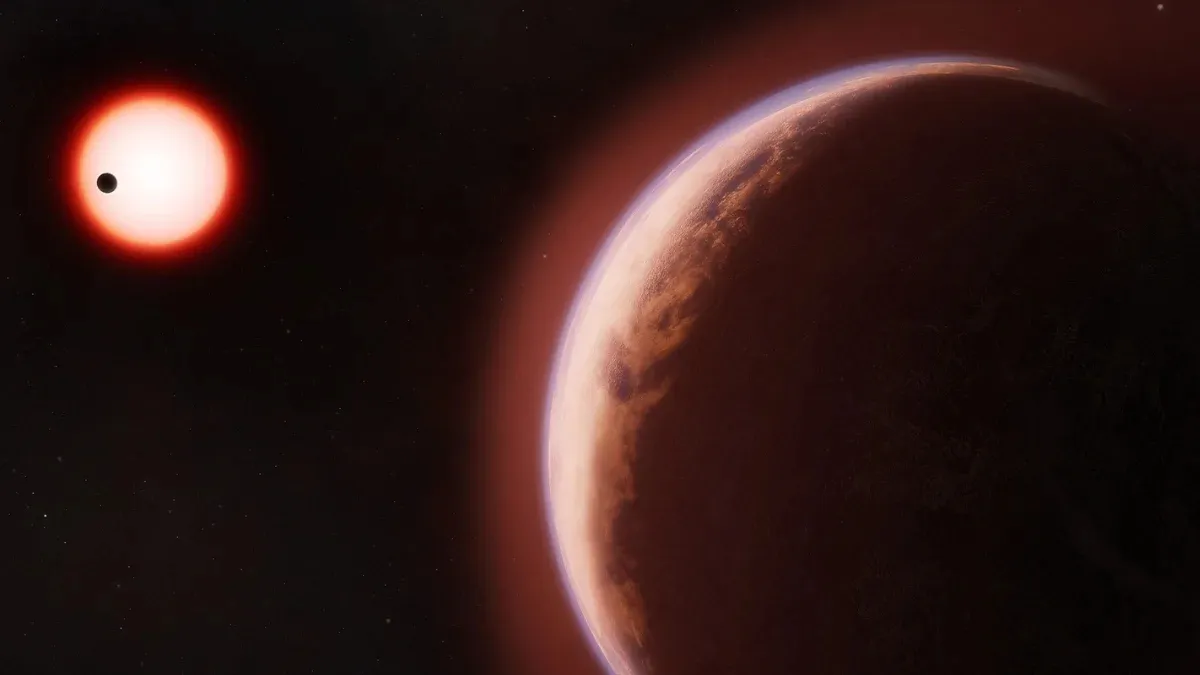
Astronomers have confirmed for the first time the presence of an atmosphere on a rocky exoplanet located in its star’s so-called habitable zone. This discovery marks an important step in the search for worlds where conditions for life could potentially exist.
The exoplanet in question is LHS 1140 b, located approximately 50 light-years from Earth. Researchers believe it has managed to retain its atmosphere for billions of years despite the intense radiation from its star.
The discovery is described in a new study reported by Science Alert. Until now, astronomers had primarily found atmospheres on large gas giants similar to Jupiter. Such planets are unsuitable for life as we know it. Now, for the first time, an atmosphere has been detected on a relatively small rocky planet located in a zone where temperatures theoretically allow for the existence of liquid water. That is why this discovery is considered one of the most significant in exoplanet research in recent years.
The planet LHS 1140 b is significantly larger than Earth. Its mass is about five times that of Earth, and its radius is 1.7 times larger. Because of these parameters, it is classified as a so-called “super-Earth.” It orbits a red dwarf—a small and relatively cool star located about 50 light-years from our planet.
During their study, scientists determined that the atmosphere of LHS 1140 b consists primarily of helium. According to the authors of the study, this may be a natural stage in the evolution of many small planets. Scientists explain that over time, such worlds may lose lighter hydrogen while retaining helium.
The researchers were particularly intrigued by the fact that the planet was able to retain its atmosphere despite the harsh conditions. Red dwarfs are known for their intense radiation, which often literally “blows away” the atmospheres of nearby planets. However, according to astronomers’ estimates, LHS 1140 b has retained its gaseous envelope for over three billion years.
For the study, the team used the ground-based WINERED spectrograph, located in the Atacama Desert in Chile. The observations were made as the planet passed in front of its star’s disk. It was then that the astronomers were able to analyze how the atmosphere absorbs light and determine its composition.
The scientists emphasize that this discovery has shown that even modern ground-based telescopes can carry out extremely complex studies that, until recently, were thought to be the exclusive domain of space observatories, such as the James Webb Space Telescope. A new phase of research lies ahead for the scientists. They want to determine whether LHS 1140 b has oceans, as well as other conditions that could make the planet habitable.
Although it is still too early to speak of the existence of life on this planet, the discovery has already become an important step in the search for Earth-like worlds. It also opens up new possibilities for studying other rocky planets that may orbit distant stars. This is reported in a new study published in the journal Science Alert.
The European Space Agency’s (ESA) Mars Express orbiter has sent back new images of the Martian surface showing “metallic” waves inside the massive Kaiser Crater.


