
British commander in Estonia says he will go straight into battle without delay
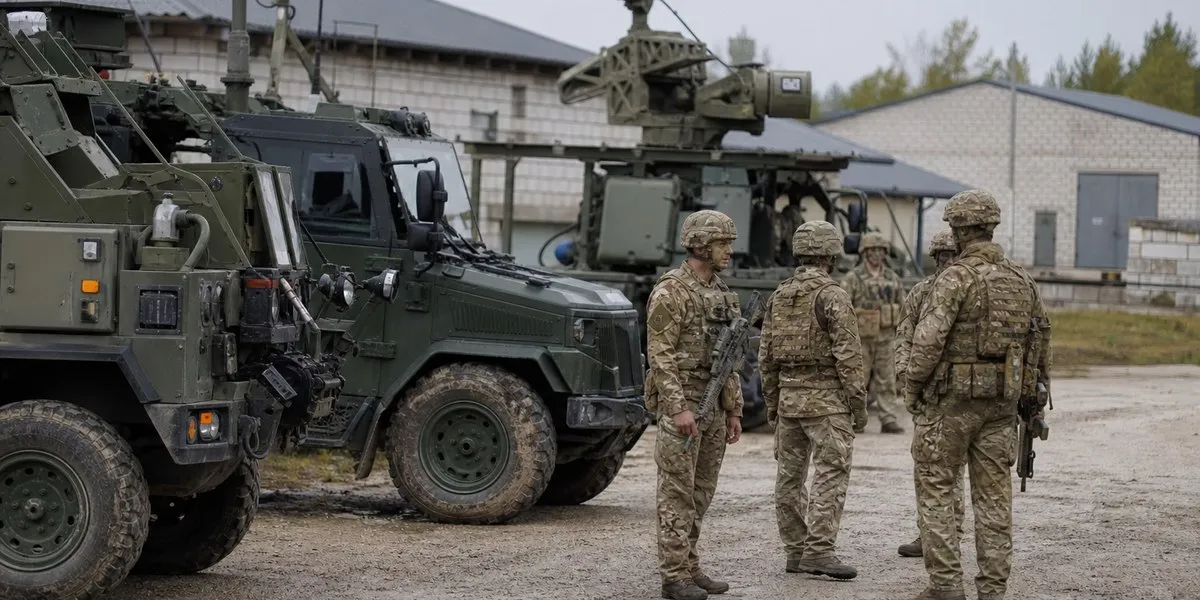
Brigadier Jamie Murray, commander of the British contingent in Estonia, said that if necessary, he would go straight into battle without delay. According to him, NATO's and Estonia's defence plans fully complement each other, while the necessary decisions will be made by NATO's Supreme Allied Commander Europe.
Murray, who is also deputy commander of the Estonian Division, told ERR News about this. He rejected claims that the Alliance could respond slowly to a potential attack by Russia — an aggressor state — and said that the military constantly considers how to react quickly and take designated positions in order to stop an invasion.
British presence in Estonia
Murray has led the British contingent in Estonia since June 2025. His two-year posting is part of an approach under which allies keep their service members in the country for longer periods instead of rotating them every six months.
British military personnel have been in Estonia for nine years. About 900 British soldiers are currently stationed there, and their number is expected to increase to nearly 1,200 next spring. The battlegroup based in Tapa is under the command of an Estonian brigade.
More current news is available on the UA.News Telegram channel Telegram.
The commander described the interaction between British and Estonian military personnel as exceptionally close. In his assessment, cooperation covers operational planning, battlefield communications, data sharing and the use of modern methods of warfare. He also noted that trust between the forces of the two countries has been built over nine years.
Lessons from the war in Ukraine
The British Army, like Estonia, is studying the experience of modern warfare, including Russia's war against Ukraine. At the same time, Murray cautioned against mechanically transferring conclusions from the Ukrainian battlefield to other possible conflicts and geographical conditions.
He stressed that the widespread use of drones does not mean the end of the era of heavy armoured vehicles. According to him, the British Army uses a 20-40-40 resource allocation model: 20% is directed toward expensive heavy systems, 40% toward cheaper means that can be produced on a larger scale, and another 40% toward ammunition and other consumables.
According to Murray, the arrival of a new British contingent next spring will mean a transition from the current model to a unit formed with Estonia's conditions in mind. It will have mobile vehicles, modern weapons systems and drones with a range of up to 250 kilometres.


