
Experiment in Italy did not confirm gravitational decoherence model — ScienceDaily
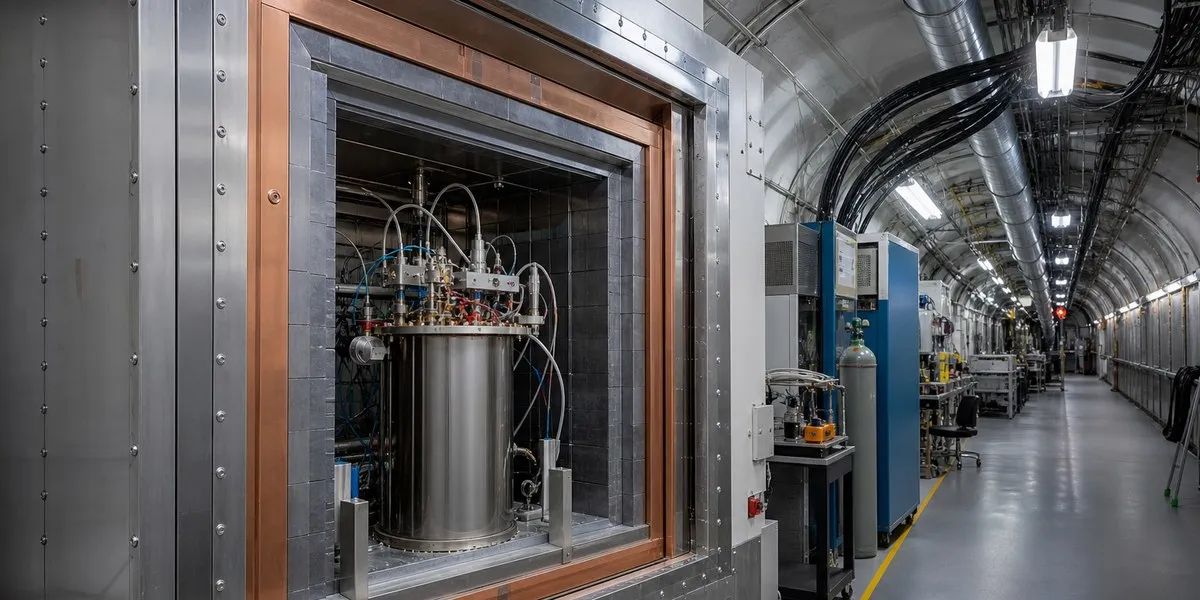
Researchers at the Gran Sasso underground laboratory in Italy did not detect the radiation that should arise under one of the models of gravitationally induced quantum decoherence. The experiment narrows the range of applicability of the model proposed by Hungarian physicist Frigyes Károlyházy, ScienceDaily reports. The study results were published in the journal New Journal of Physics in June 2026.
Search for weak radiation
Quantum mechanics allows superposition — a combination of possible states of a system. At the same time, such pronounced quantum effects are not observed in the everyday macroscopic world. Physicists call their loss decoherence; the causes of this process and the possible role of gravity remain an open question in fundamental physics.
The Károlyházy model assumes that spacetime undergoes tiny unavoidable fluctuations. According to this hypothesis, they gradually destroy quantum superpositions. It is impossible to directly detect such fluctuations, but they should randomly accelerate charged particles. This, in turn, should cause extremely weak electromagnetic radiation.
More current news is available on the UA.News Telegram channel Telegram.
62 days of underground measurements
The team conducted observations at the INFN Gran Sasso laboratory, located beneath a 1.4-kilometer-thick layer of rock. The natural shielding reduces background radiation, including the impact of cosmic rays, which is critically important for searching for a weak signal.
For the measurements, the researchers used a detector with a high-purity germanium crystal about the size of a coffee cup, additionally shielded by layers of copper and lead. Data were collected for 62 days, after which the expected background radiation level was subtracted and the residual signal was compared with the prediction of the Károlyházy model. No corresponding signal was found.
What the result means
The absence of a signal does not prove that gravity does not affect quantum decoherence. At the same time, it rules out one important version of this explanation and sets stricter constraints for further theories seeking to combine gravity and quantum mechanics. The study was supported by the Foundational Questions Institute through the Consciousness in the Physical World program.


