
Hubble has captured an image of a dwarf galaxy in the constellation Canis Major

The Hubble Space Telescope has released a new image of the dwarf galaxy ESO 490-017, located in the constellation Canis Major. This unusual object is located approximately 23 million light-years from Earth and helps scientists better understand how matter is distributed throughout the universe. This was reported by NASA.
In the new image released by NASA experts, you can see the dwarf irregular galaxy ESO 490-017. Despite its modest size, it has already attracted the attention of astronomers. Its diameter is about 12,000 light-years, which is significantly smaller than the size of our Milky Way. The peculiarity of this galaxy is that it belongs to the so-called irregular galaxies. Unlike the spiral or elliptical galaxies familiar to many, such objects do not have a distinct shape. Their structure appears chaotic, and stars and gas are distributed unevenly.
At first glance, ESO 490-017 is even hard to make out. Due to its low brightness, it resembles a faint star cluster. That is why this object remained largely unnoticed in space photographs for a long time. However, Hubble’s capabilities allowed it to be captured in high detail, revealing even the galaxy’s finest features.
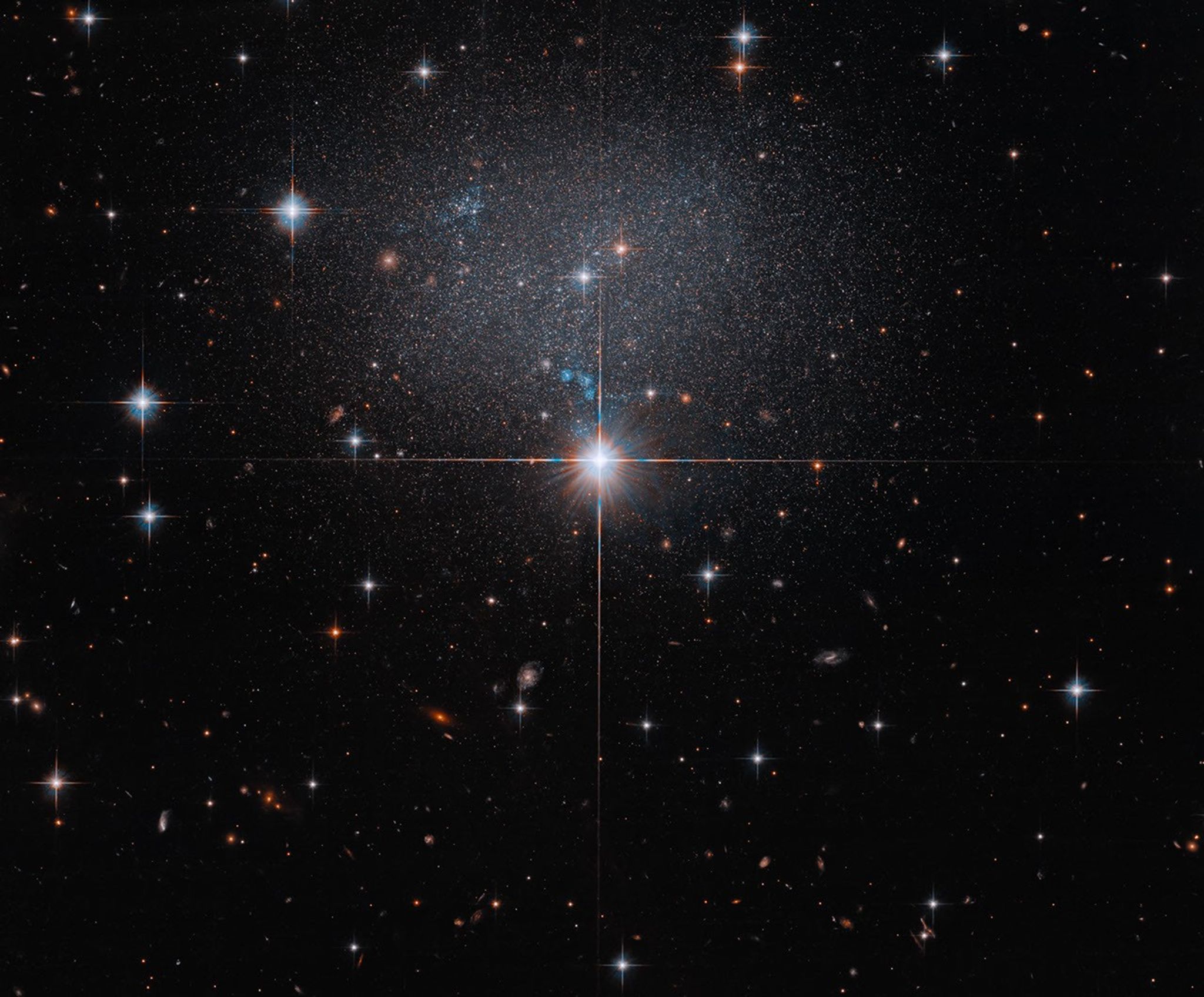
The photo shows more than just ESO 490-017 itself. The bright stars in the foreground belong to our galaxy and are easily recognizable by their characteristic light rays. And the numerous red, orange, and beige dots around them are other distant galaxies. Some of them are so clear that you can make out their spiral structure.
Scientists explain that this image was obtained as part of the large-scale Hubble science program. Its main goal is to study the motion of galaxies and understand how large cosmic structures influence one another under the influence of gravity.
NASA notes that matter in the universe is distributed unevenly. That is why galaxies are constantly moving under the influence of immense gravitational forces. Astronomers call this phenomenon the “cosmic flow.” Observing objects like ESO 490-017 helps create a more accurate map of the universe and better understand its evolution.
Another important advantage of the Hubble Space Telescope is its ability to determine the distance to distant galaxies with considerable accuracy. To do this, scientists use red giants—old stars whose brightness is well known. Such objects are called “standard candles.” It is thanks to them that it was determined that ESO 490-017 is located approximately 23 million light-years from Earth. “Each such image is not just a beautiful picture, but another piece of a vast cosmic mosaic,” the researchers explain. According to them, even small and inconspicuous galaxies can provide answers to important questions about the origin and evolution of the Universe.
Despite its advanced age, Hubble continues to surprise us with new discoveries. The telescope has been operating in orbit for over three decades, yet it remains one of the most important tools in modern astronomy. And every new image from its cameras allows humanity to peer a little further into the boundless cosmos.


