
China is helping Russia develop batteries for FPV drones
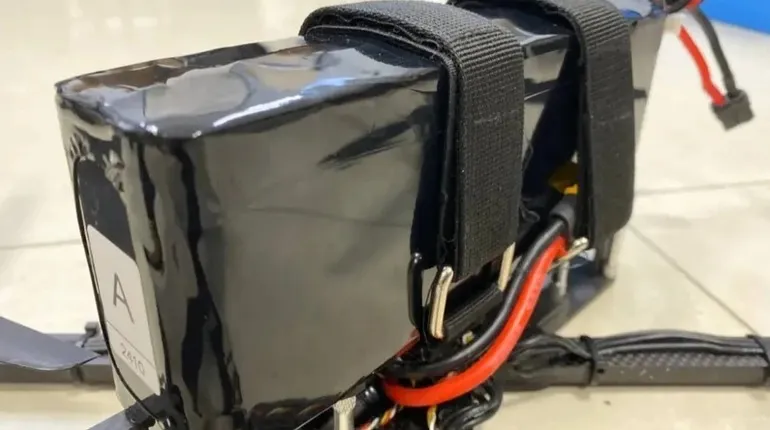
Russia is trying to establish its own production of lithium-ion batteries for FPV drones. To this end, the country has sharply increased its purchases of raw materials and equipment, with assistance from companies in China and South Korea. According to investigators, these shipments could supply batteries for hundreds of thousands of drones.
Russia is actively developing the production of lithium-ion batteries, which are used, in particular, in FPV drones. “Russia is rapidly developing its own lithium-ion battery production industry for FPV drones with the help of Chinese and South Korean companies. The development of this industry in Russia will significantly complicate the West’s ability to influence the Russian military’s access to drones,” the report states.
The Russian government aims to gradually make battery production as independent as possible from foreign supplies. Anastasia Mikhailova, director of “Renera,” a subsidiary of “Rosatom,” announced this at an industry exhibition in Yekaterinburg in the summer of 2025.
According to her, the company is moving toward full production autonomy in the manufacture of drone components. Rosatom plans to fully localize the production of lithium-ion batteries by 2030. However, Russia currently does not have sufficient domestic lithium reserves. Therefore, it cannot do without the help of foreign suppliers.
Chinese companies supply raw materials
Chinese companies have come to the aid of the Russian battery industry, as reported by The Insider. One indicator of the industry’s rapid development has been the sharp increase in imports of electrolytes, which are needed to produce lithium-ion batteries. Specifically, in the first quarter of 2025, Russia imported more than 6.6 metric tons of electrolyte based on lithium hexafluorophosphate or lithium tetrafluoroborate.
On an annualized basis, this amounts to approximately 26 metric tons. According to investigators’ estimates, this quantity could be sufficient to produce batteries for approximately 150,000 FPV drones. By comparison, in 2024, Russia imported about 9 metric tons of this electrolyte. In 2023, it imported 12 metric tons, and in 2022, only 4 metric tons. In other words, purchases surged sharply precisely against the backdrop of a full-scale war and the widespread use of drones.
The main manufacturers of electrolytes that supplied products to Russia are said to be the Chinese companies Huizhou Capchem Chemicals, Jiujiang Tinci Materials Technology, Weifang Tianyuan Battery Material, and Huzhou Kunlun Enchem Battery Materials. Among the main Russian importers are Obruch DV LLC, AK Rigel JSC, Lenenergomash R&D LLC, and Uraltekimport LLC. According to investigators, the latter company purchased virtually a complete set of components for assembling batteries. These include cathode and anode materials, separators, drying cabinets, and thin sheets of magnesium-aluminum alloy. These are used to create lightweight battery casings.
Russia has increased its imports of cobalt oxide 15-fold
Another indicator of production growth is the purchase of cobalt oxide. In 2025, Russia imported approximately 5.8 metric tons of this material per quarter. During the same period the previous year, the figure was only 400 kilograms. Thus, imports increased approximately 15-fold.
Cobalt is used in battery production, specifically for manufacturing cathode materials. According to The Insider, in 2025, Russia also imported about 93 metric tons of pure lithium hydroxide and 80 metric tons of battery-grade lithium carbonate per quarter. These materials are key raw materials for the production of lithium-ion batteries.
The Chinese company Sichuan Zhiyuan Lithium Industries Ing is cited as the main producer of high-quality lithium carbonate supplied to Russia. The buyer was the Russian reseller Promtorg-Invest LLC. The Insider estimates that the volume of imported lithium raw materials could have been sufficient to produce several hundred thousand batteries. “Based on the approximate weight of a typical drone battery and the proportion of lithium it contains, we can estimate that the supplied lithium raw materials could have been enough for several hundred thousand batteries,” the journalists noted.
South Korea Is Also Helping Russia
Russia is not only purchasing raw materials. It also receives some finished battery cells and equipment from South Korea. In particular, the “Renera” plant in Neman, Kaliningrad Oblast, purchased 56 metric tons of finished lithium-ion cells from South Korea during the first quarter of 2025.
The supplier was the South Korean company Enertech International, a subsidiary of “Renera.” In addition, the Russian company imported drying cabinets manufactured by Jktech from South Korea. In other words, Russia is simultaneously purchasing raw materials, finished cells, and the equipment needed to launch its own production.
Why Does Russia Need Its Own Batteries?
FPV drones have become one of the key types of weaponry in Russia’s war against Ukraine. Such drones are relatively inexpensive, can be produced quickly in large quantities, and their components have long been supplied in bulk from China. FPV drones are typically assembled from a large number of ready-made parts. The process is similar to that of a construction set: the frame, motors, electronics, camera, battery, and other components are purchased separately, after which everything is assembled into a single drone.
However, the export of parts for military equipment from China is formally prohibited by Chinese law. Despite this, Chinese components continue to reach Russia through various supply chains. According to the Conflict Intelligence Team, drones have become the deadliest weapon of this war. They accounted for 42% of civilian deaths in 2025 and over 80% of military casualties in 2026.
Therefore, the ability to produce batteries independently is of significant military importance to Russia. If the country can establish a full battery production cycle, it will be easier for it to maintain high volumes of FPV drone production even in the event of tighter sanctions or restricted access to finished batteries.
Russia is developing the industry faster than it claims
Publicly, Rosatom speaks of full localization of lithium-ion battery production by 2030. However, actual procurement volumes of raw materials and equipment indicate that the process is already actively underway. Russia remains dependent on foreign supplies for now. It lacks sufficient domestic lithium, and a significant portion of the necessary materials is supplied by Chinese companies. It receives some finished components and equipment from South Korea.
At the same time, the scale of imports shows that this is no longer a matter of isolated purchases. “The sharp increase in raw material purchases indicates that a battery industry is emerging in Russia practically from scratch, outpacing public statements by officials,” according to an article in The Insider.
Thus, Russia is attempting to gradually establish its own battery production base and reduce its dependence on finished components from abroad. For the Russian military, this means a more stable supply of batteries for FPV drones, while for Ukraine and its partners, it presents yet another challenge that must be factored into sanctions policies and controls over the supply of technology and raw materials. GuildHall reports this, citing relevant data and publications.
In Kyiv, a logistics center belonging to the “Ranok” publishing house was damaged by Russian shelling.
In Russia, the massive attack on Ukraine was cynically called a “retaliatory strike.”


