
China prepares satellite coordination standards — South China Morning Post
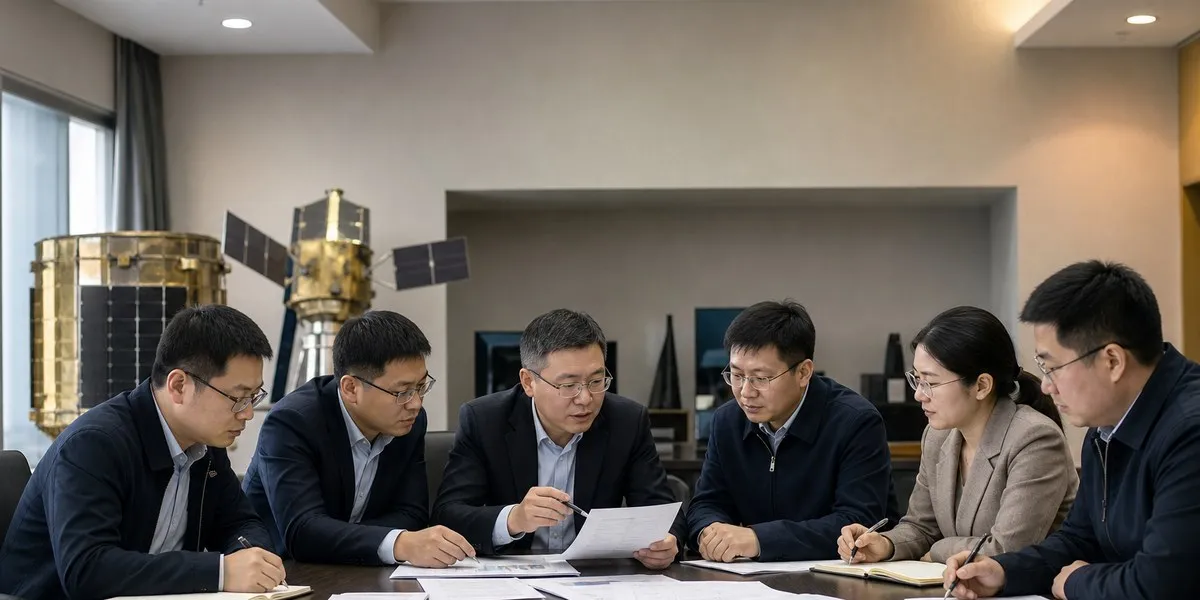
In Beijing, China, an expert group of the China Institute of Command and Control approved work on 10 proposed voluntary standards for autonomous satellite coordination and data exchange. Draft documents are to be published for consultation, the South China Morning Post reports.
The institute said the standards are intended for China’s civilian and commercial satellites in low Earth orbit. They cover system design, mission scenario descriptions, distributed data services, satellite and mission data, coordination at the constellation and smaller satellite-group levels, as well as the design of autonomous controllers.
Interoperability of satellite networks
According to the CICC’s concept, common formats should help satellites operated by different entities consistently describe tasks, report their status and capabilities, and exchange mission data. If one satellite detects an object of interest, it could potentially transfer information to another spacecraft with a different sensor or a better view of that area.
Orbital Gateway Consulting founder Blaine Curcio noted that large Chinese satellite constellations are being created by different organizations, unlike SpaceX’s vertically integrated Starlink system. In his view, the standards are important for the future interoperability of such satellites. At the same time, the practical effect will require time, as the requirements must be incorporated during spacecraft design before their production and launch.
More current news is available on the UA.News Telegram channel Telegram.
Potential military use
Military and defense-related institutions are involved in the work on the standards. The expert group includes Unit 61646 of China’s People’s Liberation Army, which works with satellite information processing and remote-sensing data. One of the institutions leading the development is the 513th Institute of the China Academy of Space Technology, which works on electronics for the space and defense sectors.
Timothy R. Heath, founder of the research and consulting company Perceptum, believes that autonomous satellite networks could shorten the path between collecting information on a potential target and transmitting usable data to military operators. In his assessment, satellites could exchange data from different sensors, use artificial intelligence to identify potential targets, and transmit information to human operators.
Gregory Falco, a professor at Cornell University, noted that such an architecture could make it possible to process data and make decisions closer to where they are collected, without sending them to Earth first each time. He also suggested that satellites could continue operating if contact with ground stations is lost. Namrata Goswami, a professor at Johns Hopkins University, added that the network could theoretically autonomously redistribute functions after jamming or an attack on one of its parts.
At the same time, Heath emphasized that the civilian sector is the main driver of the standards’ development, while military use is only one of the factors. The United States is also developing related capabilities, although these programs are not direct analogues of the CICC initiative: the Space Development Agency uses common networking and optical standards for satellites from different manufacturers, while DARPA is developing the Space-BACN program to connect satellite constellations with incompatible optical communications standards.




