
Holiday on October 3, 2026 — National Foundation Day in South Korea: The Story of Gyechondjol
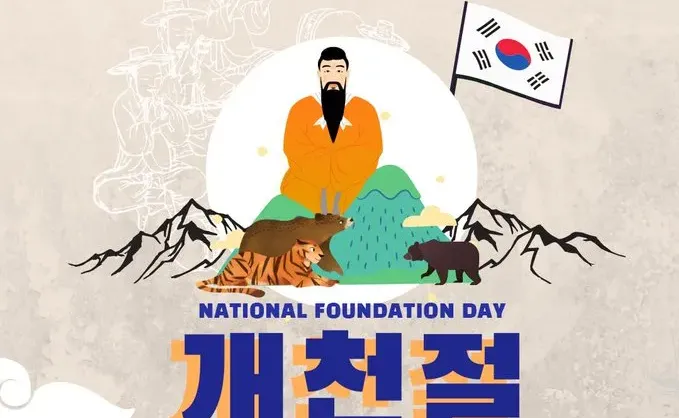
On October 3, South Korea celebrates National Foundation Day, or Gaecheonjeol. The holiday is linked to an ancient legend about Dangun, who, according to Korean tradition, is considered the founder of the first state on the Korean Peninsula—Gojoseon. In 2026, October 3 falls on a Saturday, so October 5 will be an additional day off.
National Foundation Day is one of South Korea’s major national holidays. In Korean, it is called Gaecheonjeol (개천절). The name can be translated as “Day of the Opening of Heaven” or “the day when the heavens opened.” The holiday is celebrated annually on October 3. It commemorates the legendary founding of Gojoseon—an ancient state considered in Korean tradition to be the first state of the Korean people. According to legend, this took place in 2333 B.C., and the founder was Dangun Wanggeum.
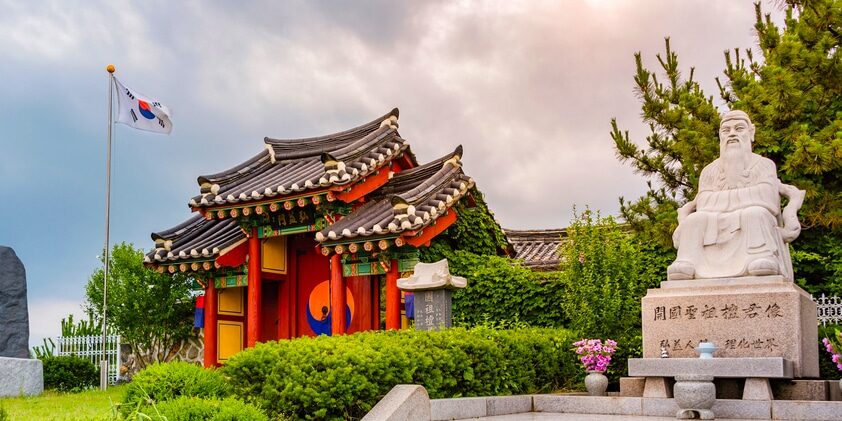
That is why October 3 is not just another day off for Koreans. This day is linked to the origins of the Korean nation, its ancient culture, and its shared historical narrative. Official South Korean materials emphasize that Gyechondjeol symbolizes the beginning of Gojoseon and the birth of the Korean nation. At the same time, the story of Dangun is viewed as a legend rather than a documented account of the events of 2333 BCE.
Where Did This Date Come From?
The history of the holiday is linked to an ancient Korean myth about the founding of the first state. According to the legend, the heavenly ruler had a son named Hwanun. He wanted to live among people and descended to earth along with his followers. There he met a tiger and a bear who wanted to become human.

Hwanung gave them a task: they had to spend 100 days in a cave, eating only garlic and wormwood and avoiding sunlight. The tiger could not withstand the trial and left the cave. The she-bear, however, managed to fulfill the condition and transformed into a woman named Ungnyeo. Eventually, Ungnyeo became Hwanun’s wife. According to the legend, it was from their union that Dangun was born. Dangun, as the story goes, founded Gojoseon in 2333 BCE. It is this story that forms the basis of the traditional view of the origin of the Korean people.
Who Is Dangun
Dangun Wanggeum is one of the most famous figures in Korean mythology. He is often referred to as the legendary forefather of the Korean people and the founder of Gojoseon. In the legends, he has an unusual origin. His father was Hwanung—a celestial hero who came down to the world of mortals—and his mother was Ungnyeo, who had previously been a bear.
According to legend, Dangun founded the state of Gojoseon and ruled it for a very long time. The details of his life vary across different versions of the legend. Korean researchers and historians do not regard this story as a literal historical account. At the same time, the legend of Dangun holds great cultural significance, as over the centuries it has helped shape the perception of a shared origin among Koreans. Therefore, Dangun remains an important symbol of Korean historical and cultural identity to this day.
What Does the Name “Gaecheonjeol” Mean?
The name of the holiday also has a special meaning. “Gaecheonjeol” is literally associated with the concept of “the opening of the heavens.” In Korean tradition, this refers to the moment when Hwanung descended from the heavens to the world of humans.
In other words, it is not merely about the founding of the state. In a legendary sense, it is the moment when the heavenly and earthly worlds were united, and the history of the Korean people began. For this reason, Gaecheonjeol has not only national but also cultural and symbolic significance. It combines ancient mythology, historical memory, and a modern understanding of the Korean nation. That is why the official translation of the name is often rendered as “National Foundation Day.”
When the Holiday Became Official
The tradition of commemorating the founding of Korea existed long before the emergence of the modern Republic of Korea. An important feature was that the date was originally tied to the Korean lunar calendar. In 1919, supporters of the Korean independence movement began using the third day of the tenth month of the lunar calendar as the date of the nation’s founding. Later, the approach to the calendar changed.

In 1949, the South Korean government established October 3 on the Gregorian calendar as the official holiday. Since then, this date has been a permanent national holiday. In other words, the current date of October 3 was not chosen at random. It stems from an ancient tradition, but it was officially established in the modern calendar only after the founding of the Republic of Korea.
Why This Holiday Is Important to Koreans
Kechondol serves as a reminder of the shared origins of the Korean nation. For South Korea, this is particularly important given the complex history of the Korean Peninsula. The holiday is linked to the idea of the very ancient roots of Korean culture. At the same time, it is not limited to simply recounting the story of an ancient kingdom.
In modern Korea, this day is also a time to reflect on values associated with ancient traditions. One of these is “Hongik Ingan” (홍익인간). This phrase can be translated as “to bring widespread benefit to humanity” or “to live for the good of all people.” It is precisely this idea that is highlighted during official events marking the holiday. For example, at one of the official ceremonies, it was explained through stories of ordinary people who helped others and contributed to society.
How National Foundation Day Is Celebrated
On October 3, official ceremonies are held in South Korea. One of the central events is usually a state ceremony in Seoul. Such ceremonies are attended by government officials, citizens, representatives of cultural organizations, and foreign diplomats. The national anthem is performed, the national flag (Taegeukgi) is displayed, and participants reflect on the country’s history.
In previous years, the main events have been held, among other places, at the Sejong Center for the Performing Arts in Seoul. One such ceremony was attended by about 1,500 people. In addition to national events, cities and regions host exhibitions, cultural programs, traditional ceremonies, and performances. Some events are also organized by Korean diplomatic missions abroad.
Traditional Ceremony on Mount Manisan
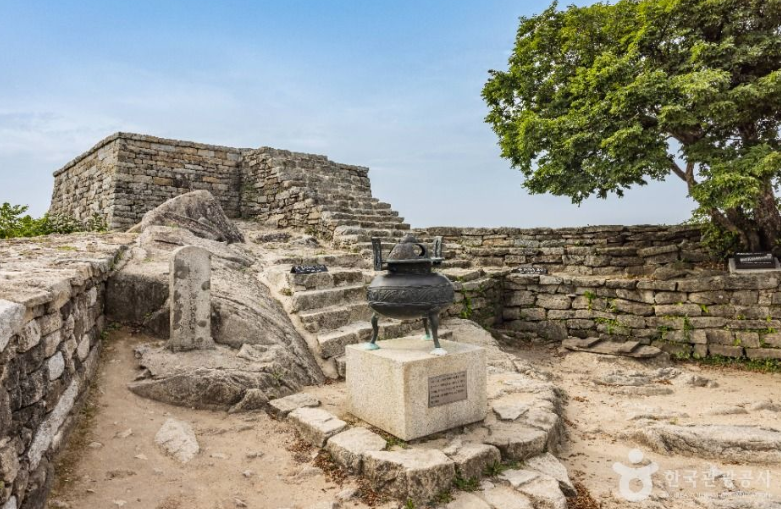
One of the most famous traditions associated with Gyeongjeongjeol takes place on Mount Manisan on Ganghwa Island. At the summit of the mountain stands the ancient Chamseondang altar. According to legend, Dangun himself built it to perform rituals and give thanks to the heavens.

On the holiday, a ceremony dedicated to Korea’s history and its legendary founder is held there. Solemn processions make their way to the event venue. This tradition is interesting in that it combines a modern national holiday with very ancient cultural motifs. For this reason, Manisan remains one of the symbolic places associated with Gyechondol.
What Else Happens on This Day
The program may vary in different cities across South Korea. Exhibitions, concerts, cultural festivals, and events dedicated to Korean history are held. At some events, scenes from ancient legends are reenacted, or stories about Dangun and Gojoseon are told. This allows people to learn more about the country’s history beyond what they find in textbooks.
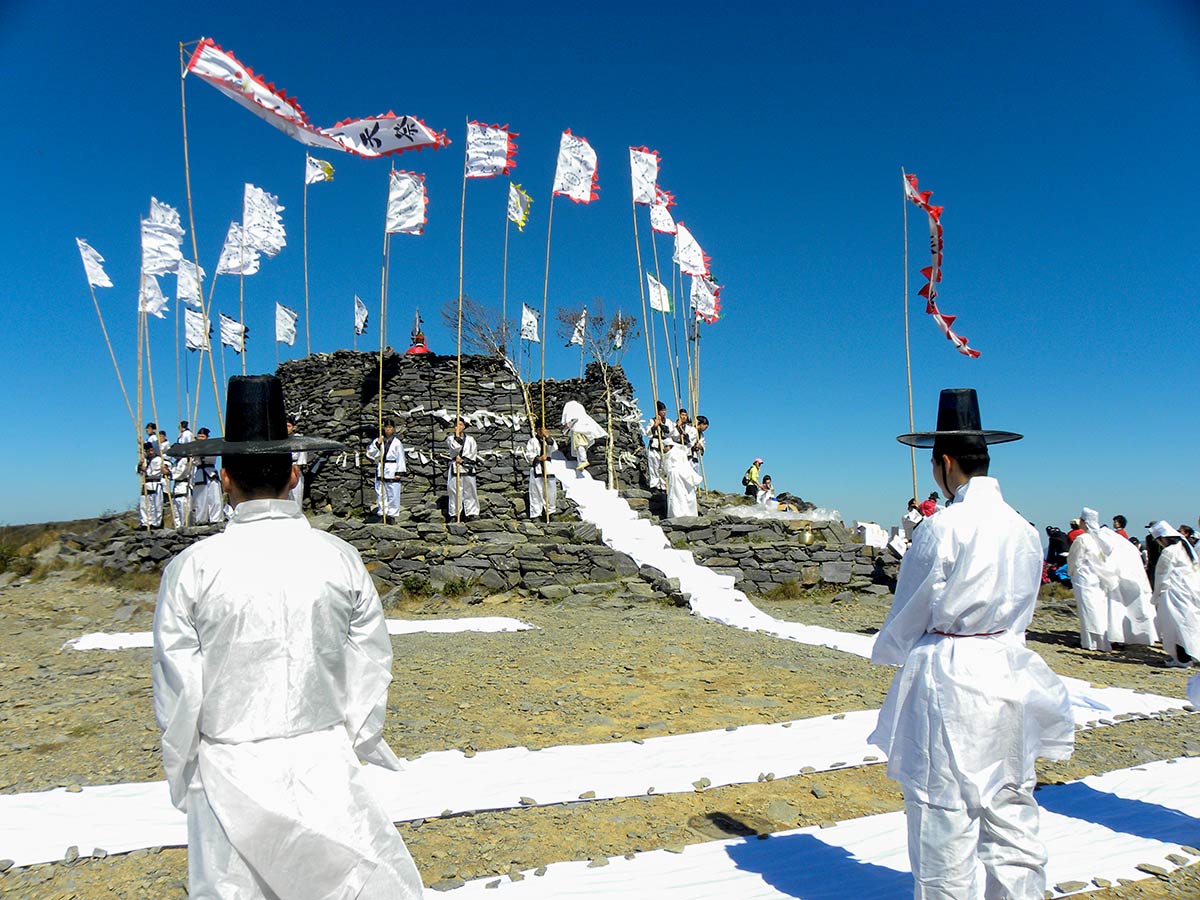
Traditional ritual events are also held. In some places, prayers or ceremonies are organized for the well-being of the country and its people. South Korean embassies abroad may also host formal receptions and cultural programs. For example, in 2026, the South Korean Embassy in Iran held a special reception dedicated to National Foundation Day and Armed Forces Day.
Is October 3 a holiday?
Yes. National Foundation Day is a national holiday in South Korea. In 2026, October 3 falls on a Saturday. Therefore, Monday, October 5, is a substitute holiday.

The South Korean Ministry of Employment and Labor explicitly states that in 2026, October 3 and October 5 are considered separate national holidays. In other words, the substitute holiday does not “cancel out” October 3 itself. For many people, this means an extra day off. At the same time, companies and employees who work on special schedules may have different working conditions in accordance with labor regulations.
Interesting Facts About National Foundation Day
Gojoseon should not be confused with modern-day North and South Korea. It was an ancient state traditionally associated with Dangun. Its name is often rendered as Gojoseon to distinguish it from the later Joseon Dynasty.
The date of 2333 BCE is derived from traditional lore. This does not mean that modern science has archaeological evidence confirming the existence of this particular state in that exact year. For modern Korea, this date holds primarily cultural and symbolic significance.
Gyeongjeonjeol is celebrated not only in South Korea. Korean diplomatic missions and Korean communities abroad also organize commemorative events.
The holiday is not solely tied to mythology. Official ceremonies also highlight modern values, particularly helping others and contributing to society.
The Taegukgi is also an important part of the celebration. During state ceremonies, participants display the national flag and sing the national anthem.
Why Is This Day Called “The Day the Heavens Opened”?
The name Gecheongjol comes from a Korean expression that is literally associated with “the opening of the heavens.” This refers to the legend of Hwanun, who descended from the heavenly realm to Earth. Therefore, in the traditional understanding, the holiday symbolizes more than just the founding of the state. It marks the beginning of a new era for the people who lived on the Korean Peninsula.
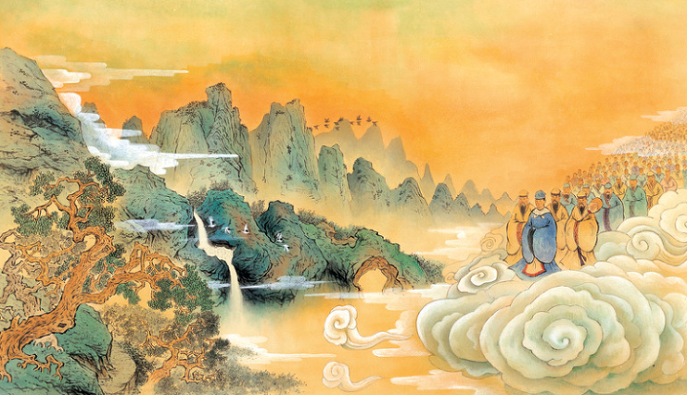
This is precisely why the image of the heavens remains an important part of the holiday’s symbolism. The legend of Hwanun, Ungnyeo, and Dangun has been passed down from generation to generation and remains one of the most famous Korean myths. In modern South Korea, this story is viewed first and foremost as part of the national cultural heritage. It helps explain why National Foundation Day remains so significant even thousands of years after the legendary events.
When Is National Foundation Day in 2026
In 2026, South Korea’s National Foundation Day will be celebrated on Saturday, October 3. It will be an official national holiday. Since the date falls on a Saturday, Monday, October 5, will be a substitute holiday.

Thus, for Koreans, this will be more than just a day of ceremonies and cultural events. Gaecheonjeol will once again serve as a reminder of one of the oldest legends in Korean culture—the story of Dangun and the founding of Gojoseon—and how this story has become part of modern national identity.




