
A Chinese test train accelerated to 800 kilometers per hour in 5.3 seconds
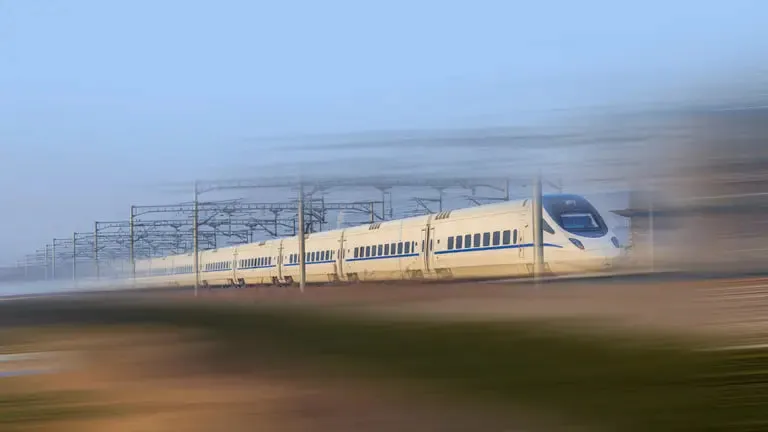
In China, an experimental maglev vehicle set a new acceleration record. The vehicle, weighing about 1.1 metric tons, was able to accelerate to 799.84 km/h in just 5.3 seconds on a test track.
During the tests, experts evaluated not only the maximum speed but also the system’s operational stability and the structure’s ability to withstand significant loads. The experiment was conducted on a special one-kilometer track in Hubei Province.
Maglev trains have been operating in China, Japan, and some European countries for several decades. They move thanks to magnetic coils that create an alternating electromagnetic field, lifting the car off the track and propelling it forward without friction against the rails.
Preliminary Tests
The Chinese Fuxing train remains the world’s fastest commercial maglev. It reaches a top speed of 349.23 kilometers per hour, and its average speed is 317.04 kilometers per hour on a 1,021.93-kilometer route.
The first public test run of the prototype car took place in June 2025. At that time, the train accelerated to 650.17 kilometers per hour in 7.1 seconds, and in July, engineers increased the top speed to 696.84 kilometers per hour. In November, the speed reached 798.23 kilometers per hour, and during the latest tests, the car accelerated to 799.84 kilometers per hour in 5.3 seconds.
What the latest tests showed
Achieving such results requires exceptional precision. At high speeds, the car becomes highly sensitive to even the slightest fluctuations, so track deviation must not exceed 0.5 millimeters. Control systems must also ensure ultra-precise positioning of the car within operating parameters.
A series of successful test runs validated several technological solutions at once. Experts tested the high-voltage power supply, levitation control, precise positioning, the electromagnetic propulsion system, and emergency braking.
Where this technology can be used
Conventional passenger transport at such speeds remains unlikely due to the high cost of infrastructure, significant electricity demands, and safety requirements. Therefore, engineers are exploring other areas of application.
Experts plan to adapt magnetic acceleration for launching cargo rockets, drones, and aircraft. Initial acceleration of vehicles before takeoff using maglev could reduce onboard fuel reserves. In addition, such electromagnetic systems could find applications in high-speed industrial transport systems and elevators.
Popular Science reports on this.
China has threatened the U.S. over new sanctions against Russia.
Earlier, Zelenskyy thanked the U.S. Senate for approving harsh sanctions against Russia.
The U.S. Senate has backed a sweeping bill imposing new sanctions against Russia and Iran. The bill passed with 68 votes in favor and nine against, and will now be considered by the U.S. House of Representatives.


