
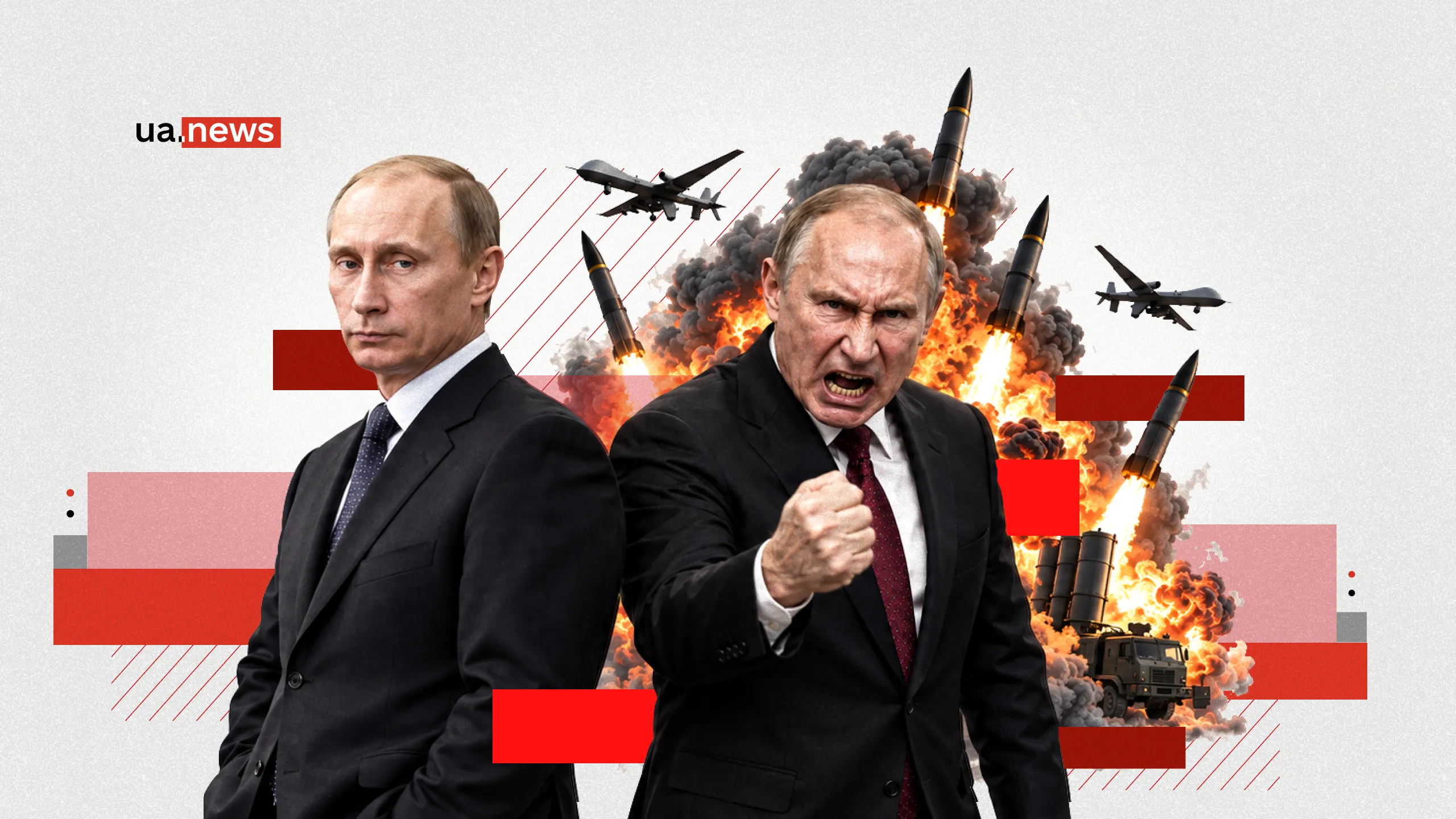
Today, October 7, 2026, Vladimir Putin turns 74. This date, which is a sad one for every Ukrainian, is actually a good occasion to reflect on who he used to be and what his path to power has been like. The Russian leader has come a long way from being a liberal and pro-Western figure who continued Boris Yeltsin’s democratic course to the present day: a dictatorship, an endless bloody carnage in Ukraine, and a permanent confrontation with the West, which the Kremlin leader also regularly threatens with a nuclear apocalypse.
How did Vladimir Putin become who he is today? What was his path to absolute power, and Russia’s path to a gradual abandonment of democracy and a transition to autocracy? UA.News political analyst Mykyta Trachuk examined the issue.
The Path to Power: A “Gray” KGB Bureaucrat Tasked with Continuing Democratic Reforms
In the 1990s, Vladimir Putin was an aide to Anatoly Sobchak, the mayor of St. Petersburg and a well-known democratic politician. He was very close to Sobchak and shared his ideas. But even then, there were rumors—and even published reports—about “shady schemes” in St. Petersburg’s ports, Putin’s ties to the “Northern Palmyra” organized crime group of that era, and so on.
In the mid-1990s, a group of deputies from the Leningrad Regional Council even conducted a special investigation into Putin’s activities regarding the issuance of licenses for the export of raw materials and non-ferrous metals. St. Petersburg lawmakers accused Putin of abuse of power and corruption. Specifically, the commission’s report cited the issuance of a license to export raw materials abroad in exchange for food supplies that never actually reached the city.
Sobchak was even advised to remove Putin from office. However, the matter was swept under the rug: it was the “turbulent ’90s,” and many simply didn’t care.

Later, Putin—a former KGB officer—became head of the FSB, which is essentially the same agency. He had previously graduated from the law faculty of Leningrad University and then spent 15 years in the KGB, including a stint in East Germany. This experience as an intelligence officer left its mark on his entire subsequent reign: the ability to work behind the scenes, manipulate information, use compromising material, and put the interests of “his own” above all else. On July 25, 1998, by decree of Yeltsin, he was appointed director of the Federal Security Service of Russia.
In 1999, Yeltsin, together with “The Family” and his close oligarch associates, decided to step down and name Putin as his successor. He was considered a “gray,” submissive, unambitious bureaucrat who would continue the previous course toward democracy, market reforms, and the integration of the Russian Federation with the West, serving as a compromise figure for all influential groups in Russia at the time. St. Petersburg Mayor Sobchak, whom Putin had even secretly smuggled out of the country when a case was being prepared against him in 1997, later said:
“I understand why Yeltsin chose Putin as his successor—he will never betray you. But I also understand that, once he gains power, Putin will never give it up to anyone.”
Those words proved prophetic.
On December 31, 1999, Yeltsin resigned, uttering his famous words, “I’m tired, I’m leaving.” The path to the presidency was now open for Putin.

At the Dawn of Absolute Power: The Mask of a Democrat and the First Warning Signs
At first, Putin remained democratically minded—at least in public. He said all the right things, ostentatiously befriended the West, maintained normal relations with Russia’s neighbors, and so on. In March 2000, he won the election convincingly and, most importantly, fairly, receiving over 52% of the vote, and Western leaders hailed this result as evidence of the Russian people’s democratic choice. Even during the election campaign, he stated that “Russia is part of European culture” and that he could not imagine his country isolated from the “civilized world.”
But even then, his authoritarian tendencies were becoming apparent. The first victim was independent journalism: Putin began systematically restricting constitutional freedoms immediately after coming to power, and television—in particular, the well-known ORT channel with its program hosted by the iconic journalist Sergei Dorenko—was the first to be brought under state control. Without control over the media, the Russian president would not have been able to secure public support for a new brutal war in Chechnya.
The Second Chechen War—which, to be fair, did begin with a series of terrorist attacks by militants from “Imarat Kavkaz”—became a tool for Putin to consolidate power around the image of a “strong leader.” According to the Levada Center, as early as August 1999, Putin’s approval rating stood at just 31%, but by November it had soared to 80%. The war in Chechnya and Putin’s infamous remark, “We’ll flush them down the toilet,” transformed the then-little-known official, the head of the Russian government, into nothing short of a national leader—at the cost of thousands of lives and the gradual destruction of democratic institutions.

Then came the Yukos case. In October 2003, FSB special forces seized the plane of Mikhail Khodorkovsky, the head of the country’s largest oil company, who had openly opposed Putin. This was not merely a blow against an oligarch, but a concrete demonstration that any independent center of power would be destroyed.
Ironically, most Russians supported this move, as they viewed the oligarchs as “parasites” who were plundering the nation’s wealth. Putin then publicly called for an end to the “speculation and hysteria” surrounding the Yukos case, emphasizing that supposedly “everyone is equal before the law.” But in reality, this was a clear signal: independent political and economic forces would no longer have a say.
Putin’s second term, from 2004 to 2008, is also relevant to this analysis. Massive economic growth driven by the market reforms of the 1990s, as well as a significant rise in oil and gas prices, allowed the Russian president to finance nearly all of his policies and “whims,” including the rearmament of the army. It is worth noting that back then, in the mid-2000s, he did not yet come across as a dictator. If anything, he was a tough leader—not so much authoritarian as principled and strong, yet one who did not cross certain “red lines.”
But the 2007 Munich speech was already a very serious wake-up call. On February 10, 2007, Putin spoke at a security conference in Munich, where he harshly criticized the model of a “unipolar world,” placing the primary blame on the United States for disregarding the norms of international law. Over the years, it became clear that this speech was both programmatic and historic. Some of the most perceptive journalists even then compared it to Churchill’s Fulton speech, which marked the beginning of the Cold War. But the West, though somewhat taken aback, ultimately simply pretended it hadn’t happened—just as, incidentally, it turned a blind eye to the regular, strange, and still unsolved murders of opposition journalists such as Anna Politkovskaya.
And a year later, Russia invaded Georgia. The West reacted half-heartedly, and it was precisely this, it seems, that later emboldened Moscow to further aggression.

Putin’s
Third Term: The Final Transformation into a Dictator
After two terms, Putin formally stepped down from the presidency. Dmitry Medvedev was in power: today he comes across as a bonafide madman, but back then—though it’s hard to believe—he was a thoroughly liberal and pro-Western leader. And that could have been the end of it, and Putin could have gone down in history as, frankly speaking, a rather decent and quite successful head of the Russian state. However, he decided to return for a third term. From that moment on, it became clear that he had transformed into a full-fledged authoritarian ruler.
His return to the Kremlin in 2012 was accompanied by unprecedented street protests. Putin tolerated them during the election campaign, allowing marches through Moscow demanding his resignation. But on the eve of the inauguration, he sent a strong signal to the opposition. As tens of thousands of people marched toward Bolotnaya Square, clashes broke out with OMON: hundreds were arrested. On May 6, 2012, the day before Putin’s inauguration for his third term, the “March of a Million” took place in Moscow, ending in mass arrests, the “Bolotnaya case,” and dozens of criminal proceedings. This marked the end of Putin’s patience and the end of his “democracy” charade.

Since 2012, Russia has passed law after law, systematically restricting the rights and freedoms of its citizens, at times seemingly deliberately seeking confrontation with the West. New fines for public gatherings, pressure on nongovernmental organizations, control over internet access, and laws against insulting officials and the authorities—all of this constituted a targeted assault on civil society. Putin was no longer paying lip service to liberal values: he was rapidly and deliberately building a system in which any resistance would be suppressed.
And then came 2014: Maidan, Crimea, Donbas. This was already a very specific path in a very specific direction. After the annexation of Crimea, Putin addressed the Federal Assembly, where he once again made it clear to the whole world exactly what he really thinks. During his “Crimea speech” on March 18, 2014, he spoke about how Russia had allegedly been disrespected after the collapse of the Soviet Union, about how Russians had been “oppressed” and “crushed” their entire lives—and declared that this would never happen again.
Subsequently, the regime’s repressive nature, belligerence, and irrationality intensified. But a final break with the West (and what remained of common sense) and a complete transformation into a dictatorship had not yet occurred, despite everything.

From 2022 to the Present: Full-Scale War and Dictatorship
Everything changed irrevocably on February 24, 2022. Full-scale aggression against Ukraine has been ongoing for over 4.5 years. There are no protests in Russia, nor is there any opposition. The only anti-war party—“Yabloko”—was barred from the recent elections. And in February 2024, opposition figure Alexei Navalny, who was serving a 19-year sentence on fabricated political charges, was killed in prison. Back in 2022, while already behind bars, Navalny described Putin as a “vicious madman with a nuclear bomb” and reminded everyone that “the path that begins with slightly rigged elections always ends in dictatorship, and dictatorship ends in war.” The years have shown that the politician was absolutely right.
Constant nuclear rhetoric and corresponding threats have become the norm of late Putinism. In November 2024, Putin approved Russia’s updated nuclear doctrine, which lowers the threshold for the use of weapons of mass destruction. Constant acts of sabotage and cyberattacks against the EU are another dimension of this war. Moscow views various types of hybrid and covert operations as a full-fledged tool of modern confrontation.
And so here we are: October 7, 2026. Putin is 74. For his age, he is, unfortunately, in fairly good shape. He may remain in power for quite some time yet—and continue the war for just as long.

Russian opposition figure Gennady Gudkov once noted that Putin “intends to live forever,” investing time and resources into various methods of rejuvenation and life extension. The Russian leader spoke about this very topic not long ago with Xi Jinping, expressing his desire to “live to be 150 years old.” It seems the Russian dictator doesn’t even want to entertain the thought that he is an ordinary biological human being who will also die someday.
In summary, Putin’s story is that of a man who rose “from rags to riches,” climbing from the ranks of obscure bureaucrats to the pinnacle of absolute power. He began as a pro-Western liberal, a continuator of Yeltsin’s policies and a supporter of democratic reforms in Russia, but eventually became a dictator waging an endless war and threatening the world with nuclear weapons. And so far, there are no signs that this trajectory will change.




