
Mexican physicist to lead development of muon detector for ALICE 3 at CERN
Mexican physicist Antonio Ortiz Velasquez has been selected to lead the development of the Muon Identifier Detector (MID) for the future ALICE 3 version of the experiment at the European Organization for Nuclear Research CERN. The device is planned to be manufactured in Mexico and installed at CERN, Mexico News Daily reports.
Project for ALICE 3
The MID is included in the baseline design of ALICE 3, the future version of one of the four main experiments at the Large Hadron Collider. However, the Mexican project is not yet guaranteed to be implemented at CERN: the team needs to secure funding, complete design and construction work, and pass technical reviews.
If the device is built and approved, Mexican institutions will be responsible for one of ALICE 3's central subsystems. According to the National Autonomous University of Mexico, the appointment of Ortiz Velasquez, a senior researcher at UNAM's Institute of Nuclear Sciences, was approved by the ALICE collaboration board. The university said he became the first Mexican scientist entrusted with leading the development of a strategic ALICE 3 subsystem.
More current news is available on the UA.News Telegram channel Telegram.
Research into the early Universe
The MID is intended to track muons, particles capable of passing through a significant part of the detector after a collision. Their trajectories may help researchers study a short-lived superheated state of matter that scientists believe existed immediately after the Big Bang. Ortiz Velasquez explained that the team recreates small droplets of matter from the early Universe and studies the traces they leave in particle detectors.
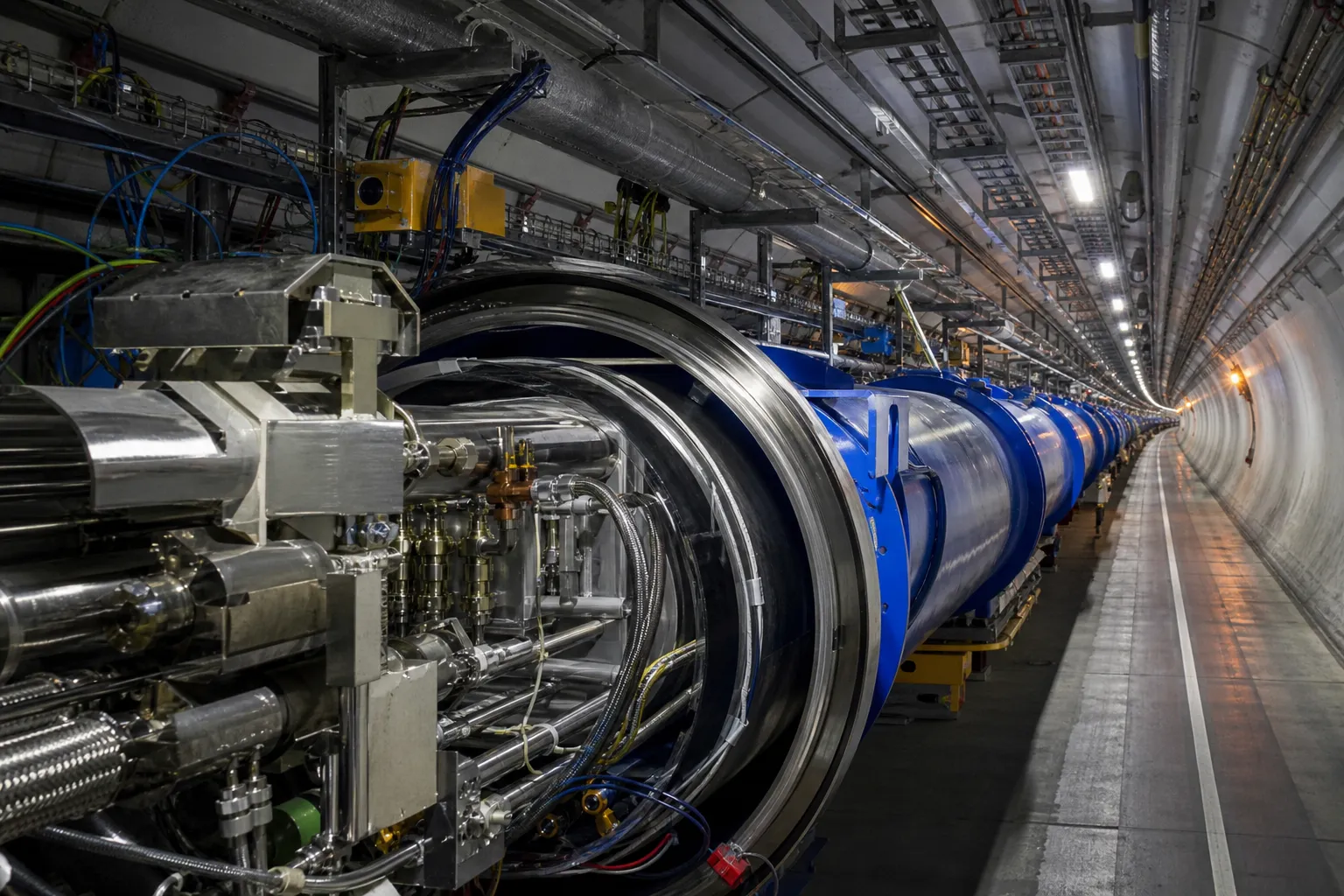
The Large Hadron Collider is a 27-kilometer circular particle accelerator located beneath part of the French-Swiss border near Geneva. It accelerates beams of protons or electrically charged atomic nuclei to nearly the speed of light and collides them. Collisions of heavy atomic nuclei can briefly create matter similar to that which existed in the early stages of the Universe's development.
The team expects to begin construction of the detector in Mexico in 2028. The facility is scheduled to begin operating in 2036. The project involves researchers from UNAM, the Center for Research and Advanced Studies, the Autonomous University of Puebla, the Autonomous University of Sinaloa, and the National Technological Institute of Mexico, as well as partners from the United States, Hungary, the Czech Republic, and Pakistan.


