
The German Ministry of Defense plans to order hundreds of Boxer armored vehicles
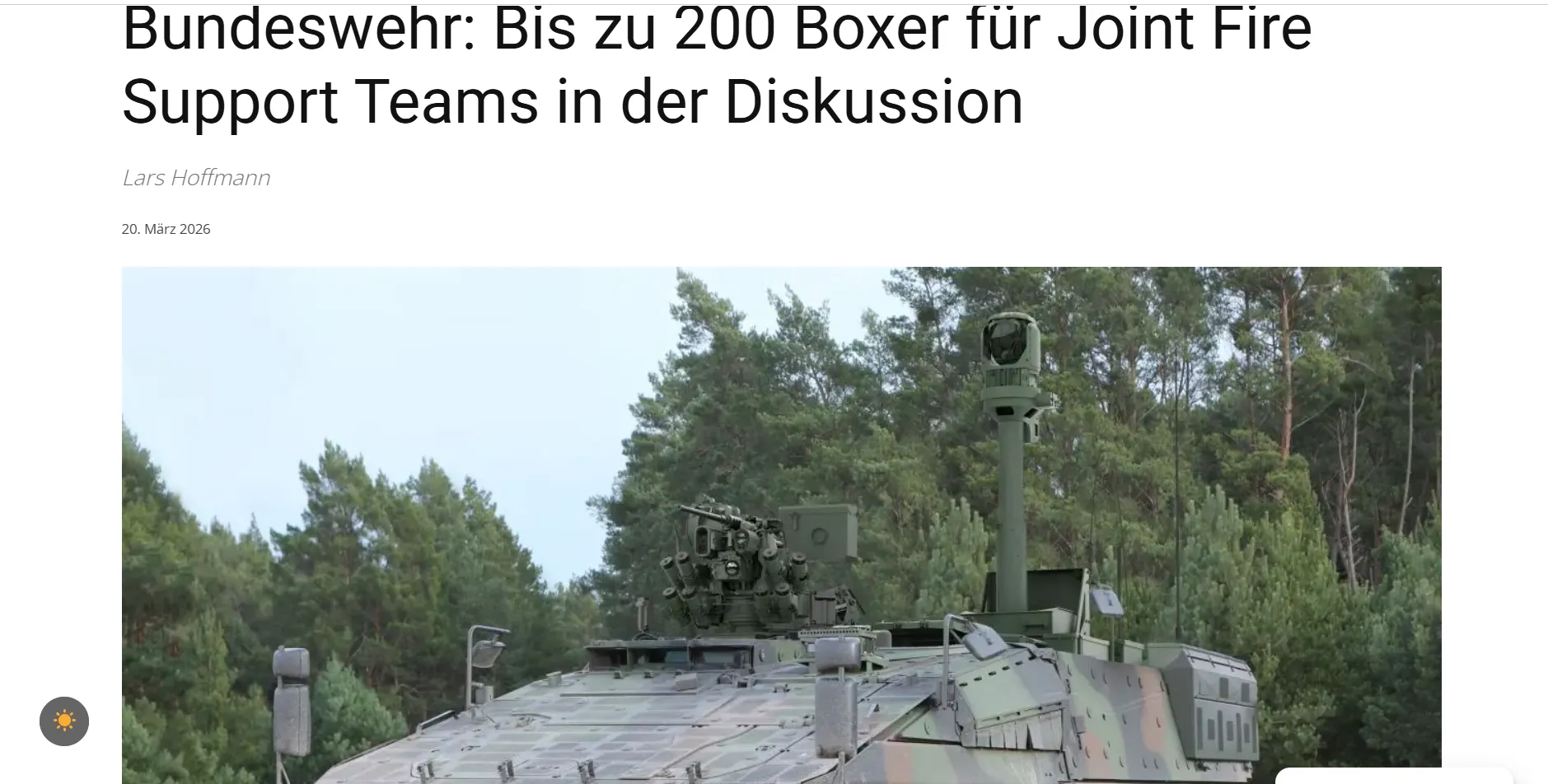
The German Ministry of Defense is considering a large-scale procurement of specialized armored vehicles for the Bundeswehr.
This involves the purchase of 150 to 200 Boxer wheeled armored vehicles equipped with the modern PAAG optical sighting system.
According to the German publication Hartpunkt, the Boxer variant with the PAAG system is not intended for direct engagement with the enemy.
It is auxiliary reconnaissance equipment, the main task of which is to detect targets and “illuminate” them with a laser designator.
Such coordination allows high-precision ground- and air-based weapons to effectively destroy enemy targets.
However, performing these functions requires the vehicle to be present directly on the front lines, which poses significant risks to the crew and expensive equipment.
Ukrainian experts from the Defense Express project are critical of the choice of this particular platform for a modern guidance station.
Although the PAAG system is a cutting-edge technological solution, its deployment on the Boxer platform raises many questions due to the vehicle’s size.
“The actual task of the Boxer with PAAG will be to approach the front line, where it will be immediately spotted and become a priority target for destruction. And if it’s lucky—to try to locate and illuminate the target with a laser until it is hit,” note Defense Express analysts.
Experts draw particular attention to the armored vehicle’s vulnerability to modern threats, specifically the widespread use of FPV drones.
The Boxer has relatively light armor that is not designed to withstand direct hits from heavy weapons or loitering munitions.
By 2026, when the battlefield is fully “drone-ified,” the use of large manned vehicles for laser guidance appears to be a somewhat outdated approach.
Analysts emphasize that such systems are much more effective when mounted on compact, unmanned robotic platforms.
“In 2026, with the battlefield clearly becoming drone-dominated and the need for weapons capable of operating beyond line of sight, such aircraft appear archaic, and the rationale for ordering as many as 150–200 units clearly requires explanation,” military experts conclude.
As a reminder, Germany has simplified arms export procedures for Ukraine and the Gulf states.
Pistorius also embarked on a tour of Asia to conclude defense agreements.
