
A 1,000-year-old silver ring bearing mysterious runes has been discovered in Britain
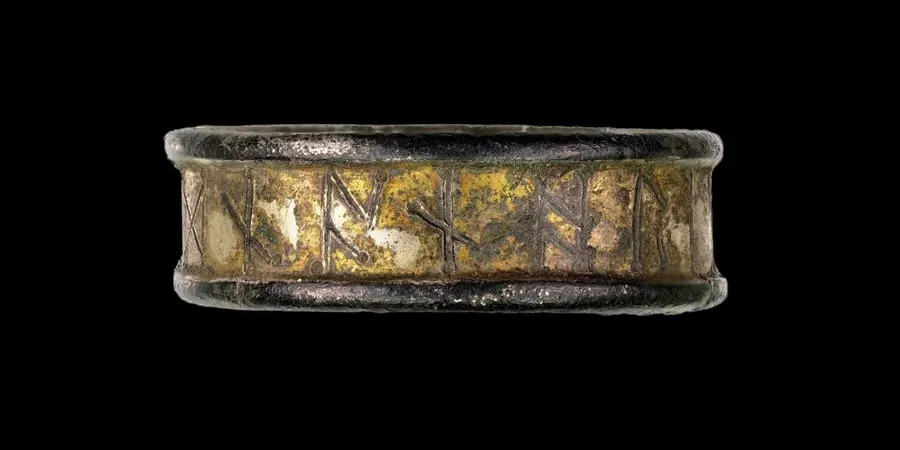
Polish treasure hunter Rafał Wesołowski discovered a silver ring dating back approximately a thousand years in a field in Lincolnshire. The ring bears mysterious runes that have not been seen for over a millennium.
The find is already being called unique, as it may contain important clues about the language and culture of ancient times.
This is reported by Heritage Daily.
At first glance, it is simply a ring with a diameter of just over 23 mm. But take a closer look, and an incredible sight unfolds on the outer surface: 16 runic symbols engraved with jeweler’s precision. Each line ends with a tiny dot—a technique that early medieval craftsmen used only for the most expensive commissions.
Martin Findell and Jasmine Higgs, researchers from the University of Nottingham who undertook the study of the artifact, are still scratching their heads. The inscription begins with a cross and contains special punctuation marks, but exactly what is written there remains a mystery.
“When I held it in my hands, I didn’t just see a piece of jewelry. I felt that someone a thousand years ago wore this ring as something very personal, perhaps as protection or a magical spell,” Rafal shares his impressions.
Archaeologists compare this find to the famous Kingmore ring. Those rings often did not bear the owners’ names. Instead, magical formulas were engraved on them—a sort of “antivirus” of that time, meant to protect against illness, the evil eye, or misfortune in battle.
The craftsmanship (those same dots at the ends of the lines) is identical to another treasure from the British Museum—the Whitley Hill ring. This suggests that in the 8th–10th centuries, a very specific jewelry tradition existed in this region, accessible only to the upper echelons of society.
Lisa Brandl, an officer with the Portable Antiquities Scheme (PAS), is certain: this find is just the tip of the iceberg. In addition to the ring, an Anglo-Saxon buckle was found in the same field. Together, these items suggest that a previously unknown settlement of the true “intellectual elite” of that time may have existed in Quadring.
As a reminder, in Switzerland, the cargo of a Roman ship containing hundreds of artifacts was recovered.
Also, in the Vinnytsia region, a man found artifacts from Roman times and tried to sell them.


