
Scientists say Nepal flood exposed limits of adaptation — Climate Home News
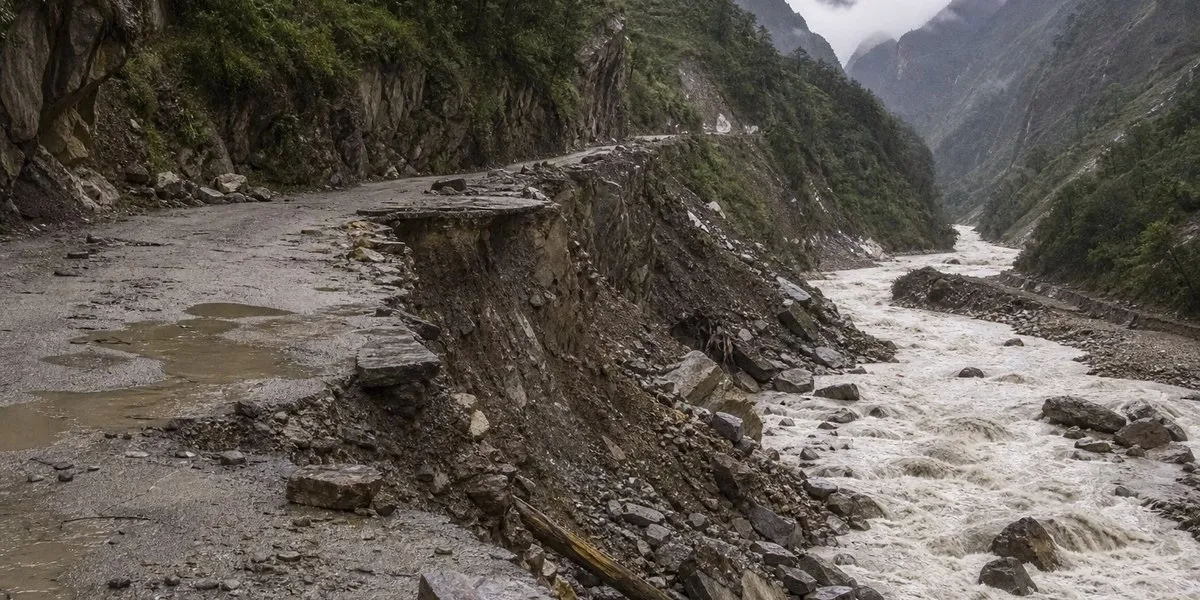
In Nepal, on the border with Tibet, a sudden flood caused by a rock-ice avalanche demonstrated the limits of adaptation to climate risks. As Climate Home News reports, researchers from the international World Weather Attribution (WWA) group said authorities had very little opportunity to prevent deaths and destruction.
The avalanche began on the morning of August 26 beneath a glacier. Large masses of rock and ice fell more than a kilometre to the valley floor, swept up other debris and turned into a flow that moved downstream along the Nepal-Tibet border. The flow entered the narrow Lhende Khola river gorge and swept through the Gyirong border crossing at a speed of 170 km/h.
Casualties and destruction
The flood swept through villages, roads, bridges and hydropower facilities. More than 1,300 people died in Nepal, while another more than 5,000 are considered missing. At least 40 people died in Tibet, administered by China. People in elevated areas far from the river mostly survived, but because of the speed of the flow, many residents received no warning to find shelter or reach a safer place.
According to the Nepalese government, more than 7,500 houses, 105 bridges, 48 public buildings, 47 cultural heritage sites, 18 schools, 13 hydropower facilities and seven medical institutions were damaged. In total, more than 30,000 people were affected by the disaster.
More current news is available on the UA.News Telegram channel Telegram.
Difficulty of forecasting
WWA noted that rock-ice avalanches are difficult to forecast because such phenomena are insufficiently studied and methods for monitoring them are still being developed. Study co-author Walter Immerzeel, a professor of mountain hydrology at Utrecht University, said it was impossible to predict this disaster using available methods.
According to him, remote sensing, radar interferometry, field sensors, drones, seismometers, water-level measurements and surveillance cameras may help identify dangerous areas in the future. At the same time, monitoring thousands of glaciers in the Himalayas will require significant investment, international cooperation and coordination.
WWA co-founder Friederike Otto said climate change was one of the factors behind the disaster, and local adaptation cannot fully protect people downstream from destruction on such a scale. Nepal requested emergency funding from the UN Fund for Responding to Loss and Damage; the country estimates recovery and reconstruction at $4.8 billion. Members of the fund's board informally discussed the possibility of allocating up to $20 million, but no decision has yet been made.


