
Germany has criticized the closure of its funds in Georgia
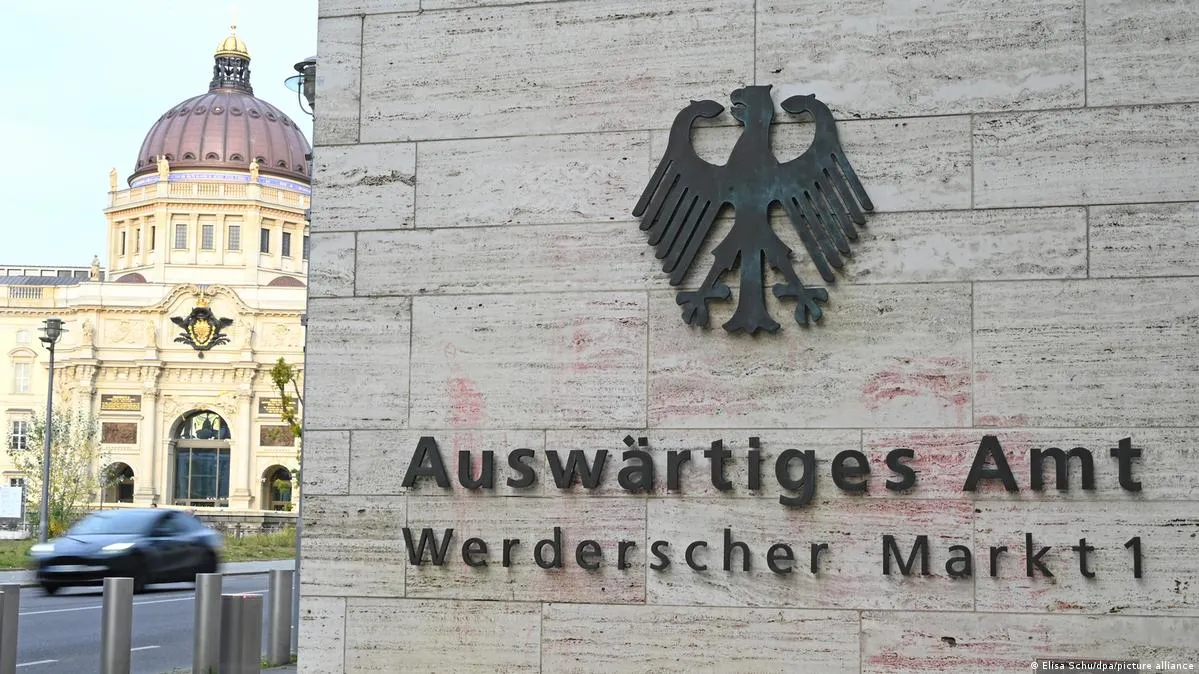
The German government has criticized Georgia’s decision, which led two German political foundations to close their offices in Tbilisi. Officials in Berlin stated that this is a great loss for Georgian society and that the current course of the Georgian government is increasingly distancing the country from the EU.
Germany reacted to the closure of the Konrad Adenauer Foundation and the Friedrich Naumann Foundation’s offices in Georgia. Both organizations ceased operations at their offices in Tbilisi after the Georgian authorities rejected their applications for project funding. Martin Giese, a spokesperson for the German Foreign Ministry, called the situation “a great loss for Georgia and Georgian society.”
According to him, the German Foreign Ministry is closely monitoring the situation and maintaining contact with the political foundations. Giese emphasized that they had been working in Georgia for many years and, in Berlin’s assessment, had made a significant contribution to the development of democracy and civil society. The German Foreign Ministry also stated that it had clearly conveyed to the Georgian authorities its “complete lack of understanding regarding the reasons” behind the decisions.
Why the foundations closed their offices
The Friedrich Naumann Foundation stated that the Georgian authorities demanded that it coordinate certain aspects of its work and align its programs with state priorities. The organization believes that under such conditions, it could not continue to operate in accordance with its principles. The foundation submitted an application to continue its work in 2026 in accordance with Georgia’s new legislation on foreign grants. However, on July 28, the Georgian authorities rejected the application.
Following this, the foundation stated that it no longer saw any possibility of operating in the country as it had before. The office in Tbilisi closed on September 30. A similar situation arose with the Konrad Adenauer Foundation. The foundation stated that the decision to close was a direct consequence of the political and legal conditions created by the Georgian authorities. The foundation noted that the German government had also attempted to secure the possibility of continuing its work in Georgia. However, these efforts were unsuccessful.
Representatives of the foundation explained that it simply made no sense for them to remain in the country without the ability to carry out their core work. The Konrad Adenauer Foundation had been operating in Georgia since 2003. Its activities focused, in particular, on democracy, the rule of law, parliamentary institutions, and European dialogue.
The Friedrich Naumann Foundation had been operating in the country even longer—since 2002. During that time, it collaborated with local organizations and representatives of liberal political circles. Both organizations stated that even after closing their offices, they do not plan to completely sever ties with Georgia. The Adenauer Foundation, in particular, wants to maintain ties with its partners and retain the option of returning to the country should political conditions change.
Berlin is once again discussing Georgia’s path toward the EU
A spokesperson for the German Foreign Ministry also linked the situation to the broader policies of the Georgian government. According to him, Georgia is experiencing a complex domestic political crisis. Against this backdrop, the country has suspended negotiations on accession to the European Union.
Berlin warned that continuing the Georgian government’s current course “will sooner or later become incompatible with maintaining its status as a candidate for EU membership.” At the same time, this does not mean an automatic loss of candidate status. The German side is highlighting the potential consequences of the Georgian government’s future course of action.
Germany has already suspended joint projects
Philipp Geiger, a representative of the German Ministry for Economic Cooperation and Development, recalled that Berlin had previously supported Georgia’s European course. However, the German government believes that under current political conditions, such cooperation has become significantly more difficult. Back in December 2024, the German ministry suspended joint projects with Georgia. Their total value amounted to 237 million euros.
According to Geiger, this was Berlin’s response to the Georgian government’s decision to abandon its course toward closer ties with the EU. At the same time, two other German political foundations—the Friedrich Ebert Foundation and the Heinrich Böll Foundation—are continuing their work in Georgia for now.
Thus, the closure of the two German foundations marks yet another episode in the deterioration of relations between Berlin and Tbilisi. Germany links the situation not only to the work of the foundations themselves but also to the broader issue of Georgia’s political course and its relations with the European Union. DW reports on this.
As a reminder, the European Commissioner stated that Ukraine will not receive preferential terms for EU accession.
The European Commission will allocate €130 million for drones to strengthen border control.
Bulgarian Prime Minister Rumen Radev stated that Europe should reconsider the balance between military, economic, and diplomatic tools and prioritize diplomacy in its relations with Russia. According to him, further escalation could lead to the risk of a Russian nuclear strike.
NATO Secretary General Mark Rutte stated that the North Atlantic Alliance does not see an immediate threat to its territory and views nuclear blackmail by Russia as an attempt to divert attention from its own defeats in Ukraine.




