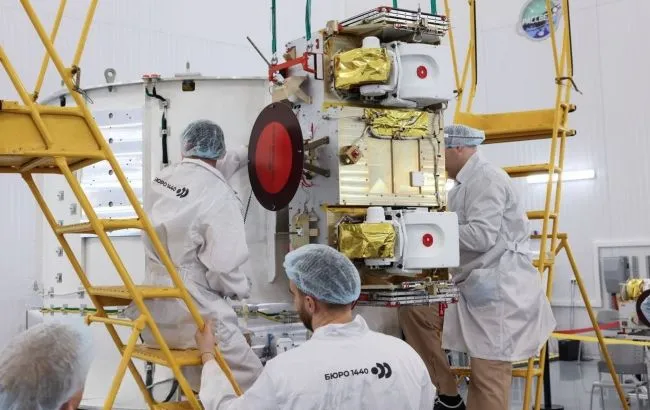
Russia is developing its own satellite system, “Rassvet,” which is positioned as an equivalent to the American Starlink. More than 1,300 companies are working on the project, but most of the key suppliers are not yet subject to U.S. or EU sanctions.
The main developer of “Rassvet” is the Russian company “Bureau 1440.” However, the company does not have a full production cycle for satellites and ground equipment. In fact, “Bureau 1440” fulfills several roles at once: it coordinates the work, procures the necessary components, and integrates them into a finished system.
The company’s only in-house production is for solar panels, which are manufactured by its subsidiary, Labs 1440. The Russians obtain the rest of the parts, equipment, and services from a large network of contractors. According to the investigation, this network already includes more than 1,300 companies.
Who Receives the Most Money
Analysts singled out 150 companies through which the largest payments pass. Among them are 21 main suppliers. In 2025, each of these 21 companies received more than 100 million rubles from “Bureau 1440.” In total, they were paid 7.4 billion rubles, or about 89 million dollars.
But there is an important detail. Of the 21 major suppliers, only five are already subject to Western sanctions. This list includes Sotis, RPC Micran, Elesar Group, Rezonit, and OKB “Fakel.” The latter company is a subsidiary of Roscosmos and likely supplies engines for the “Rassvet” satellites. In 2025, it received approximately $1.86 million from “Bureau 1440.”
Most Key Suppliers Are Not Subject to Sanctions
The other 16 companies on the main list continue to operate without restrictions from the U.S. or the European Union. The Russian company Pallada LLC received the most money in 2025. It was paid 1.6 billion rubles, or about $18.9 million. The company imports a significant portion of its products from China.
Belarusian Aerospace Instruments CJSC received another $8.3 million. The company is involved in research and development. Other major suppliers not subject to Western sanctions include:
RPE “TEKS” LLC — $3.64 million;
Aquamash Production Association JSC — $3.62 million;
Alternative Solutions LLP from Kazakhstan — $2.5 million;
Radio Gigabit LLC — $2.18 million;
Belrobot CJSC from Belarus — $1.93 million;
Newton Steel LLC — $1.8 million;
Macro Solutions LLC — $1.58 million;
SPC “Small Spacecraft” LLC — $1.42 million;
Labs 1440 JSC — $1.35 million;
El-Optics LLC — $1.21 million.
The latter company supplies telecommunications and laser equipment.
Ukraine has already imposed sanctions against some of these companies
There is another problem. Four major suppliers to “Rassvet” are already subject to Ukrainian sanctions, but there are no restrictions against them from the U.S. or the EU. These include Infostera LLC, which received approximately $3.94 million; MicroEM Component LLC — $3.44 million; Yue Tech JSC — $1.7 million; and Keldysh Research Centre JSC — $1.31 million.
According to the Center for Defense Reforms, this discrepancy between the sanctions lists allows Russia to continue purchasing the necessary components. In other words, a company may be restricted by Ukraine but still be able to do business with other countries and international suppliers.
Why Does Russia Need “Rassvet”?
“Rassvet” is a Russian low-Earth orbit satellite system project. It is being developed by “Bureau 1440.” The stated goal is to provide high-speed satellite internet. Russia plans to use the system for both civilian and military purposes.
This is precisely why the project is of strategic importance to the Russian Federation. Its own satellite network could provide Russians with an independent communications channel that does not rely on foreign systems. At the same time, the scale of the supply chain demonstrates just how many companies are involved in the creation of the Russian system. According to the investigation, this already includes more than 1,300 companies, and a significant portion of the main suppliers remain outside Western sanctions lists.
Thus, “Rassvet’s” vulnerability may lie not only in Russia’s technological dependence on certain components, but also in how effectively international sanctions block access to those components.