
The Soviet spacecraft landed on Venus and measured its own cover instead of the planet's surface
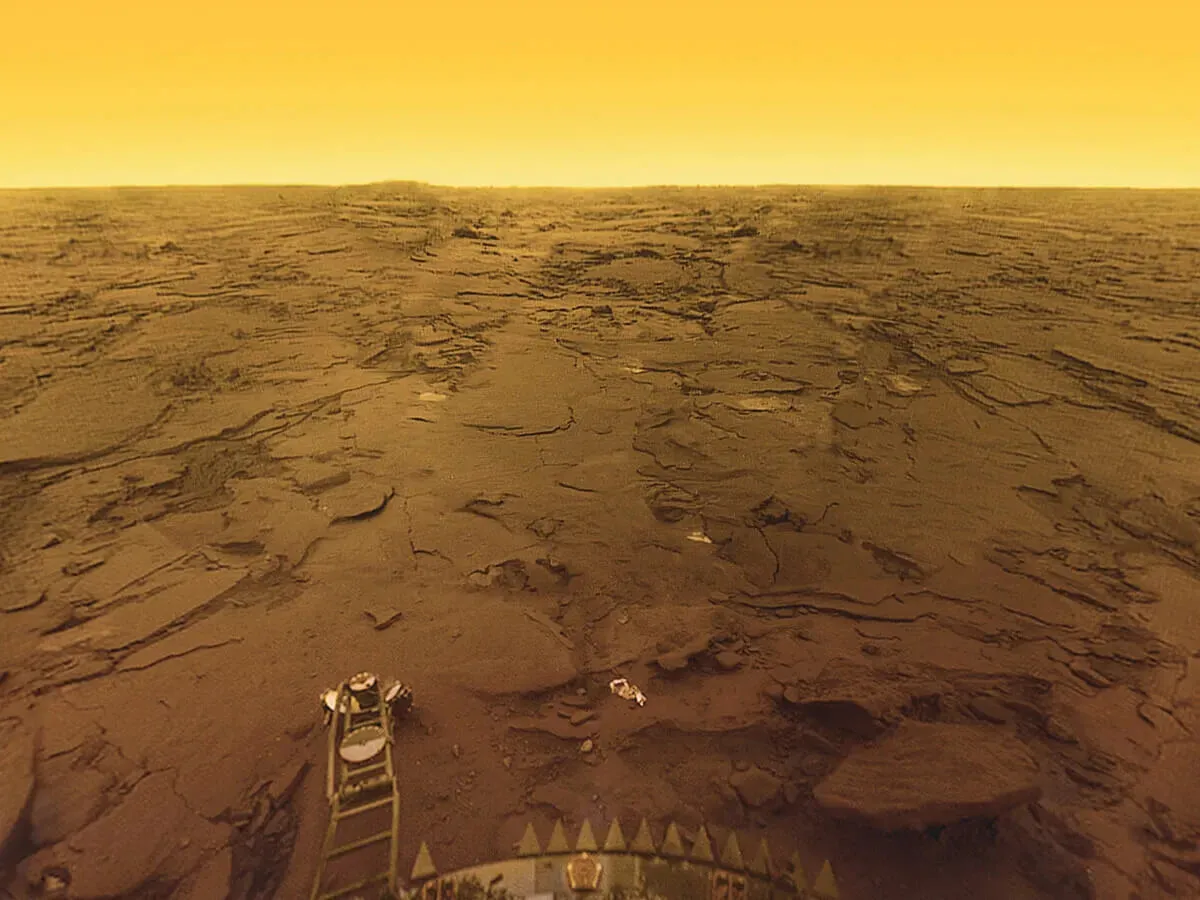
The Soviet “Venera-14” landing module passed through Venus’s hellish atmosphere, reached its surface, and then, as a result of an unforeseen technical error, measured its own cover instead of the planet’s surface.
This incident significantly disrupted the planned course of scientific research.
In 1981, the Soviet Union launched spacecraft to Venus with the goal of remaining on the planet’s surface long enough to transmit scientific data. The “Venera 13” and “Venera 14” landers successfully touched down in March 1982.
They encountered Venus’s extremely harsh conditions: a surface temperature of 870 degrees Fahrenheit, atmospheric pressure 90 times that of Earth’s, and clouds of sulfuric acid.
When designing the Venera spacecraft, Soviet engineers assumed that the landers would eventually fail.
This was practically a foregone conclusion. Therefore, the goal was modest: to delay their failure long enough for the probes to transmit scientific data back to Earth.
The designers understood that a prolonged stay of the equipment in such a hostile environment was absolutely impossible.
The “Venera” itself was built as a titanium-reinforced, airtight hull with a thick metal shell and a heavily insulated interior—something like a giant thermos or a deep-sea submarine.
This complex and ultra-strong engineering design was intended to provide short-term protection for the sensitive onboard electronics against the immense external pressure and high temperatures.
At the same time, Venus’s atmosphere was so dense that it rapidly slowed the spacecraft down.
Parachutes were deployed to extend the survival time, but they also increased the time the spacecraft spent in the scorching atmosphere.
Therefore, the Soviet solution was to cut the parachutes at an altitude of 31 miles above the surface; the spacecraft was deliberately made to descend rapidly, as a gradual descent would have been fatal.
The main objective of the probes, aside from short-term survival, was to collect data. The color cameras aboard Venera 13 provided the first color panoramas of another planet’s surface.
The images showed orange-brown volcanic rocks, a hazy yellow sky, and flat basalt slabs. Microphones recorded the wind, the sounds of drilling, and mechanical impacts.
More than forty years later, the data collected by the probe remains among the few direct images and recordings from Venus.
The popular historical and analytical website 19fortyfive shares unique details about the mission and a historical curiosity.
Scientists Have Figured Out Why Venus Is So Inhospitable
American scientists have proven that life may once have existed on Venus


