
Russia has launched the nuclear-powered cruiser Admiral Nakhimov for sea trials
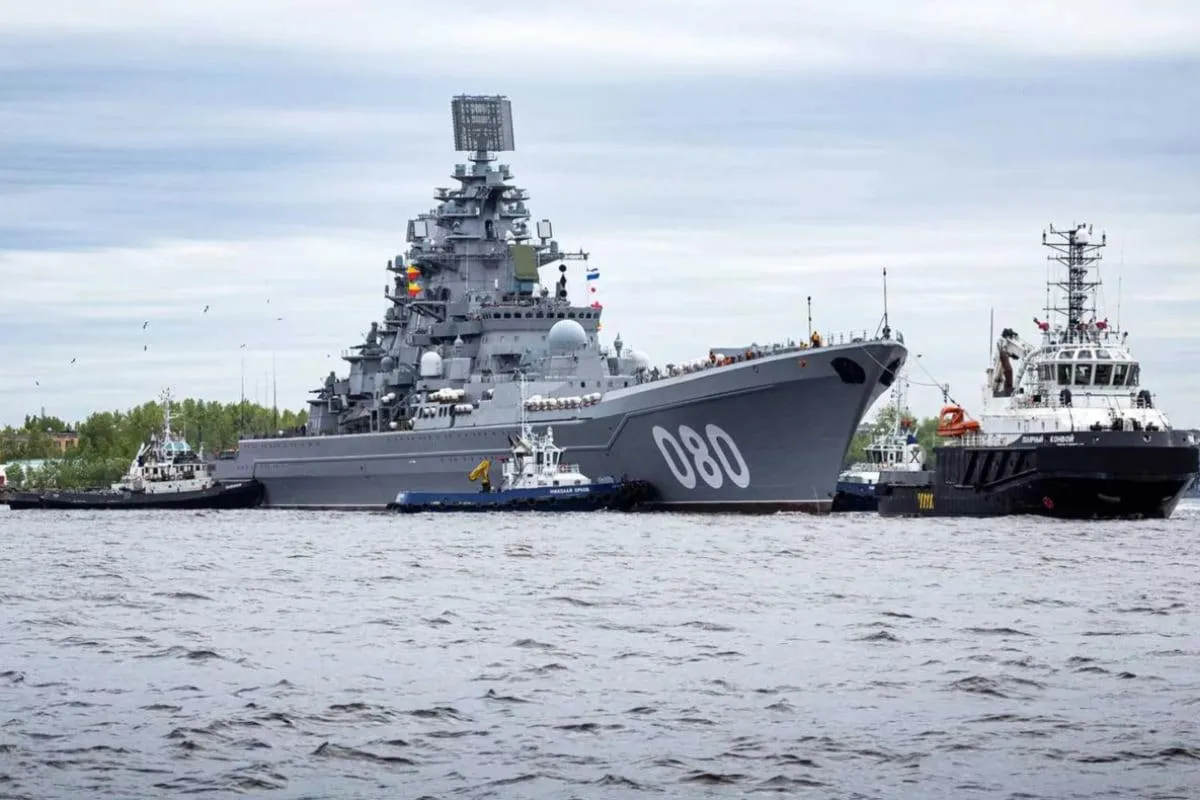
Russia has begun the final phase of sea trials for the nuclear-powered cruiser Admiral Nakhimov, which is considered one of the most powerful surface ships in its fleet. Following modernization, the ship received a significant upgrade to its armament and now has 176 launch cells for various types of missiles.
According to the Russian Ministry of Transport, on June 1, 2026, the cruiser officially entered the final phase of testing. The ship entered the shipyard back in 1999—almost 27 years have passed since then, which is longer than it served in the Soviet Navy.
The modernization process has dragged on for decades. The contract was signed in 2013, and the ship was originally scheduled to return in 2018. Instead, the ship entered final testing only this year—eight years behind schedule.
As it turned out, the initial cost of the contract was about 50 billion rubles ($667 million), while the final cost reached nearly 200 billion rubles—about $2.67 billion. Three times more expensive and twice as long as anticipated.
Despite this, the cruiser has been completely redesigned from the inside. Instead of the outdated Soviet “Granit” missiles, 80 modern launch cells for “Kalibr,” “Onyx,” and hypersonic “Zircon” missiles have been installed. In total, the ship now has 176 launch cells—83% more than on the American Arleigh Burke-class destroyer.
Why is it needed?
The cruiser’s main mission is to protect the Arctic waters of the Barents and Kara Seas, where Russian submarines of the Borei and Delta IV classes, armed with ballistic missiles, are on combat duty. These submarines form the backbone of Moscow’s nuclear deterrent. The Nakhimov’s nuclear propulsion system allows it to patrol the Arctic for months without calling at port and without relying on fuel logistics—which is crucial in a remote region with harsh weather conditions.
96 long-range anti-aircraft cells are designed to protect the submarines from aircraft, cruise missiles, and drones. 80 strike cells are intended to target enemy surface ships and coastal infrastructure.
There is a caveat
However, as the publication’s analysts note, all these missiles are already deployed on other ships. Admiral Gorshkov-class frigates and Yasen-M-class submarines carry the same Kalibr, Onyx, and Zircon missiles—but have much lower radar cross-sections. The "Nakhimov" simply concentrates more missiles on a single hull, but does not create fundamentally new capabilities, as noted in the article.
Second, long-range weapons do not work without a guidance system. The "Zircon" missile, capable of striking a target hundreds of kilometers away, remains dependent on satellites, maritime patrol aircraft, and submarines to locate and track the target. The larger the arsenal, the more critical this support network becomes, as the article states.
Third, survivability. In April 2022, the cruiser Moskva was sunk—despite having air defense systems. The Nakhimov is much better protected, but its 251-meter hull, with a displacement of 28,000 tons, is visible on radar from a great distance. The ship was not built according to the principles of low observability. And if it sinks, 80 strike cells and 96 anti-aircraft cells will disappear along with it. By comparison, the loss of a single frigate amounts to only 16 strike cells, according to media reports.
The information is reported by Army Recognition.
Russia has acknowledged for the first time that the cruiser “Moscow” was sunk by the Ukrainians.
On April 4, 2022, the Russian Ministry of Defense reported that a fire broke out on the cruiser “Moscow,” ammunition detonated, and the ship sustained serious damage.
As a reminder, The New York Times reported on the negative reaction from the U.S. following Ukraine’s sinking of the missile cruiser “Moscow” on April 14, 2022. The Americans were furious because they would never have approved such an attack, fearing Russia’s reaction. Moreover, Washington was unaware that Ukraine possessed missiles capable of sinking such a ship.




