
Russian satellites have approached a radar station that transmits intelligence data to Ukraine — TVP
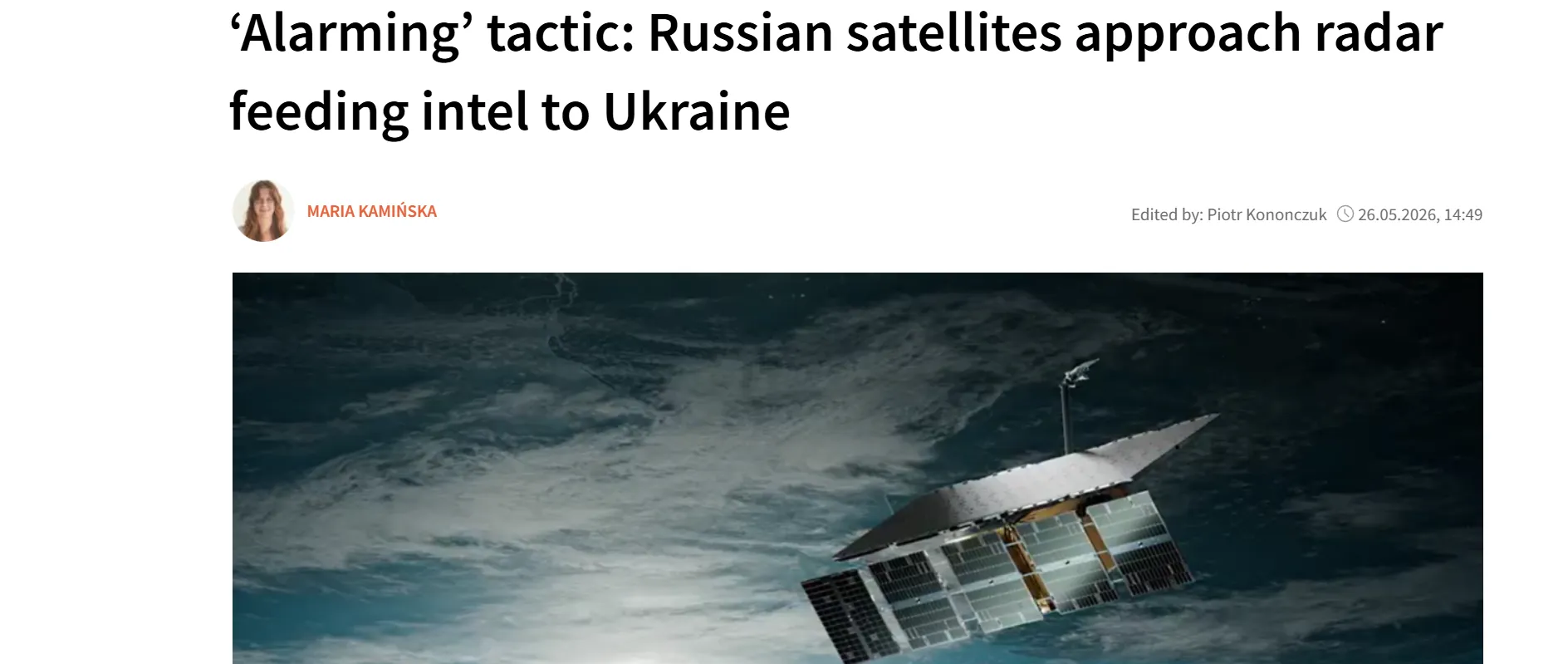
At least four Russian military satellites have approached a commercial space-based radar surveillance system that actively provides Ukraine with critical intelligence.
This was reported by TVP World.
The satellite in question is the “ICEYE-X36,” which is now being regularly monitored by the aggressor country’s space forces.
This dangerous situation raises serious questions among international analysts regarding the Kremlin’s true aggressive intentions in orbit.
Greg Gillinger, a retired U.S. Air Force space intelligence officer, stated that this could be part of a broader set of maneuvers that would allow Russian satellites to “target (kinetically or non-kinetically) ICEYE-X36.”
Open-source data indicates that a number of Russian satellites, designated “Kosmos” 2610–2613, have altered their orbits to coincide with that of the civilian spacecraft.
This means that the “Kosmos” satellites are now positioned to regularly fly near the Finnish satellite’s trajectory.
ICEYE currently operates the world’s largest constellation of synthetic aperture satellites.
Systems of this type allow for high-quality images of Earth to be captured at any time of day and even through clouds, as radio waves—rather than light—are used to collect data.
The Ukrainian side is actively using the high-precision images of the Earth’s surface to effectively combat Russian occupation forces.
It is not yet known exactly why Russia has relocated its satellites, but according to Gillinger, this is an “alarming” signal.
The American military expert noted that maneuvers similar to those performed by Russian satellites are “rare” in space operations, as they require a large amount of fuel.
In recent years, after decades of stagnation, Russia has stepped up its space ambitions, seeking to gain a strategic advantage over Ukraine and the West.
NASA satellite to re-enter Earth’s atmosphere after 14 years in orbit
Europe and China have launched a satellite to study space weather


