
Artificial intelligence has helped decode a scroll from Herculaneum in its entirety for the first time
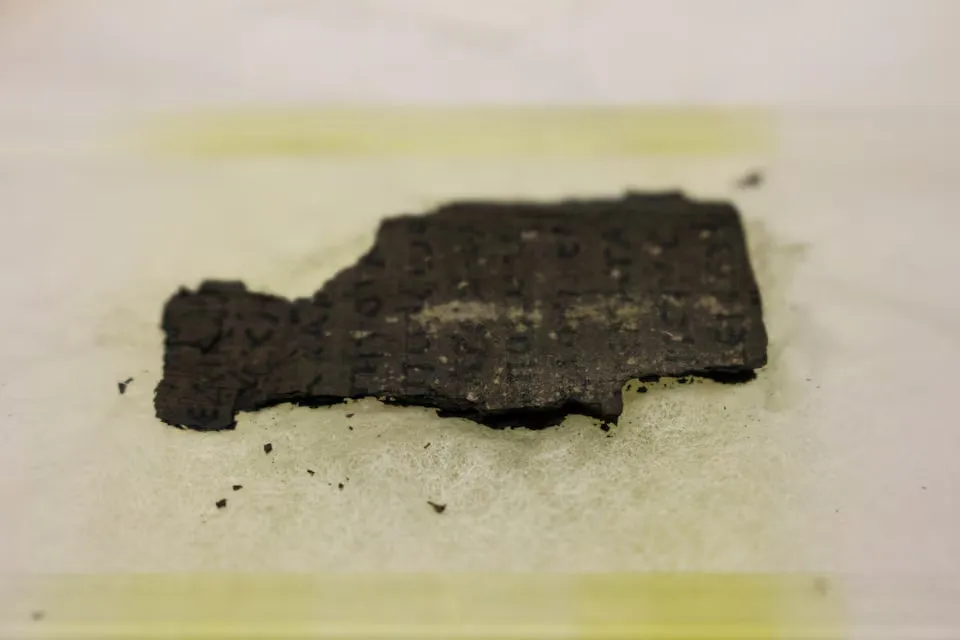
An international team of researchers has, for the first time, fully deciphered an ancient Roman scroll from Herculaneum that was charred during the eruption of Vesuvius nearly 2,000 years ago. To do so, the scientists used artificial intelligence and modern digital imaging technologies.
The achievement was announced by participants in the Vesuvius Challenge project. According to them, the new method allows ancient papyri to be read without physically unrolling them and could help decipher hundreds of other scrolls found in the city, which was destroyed along with Pompeii in 79 AD.
To accelerate the research, the project team announced that it would make all data, source code, and digital models of the papyri openly available. The organizers also promised a $1 million reward to the first person or team to fully decipher any other scroll.
One of the founders of the Vesuvius Challenge, Brent Seals, a professor of computer science at the University of Kentucky, noted that just a year ago, such an outcome seemed unlikely.
“Just a year ago, it would have been crazy for any of us to believe that we could fully read a scroll without any physical intervention, yielding hundreds of columns of text,” he said.
The charred scrolls remain so fragile that it is impossible to unroll them using traditional methods without destroying them. Therefore, the researchers used high-precision scanning and artificial intelligence algorithms that allow them to “virtually unroll” the papyrus and detect the ink on its layers.
To date, about 45 papyrus scrolls and their fragments have been scanned. At the same time, more than 600 scrolls remain ununrolled, and a significant portion of the villa where they were found has not yet been excavated. Scientists do not rule out the possibility that there may be other manuscripts there.
Since the Vesuvius Challenge project began, it has already paid out $1.8 million in rewards for achievements in deciphering texts from Herculaneum.
Among the new materials presented by the researchers are 70 columns of text from the work “On Vices: Book I,” attributed to the Epicurean philosopher Philodemus.
Scientists have also managed to reconstruct nearly 1.5 meters of text arranged in 20 columns from another document dating to 200–300 BCE. This is the oldest scroll from Herculaneum that has been successfully deciphered using virtual unrolling. The text explores issues of ethics, art, and human behavior.
Source: Reuters.
The head of DeepMind warned of an AI revolution that will change the world 100 times more profoundly.
Nobel laureate Geoffrey Hinton stated that as early as 2026, artificial intelligence will be able to replace a significant number of professions, triggering a new wave of unemployment. This is significant because technology is advancing rapidly and is already displacing call center agents and programmers.
Google has launched a pilot program to test a new interview format for software engineer candidates, in which the use of AI assistants is permitted.


