
The Mystery of the Bloody Waterfall: Scientists Have Finally Explained the Nature of the Phenomenon
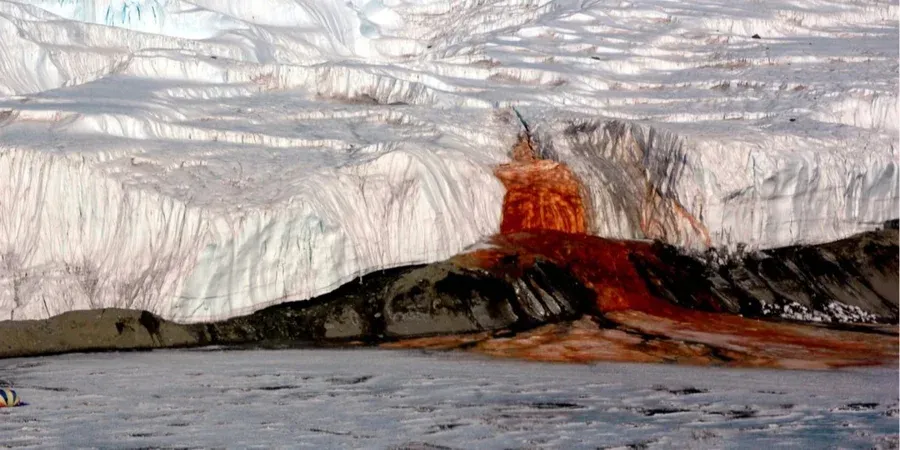
Scientists have explained how the Bloody Falls in Antarctica work, where salty brine containing iron periodically bursts through the glacier and alters its movement. Research has shown that pressure builds up beneath the ice, triggering a kind of “outburst” of water to the surface.
In the harshest corner of Antarctica, a strange phenomenon has existed for decades that looks almost like a mistake of nature: a dark red liquid resembling blood flows from beneath the glacier. Scientists have long tried to understand where it comes from and why it doesn’t freeze even in extreme cold, and only now have they been able to describe the full mechanism behind this process. We’re talking about the Blood Falls on the Taylor Glacier, which was first spotted back in 1911. At the time, scientists speculated that the red color might be caused by life—specifically algae—but this theory was later disproved.
As it turns out, the source of this unusual flow is an extremely salty brine saturated with iron. It became trapped beneath the glacier approximately 1.5 million years ago, when ancient seawater was “frozen” inside the glacial mass. Over time, the salt concentration became so high that the liquid’s freezing point dropped significantly. When the brine reaches the surface, the iron reacts with oxygen and oxidizes, giving the water its characteristic rusty-red hue.
For a long time, it remained unclear how this liquid managed to rise through hundreds of meters of ice at all. It wasn’t until 2017 that researchers were able to identify a complex system of subglacial channels through which the water flows, tracing its approximate route at a depth of about 300 meters. Scientists paid particular attention to the fact that even in such a cold environment, the water does not freeze completely. If part of the brine does turn into ice, heat is released during this process, which further warms the surrounding ice and helps keep the channels open.
Glaciologist Erin Pettit explained the mechanism simply: “As water freezes, it releases heat that warms the colder ice around it.” According to her, the Taylor Glacier is unique because it is one of the coldest glaciers where water still continues to flow. Another discovery was the microorganisms living beneath the glacier. At a depth of hundreds of meters, without sunlight and with almost no oxygen, they have existed for over a million years, using sulfates as an energy source. After successfully collecting samples, the researchers discovered a fully-fledged microbial ecosystem beneath the ice.
Because of these conditions, Bloody Falls has become an important site for astrobiology, as it is viewed as a natural model for environments that may exist on the icy moons of other planets. A new study published in the journal *Antarctic Science* also explained the nature of the brine “outbursts.” In 2018, scientists simultaneously used GPS transmitters, cameras, and temperature sensors, which allowed them to observe the process in real time.
Observations showed that during such episodes, the glacier’s surface subsided by approximately 15 millimeters, and its forward movement slowed by nearly 10%. At the same time, new red streams were recorded, and the temperature in the subglacial lake fluctuated sharply. The researchers concluded that brine gradually builds up pressure beneath the glacier and bursts out in pulses. Each such “outburst” deforms the ice, temporarily slows its movement, and triggers the cycle anew.
Scientists suggest that further observations will help understand how this process changes over time and whether it could serve as an indicator of internal changes within the Taylor Glacier. Science Alert reports on this.
Erebus Volcano in Antarctica releases microscopic gold crystals into the atmosphere every day, and scientists have been unable to fully explain this process for over 30 years. The planet’s southernmost active volcano remains one of the most mysterious natural phenomena, which is still being actively studied.


