
New four-winged feathered dinosaur described in China — Live Science
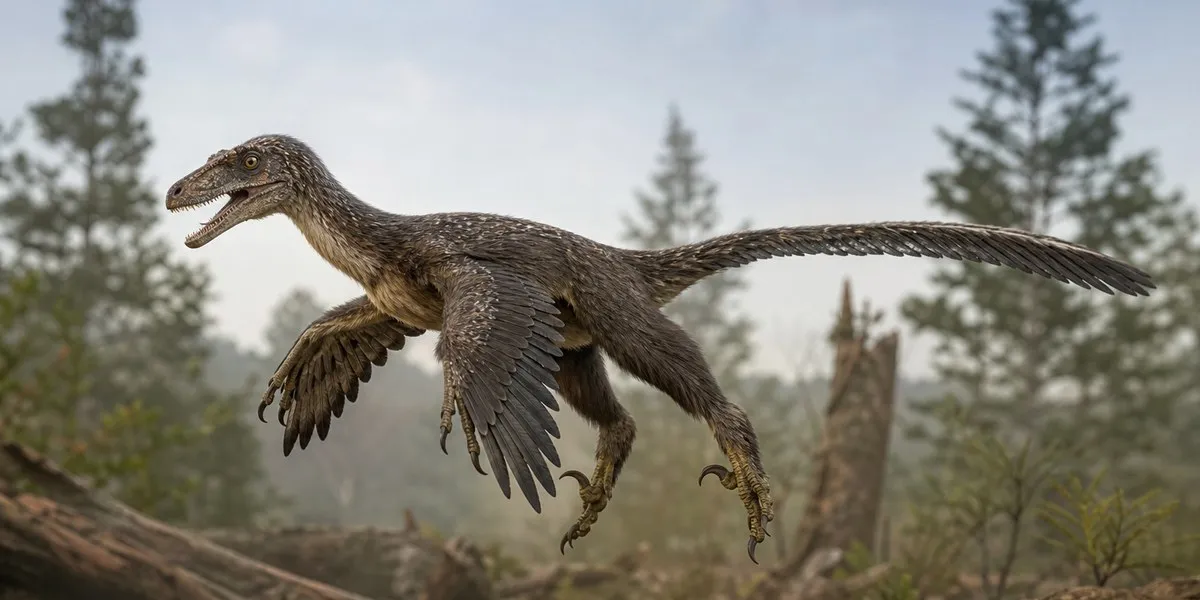
In northeastern China, paleontologists have described a new species of feathered predatory dinosaur, Norellraptor barsboldi, whose remains were preserved in exceptionally good condition. The animal had four wings, curved teeth and claws. As Live Science reports, the find adds arguments in favor of the hypothesis that flight may have arisen independently in different groups of dinosaurs.
Find from the Jiufotang Formation
The fossil was discovered in the Early Cretaceous Jiufotang Formation, estimated to be between 145 million and 100 million years old. At the time of its death, the dinosaur was about three years old, and its body length was 57 centimeters.
Norellraptor barsboldi belonged to the microraptors — close relatives of birds, but not their ancestors. Birds belong to the neighboring group Avialae. Both microraptors and early representatives of Avialae, including Archaeopteryx, had feathers. One question for scientists was whether flight arose in the common ancestor of these groups, or whether feathers and possibly the ability to fly evolved multiple times.
More current news is available on the UA.News Telegram channel Telegram.
Evidence on the evolution of flight
Andrea Cau and colleagues analyzed 194 anatomical changes in the evolution of microraptors. About 30% of them also arose in the bird lineage. These traits include the fusion of bony rib processes, which made the torso more rigid, relatively robust forelimbs, and an ulna longer than the humerus.
At the same time, a comparison of fossils showed that these shared features appeared in the two groups in a different sequence. The authors of the study, published in the journal Nature Communications, concluded that microraptors acquired traits similar to those of early birds through a different evolutionary path. This supports the hypothesis that powered flight arose independently in non-avian dinosaurs and birds.
Paleontologist Scott Hartman, who was not involved in the study, suggested that microraptors may have combined gliding with powered flight. In his view, their hind wings could have helped them stabilize flight, brake and maneuver during sharp turns.




