
Nostalgia for Mao’s ideals is growing in China
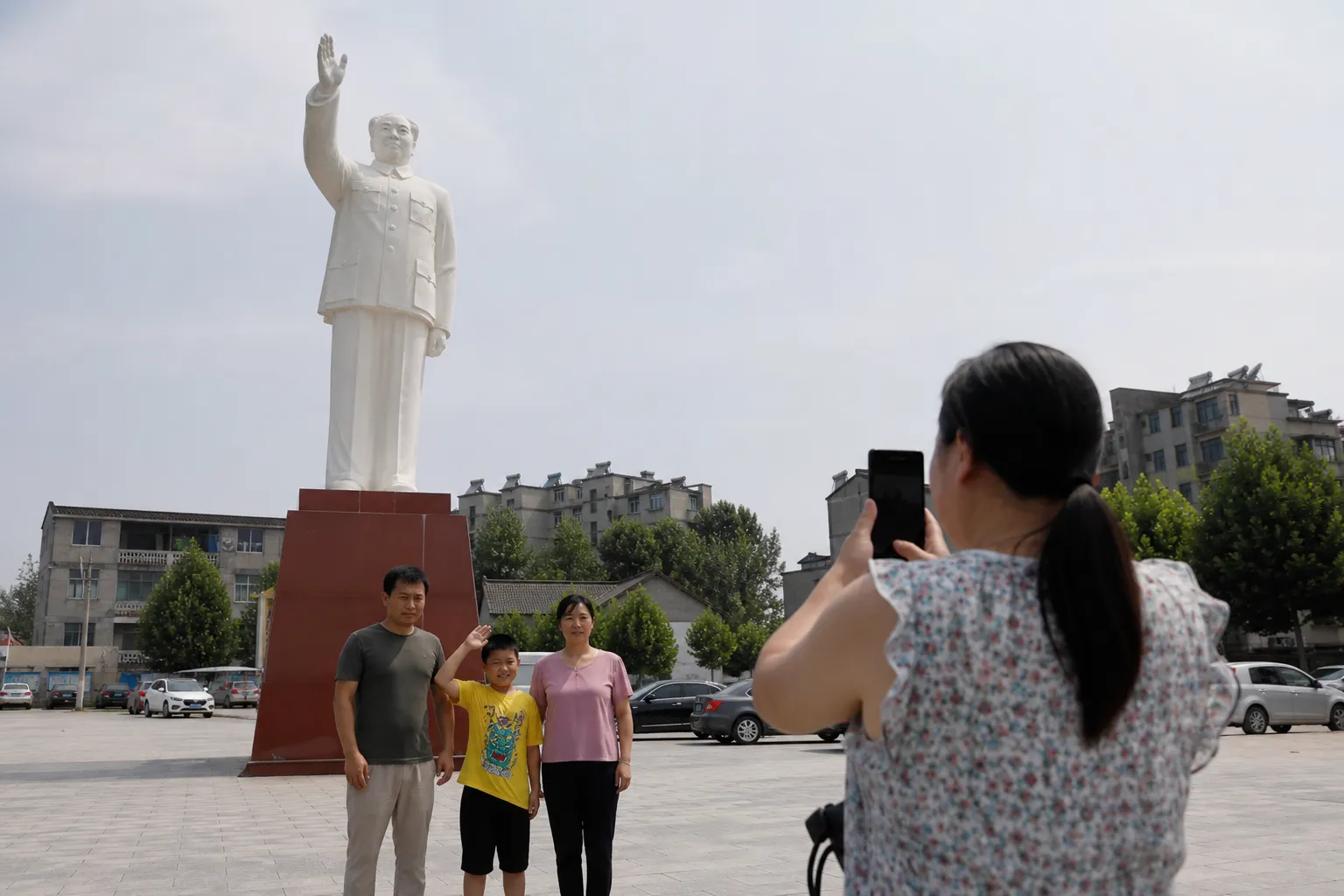
In China, nostalgia for Mao Zedong’s egalitarian ideals is growing ahead of the 50th anniversary of his death. Amid an economic slowdown, inequality, long working hours, and intense competition in education and the labor market, some Chinese people are romanticizing the period of his rule, Asharq Al-Awsat reports.
Mao Zedong, who led the communist revolution in 1949, died on September 9, 1976. His portrait still hangs above Tiananmen Square in Beijing, his image appears on Chinese banknotes, and his body is kept in a mausoleum. The Communist Party of China calls Mao a revolutionary hero, while after his death it recognized the Cultural Revolution as a serious mistake.
The Maoist village of Nanjie
In the village of Nanjie in the central province of Henan, often called China’s last Maoist village, the principles of communal ownership have been preserved. Its streets and houses are decorated with images of Mao, while local enterprises with a cooperative ownership structure fund free housing for residents.
Twenty-two-year-old student Xie Kaiyue said she reveres Mao, although he died nearly three decades before she was born. In her view, young people in the village no longer have as strong a spirit as before, and people in the past were purer.
Another place associated with Mao’s cult is the mountain village of Dazhai in Shanxi Province. Mao promoted it as a national model after local residents turned arid slopes into irrigated fields. Posters, playing cards, tableware bearing Mao’s portrait, and collections of his quotations known as the Little Red Book are now sold there.
More current news is available on the UA.News Telegram channel Telegram.
Censorship and the legacy of his rule
Public references to the dark episodes of Mao’s rule are strictly censored in China. The Cultural Revolution, which he launched in 1966, lasted ten years: intellectuals were persecuted as class enemies, and schools were closed, which, according to the report, set the country back in educational development.
The collectivization of private property and land, as well as the economic policies of the time, led to the Great Famine. According to the Chinese government, approximately 15 million people died, while historians estimate the death toll at 20–43 million. In one museum, references to the Cultural Revolution had, according to journalists’ observations, been roughly scraped off display panels.
Scholar Xu Chenggang, who was persecuted as a child because his father was labeled a rightist, said that everything available in the public sphere conforms to the party line. Under Xi Jinping’s rule, discussions about the past are further restricted by the fight against so-called historical nihilism — narratives that contradict the Communist Party’s assessments.
Idealization among young people
In December, a series of videos spread on the Bilibili platform, whose authors described the 2017 film Youth as a hidden ode to the Cultural Revolution. The videos praised Mao and accused capitalist elites of suppressing the movement. After receiving more than 35 million views in less than a week, the clips were removed.
Kerry Brown, head of the Lau China Institute in London, said that more and more people perceive the Cultural Revolution as a period of idealism rather than a pursuit of money and material goods, and called this perception a fiction. At the same time, Professor of Chinese Studies Mobo Gao said that many Chinese people regard Mao as the founder of the PRC and associate this with the foundations of the country’s modern technological development.


