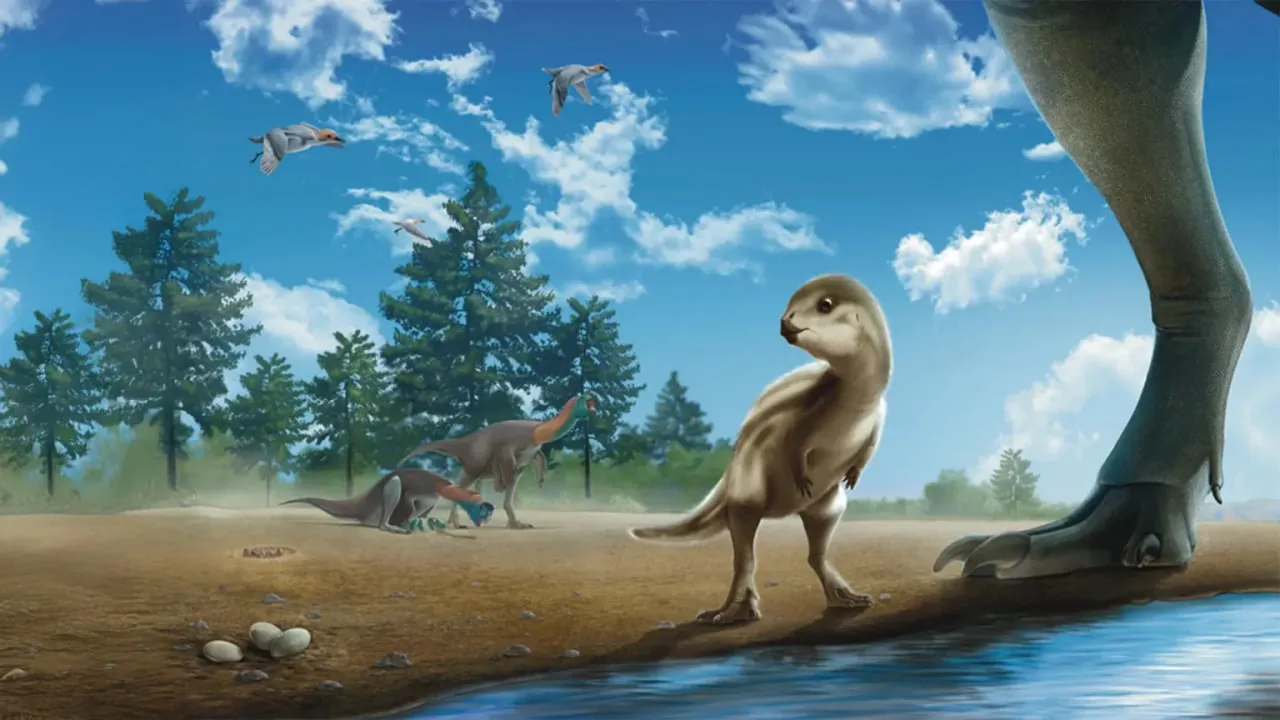
On Aphae Island in South Korea, scientists have identified a new species of dinosaur whose remains had been hidden in rock for a long time.
It is a juvenile specimen that has been named Doolysaurus—in honor of the popular Korean cartoon character Dooly.
Science Daily reports on this.
“Dooly is one of the most famous and iconic dinosaurs in Korea,” the study states.
This is the first new dinosaur species to be identified in South Korea in the last 15 years. Additionally, it is the first fossil in the country where parts of a dinosaur’s skull have been documented.
Initially, researchers saw only isolated bones, specifically parts of the legs and spine. However, after conducting a micro-CT scan at the University of Texas Center for High-Resolution Computed Tomography (UTCT), it became clear that significantly more elements were preserved inside the rock, including fragments of the skull.
The new species has been given the full name Doolysaurus huhmini. The second part of the name honors Korean paleontologist Min Huh for his contributions to dinosaur research in Korea, the establishment of a specialized research center, and the preservation of fossil sites with UNESCO support.
The study’s findings were published on March 19 in the journal Fossil Record. The fossil itself was discovered in 2023 by study co-author Hye-min Jo.
According to scientists’ estimates, the dinosaur was about two years old and still growing. It was roughly the size of a turkey, while adult specimens of this species could have been twice as large. The researchers also suggest that the body may have been covered in soft, thread-like structures. “I think it would have looked quite cute. Maybe a bit like a little lamb,” said study co-author Julia Clarke.
Most of the remains were embedded in hard rock, and their mechanical extraction could have taken years. Instead, the researchers used micro-CT scanning, which allowed them to reconstruct an almost complete skeleton in a few months. Afterward, the team spent over a year analyzing the anatomy in detail. According to Clark, this method has become key to studying fragile fossils, particularly small dinosaurs and early birds, that remain encased in rock.
Doolysaurus lived approximately 113–94 million years ago, during the middle of the Cretaceous period. Based on its structure, it was classified as a tescelosaurid—a group of bipedal dinosaurs known from East Asia and North America that likely had a downy coat.
The specimen’s age was confirmed by examining the growth patterns in a thin section of the femur.
Dozens of gastroliths—small stones that the animal swallowed to aid digestion—were also found inside the fossil. This indicates an omnivorous diet that included plants, insects, and small animals.
The presence of gastroliths was an additional clue for the researchers that a significant portion of the skeleton might remain inside the rock.
“A small cluster of ‘gastroliths’ along with two leg bones protruding outward indicated that the body had not been completely scattered before it became part of the fossil record. So I suggested to my colleagues that we come to Texas and try to scan the fossil,” Clark explained.
Dinosaursweren’t exactly like lizards: scientists described what their skin was like.
As a reminder, the oldest wooden tools were found in Greece.
Also, during excavations, archaeologists found artifacts from the time of Kievan Rus.