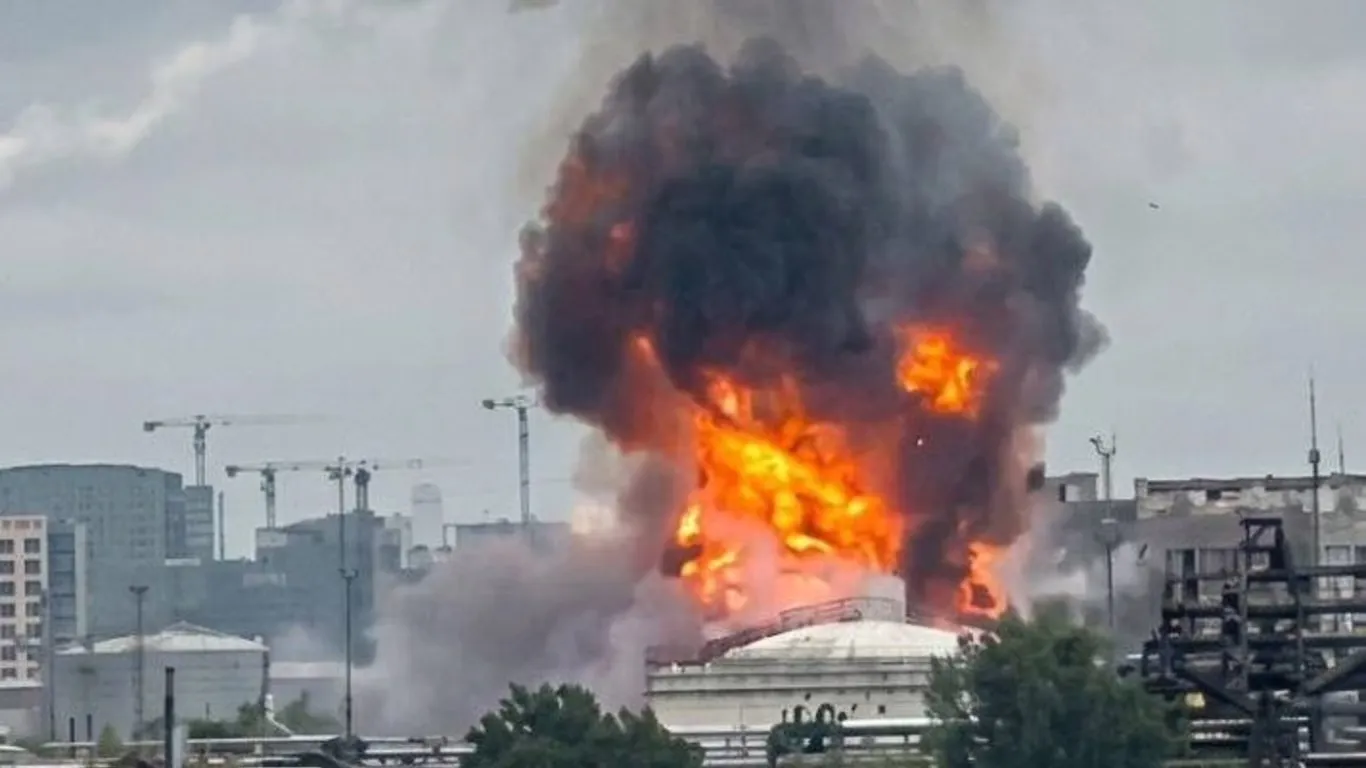
As of June 20, various regions of Russia are reporting fuel shortages and growing lines at gas stations, which is becoming yet another tool for exerting economic and social pressure on Moscow.
Ukraine is striking Russian oil refineries using long-range drones. Russian authorities have restricted fuel sales, causing gasoline prices to skyrocket and huge lines of cars to form at gas stations.
The Wall Street Journal reports that, according to analysts’ estimates, the recent wave of attacks has knocked out more than 20% of Russia’s oil refining capacity.
“This level of disruption is unprecedented in the history of the Russian-Ukrainian war,” the International Energy Agency stated in its report.
The regions closest to the front lines have been hit hardest, particularly Crimea—the peninsula annexed by Russia from Ukraine in 2014. In recent weeks, Kyiv’s drones have repeatedly struck gasoline tankers on the overland supply route passing through other occupied territories of Ukraine, leading to a gasoline shortage in Crimea. Local authorities have introduced rationed fuel distribution, including a QR code system that drivers must present to receive their allotted quota.
Restrictions on fuel purchases have been extended to 53 regions of Russia and the temporarily occupied part of Ukraine, including some remote areas such as the Arctic and Siberia. Drivers are not allowed to purchase more than a single tank’s worth of fuel to prevent stockpiling. Frustrated motorists are voicing their dissatisfaction on social media over the long wait times at gas stations.
According to Vladimir Milov, a former deputy energy minister of the Russian Federation, the latest missile strikes have become more effective because Ukraine has targeted Russia’s largest and most modern refineries, which produce high-octane gasoline using Western-made equipment that is difficult to replace.
“These 10–15 oil refineries are a very narrow and vulnerable target. Simply put, attacking them would trigger a crisis,” Milov said.
Ukraine has also used drones to attack Russian oil export terminals—a bold attempt to prevent Moscow from profiting from the spike in oil prices caused by the U.S.-Iran conflict. However, it yielded mixed results, as Russian oil exports remained at previous levels, according to the WSJ article.
As a reminder, the Moscow refinery attacked overnight controls one-third of the Russian capital’s fuel market.
According to Kovalenko, the ELOU AVT-6—a primary oil refining unit on which the plant’s operational capacity depends—is on fire at the Moscow refinery.
The Ukrainian Armed Forces attacked the key port of Kavkaz in the Kerch Strait
As a reminder, Russia attacked the Kyiv-Pechersk Lavra, causing a fire.
Prior to that, Russian KABs struck the Zaporizhzhia region, resulting in injuries.
Five State Emergency Service rescuers were killed as a result of the Russian attack on Kharkiv.