
The Ukrainian-British Griffen drone shot down a Shahed for the first time
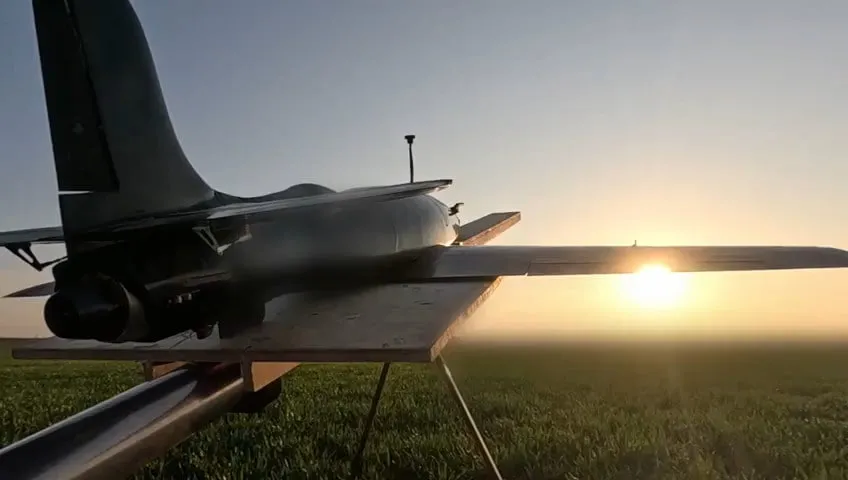
The Griffen jet-powered interceptor drone has destroyed a Russian Shahed-136-type attack drone for the first time.
According to the developers, the interception was carried out by a drone created by the British-Ukrainian company Firebolt Engineering. This is the first confirmed instance of the Griffen system being used in combat against kamikaze drones of this type.
Firebolt Engineering states that this is the first confirmed instance in Ukraine of a Shahed-type drone being destroyed by a jet-powered interceptor drone.
The company explained that the Griffen was developed in response to the appearance of jet-powered kamikaze drones in the Russian arsenal.
New variants of these drones fly more than twice as fast as previous versions, which had a maximum speed of about 180–200 km/h.
As a result, Ukrainian military personnel have nearly half the time to detect a target, identify it, and make a decision to intercept it.
Under these conditions, propeller-driven interceptor drones are finding it increasingly difficult to catch up with high-speed targets, especially at high altitudes or in conditions of active electronic warfare.
At the same time, using expensive anti-aircraft missiles to destroy large numbers of cheap drones is economically unfeasible.
The Griffen is an aircraft-type jet drone capable of speeds exceeding 350 km/h, operating at altitudes above 7,500 meters, and covering distances of up to 120 km. It is launched using a special catapult.
According to the developers’ vision, the platform represents a new class of countermeasures against drones—jet-powered interceptor drones that combine high speed with a significantly lower cost of operation compared to anti-aircraft missile systems.
Thus, the Griffen occupies a niche between propeller-driven interceptor drones and traditional air defense systems.
“The battlefield in Ukraine is accelerating the development of air defense. Griffen was created to solve a specific problem—to provide a fast, scalable, and affordable way to counter Shahed-class threats without using expensive missiles. The first confirmed combat interception served as important proof of the effectiveness of both the platform itself and the British-Ukrainian model of cooperation,” noted a representative of Firebolt Engineering.
Following its successful combat deployment, Firebolt Engineering has begun scaling up production of the Griffen, expanding the supply of power units, and working to strengthen service support and expand the system’s integration capabilities.
The company noted that its top priority is to meet Ukrainian needs. Firebolt believes that the Griffen will also be in demand among NATO countries and other partners.
The next stage in the platform’s development will be its integration into multi-layered air defense systems, as well as the expansion of its autonomous capabilities.
The company reported this to “Military.”
Ukraine has developed the APUS-1 kamikaze interceptor, which operates without GPS.
Previously, the Ukrainian Ministry of Defense codified and approved the “Nebokray” mobile workshops for use by the Armed Forces of Ukraine (AFU). The system is designed for the repair and maintenance of drones.
The Ministry of Defense has standardized and approved for use in the Armed Forces of Ukraine the new “General Chereshnya” FPV unmanned aerial system.
The Ministry of Defense has standardized and approved for use in the Armed Forces of Ukraine a new Ukrainian-made unmanned aerial system, the V-1. These ultralight bombers are designed to strike concentrations of personnel, vehicles, and armored equipment.


