
The EU expects a Russian attack within the year – WSJ
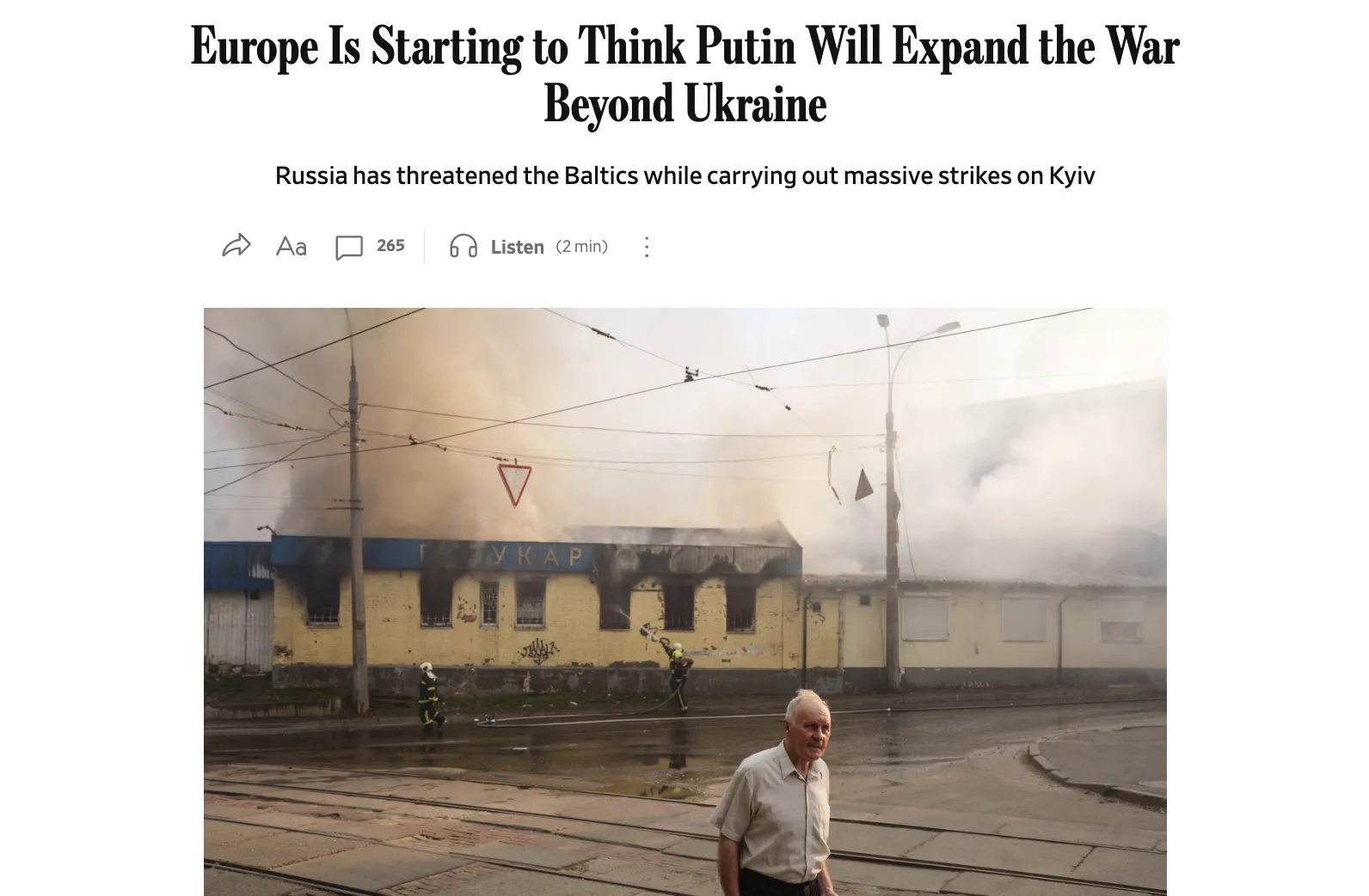
Concerns about Russia’s actions are growing in European capitals. According to The Wall Street Journal, the EU believes that Russia may attempt to expand the conflict beyond Ukraine’s borders amid the war’s stalemate.
Several European officials responsible for national security have warned that Russia may attempt to test NATO’s unity by striking one of the Baltic states, Swedish or Danish islands in the Baltic Sea, or the alliance’s territory in the Arctic.
In addition, recent threats by U.S. President Donald Trump to withdraw from NATO and his moves to reduce U.S. troops stationed in Europe are heightening the threat.
High-ranking European officials fear that Russia may see an opportunity to strengthen its position in the next 12 months, as an oil crisis triggered by a war with Iran would create additional political turmoil in Europe, bolstering far-right parties that seek to resume purchases of Russian oil and gas and halt aid to Ukraine.
According to representatives of European intelligence and military agencies, there are no signs that Russia is actually deploying troops or equipment to launch attacks on the Baltic states or other territories outside Ukraine.
However, Putin will face a difficult choice in the coming months. According to Western intelligence estimates, Russian forces are losing nearly 35,000 soldiers per month, which exceeds the Kremlin’s ability to recruit personnel.
It is noted that continuing the war in Ukraine at the current pace will soon become impossible without resorting to forced mobilization, and Putin will need to justify this step somehow.
“If you simply mobilize for this war, you’ll be signaling that you’re not actually going to win this war. So there comes a point when they need to escalate the situation to justify mobilization. And that’s a very dangerous moment. Of course, no one knows what is going on in Putin’s mind, but this could be a calculated move to advance and change the trajectory of this war,” said EU High Representative for Foreign Affairs and Security Policy Kaja Kallas.
At the same time, as the WSJ notes, Putin continues to claim that victory is near, and there are no signs that his strategic goal—domination over all of Ukraine and a shift in the balance of power in Europe—has changed in any way, despite the challenges Moscow faces on the battlefield.
For Russia, the EU is now an implacable enemy that must be punished or destroyed.
The publication notes that Russian troops would likely perform much better against European armies than against Ukraine, especially if the U.S. does not rush to the rescue. However, to initiate such an escalation, Russia would first have to bolster its military ranks.
“Mobilization is, technically, entirely feasible; their mobilization system is well-established. But it would also create serious internal problems and pressure, which could then lead to various interesting consequences. It would be a risky decision for Putin,” said Kaupo Rosin, director of the Estonian Foreign Intelligence Service.
At the same time, senior German parliamentarian Norbert Röttgen believes that the idea of breaking the deadlock in Ukraine by expanding the war to NATO countries in the Baltics may be tempting, but dangerous for Putin.
“It would be a huge and additional risk for Putin—after failing to achieve sufficient success against Ukraine, simply adding another very powerful adversary to the military conflict,” he noted.
At the same time, Röttgen acknowledged that Putin is known for his propensity for risky actions and is capable of escalating the conflict.
Currently, the North Atlantic Alliance is preparing a major overhaul of its command structure on its eastern flank. The goal of the new military structure is to maximize the speed of response and the rapid deployment of allied forces in Latvia and Estonia in the event of a direct threat from Russia.
The U.S. plans to significantly reduce its military contribution to NATO by cutting back on the provision of key resources and equipment. Washington is effectively urging its European allies to take on a larger share of the defense burden sooner. These new approaches have already sparked debate among Alliance partners.


