
Scientists Have Observed a New Acceleration in Arctic Ice Melt — The Guardian
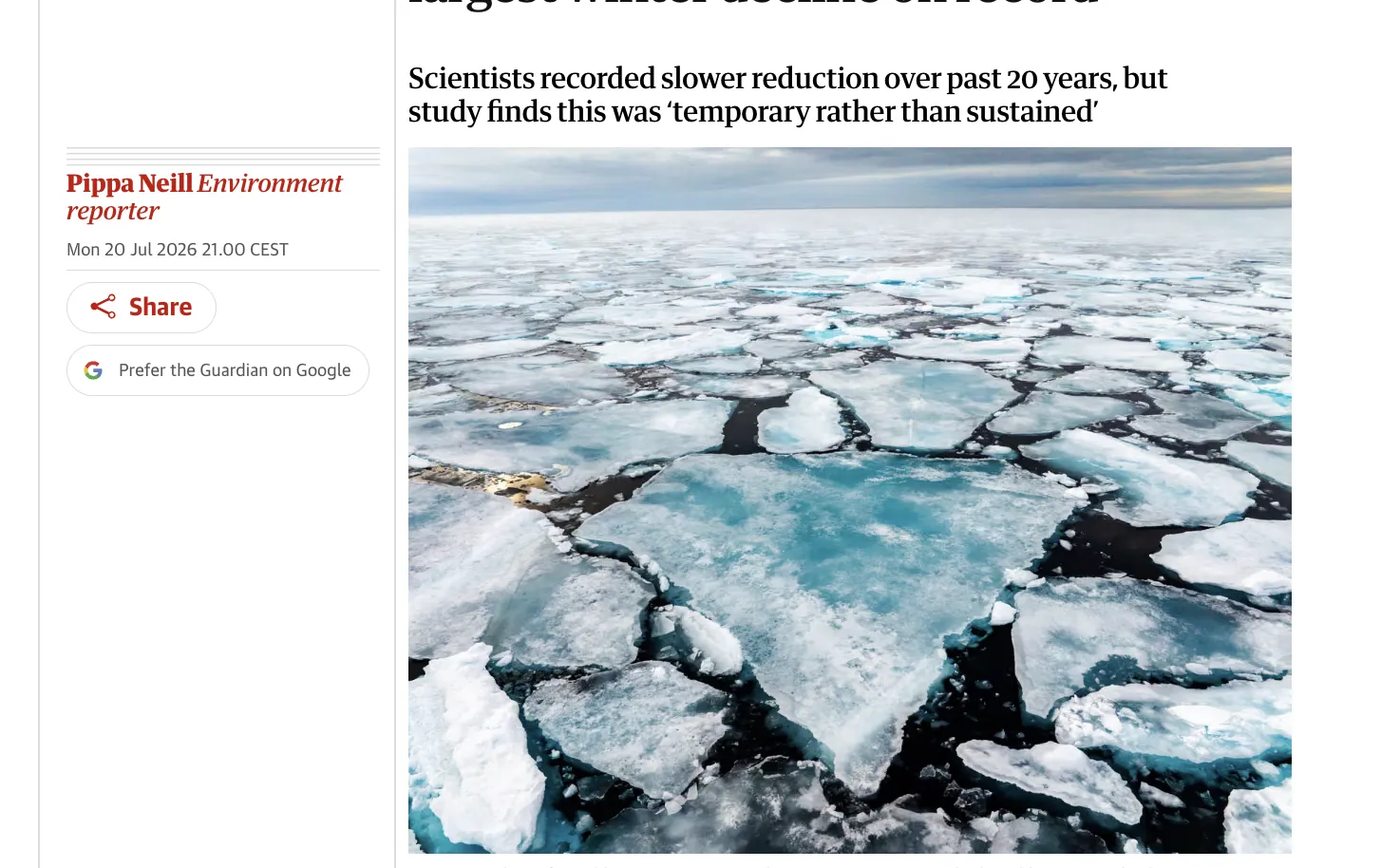
Researchers have concluded that the slowdown in Arctic sea ice melt in recent years was only temporary. According to their data, the extent of Arctic sea ice has once again begun to shrink at a faster rate.
Previously, experts noted that from 2005 to 2024, the rate of Arctic sea ice loss had slowed significantly. Despite ongoing global warming, no significant reduction in sea ice extent was observed during this period. Researchers attributed this to natural changes in ocean currents, which temporarily slowed the melting process.
However, an analysis of the latest satellite data has shown that this pause has ended. According to the study’s lead author, Dr. Duo Zhang of the University of Southampton, what appeared to be a halt in melting in the early 2020s was, in fact, only a temporary slowdown in the overall long-term process.
The period from 2024 to 2025 proved particularly alarming. During this time, the area of Arctic sea ice shrank by 5.8%, marking the largest annual decrease in winter ice cover in the history of satellite observations.
Researchers note that since 1979, when regular satellite measurements began, the area of Arctic sea ice in September—during its seasonal minimum—has roughly halved.
According to scientists, the decline in winter sea ice has consequences far beyond the Arctic. Sea ice acts as a barrier between the relatively warm ocean and the cold atmosphere. As the ice decreases, more heat and moisture enter the atmosphere, which can alter air circulation, influence cyclone formation, and affect weather conditions in more southerly regions.
The study’s authors view the new data as further confirmation that the climate crisis is ongoing. According to them, short-term periods of stabilization may create the illusion that the situation is improving, but the long-term trend remains unchanged—the Arctic continues to lose ice as global temperatures rise, reports The Guardian.
In Brussels, due to record-breaking heat, the European Commission was forced to partially shut down the air conditioning system at its headquarters. The decision affected several floors of the Berlaymont building and has already impacted working conditions for staff. The institution notes that these measures are temporary and related to extreme weather conditions.
Paris has imposed a temporary ban on alcohol consumption in public places due to the record-breaking heatwave that has swept across France and much of Europe. The decision was made amid an overwhelmed healthcare system and a sharp rise in hospitalizations. The temperature in the city reached +40.9 °C, setting a new record high for June.


