
The United Kingdom is carrying out a large-scale reform of its military, drawing on Ukraine's experience — Politico
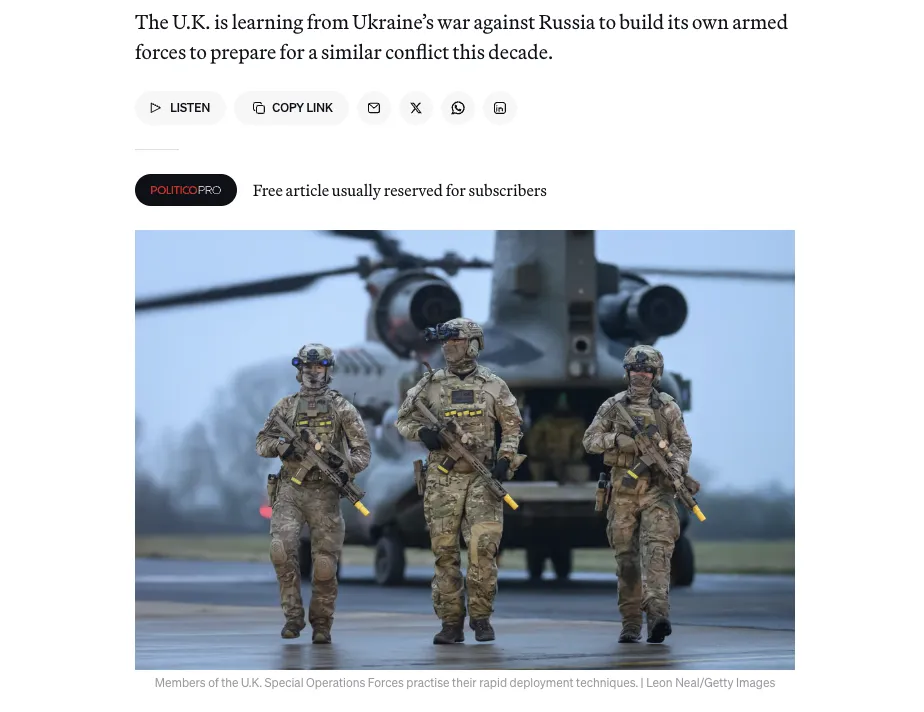
The British government is launching one of the most ambitious defense reforms in recent decades, drawing on Ukraine’s military experience. According to Politico, this involves a review of the structure and approaches to modern warfare.
The Defense Investment Plan (DIP), which Prime Minister Keir Starmer will present before stepping down, completely reshapes the country’s priorities. Instead of expensive and massive defense systems, London is shifting to a concept of low-cost weapons to destroy high-value targets and accelerate innovation within a matter of weeks. Russia’s invasion of Ukraine has demonstrated the vulnerability of large ships and aircraft carriers and highlighted the urgent need for autonomous systems, artificial intelligence for target acquisition, and massive stockpiles of inexpensive drones and ammunition.
As part of the plan, the United Kingdom is completely halting funding for the future construction of Type 83 destroyers and Type 32 frigates. Instead, investments will go toward six new Common Combat Vessels, which will control unmanned maritime platforms: Type 93 unmanned underwater vehicles, Type 91 missile boats, and Type 92 and Type 94 sensor systems.
Ukraine served as an example of this, as it destroyed Russia’s Black Sea Fleet—without a navy of its own—using a combination of missiles and drones. The modernization will also affect the Royal Air Force, which will fund the development of autonomous unmanned aircraft for joint use with sixth-generation manned fighter jets. Tim Villasi-Vilsi, a senior research fellow at the RUSI think tank, emphasized that the country needs to abandon large, inefficient projects and become significantly more agile.
The overall plan calls for an additional allocation of 15 billion pounds to the current defense budget of 270 billion, and its further implementation will depend on Andy Burnham, who is set to lead the government later this summer. These funds will partially bring Britain closer to NATO’s goal of spending 3.5% of GDP on defense by 2035, a target on which the country currently lags behind Germany, France, and Poland. Of the increased funding, 5 billion pounds will be spent on “drone transformation.”
Experts add that the Ukrainian side is now effectively teaching the British how to wage modern warfare, since without these changes, the British Army would not have lasted more than a few weeks on the battlefield.
Earlier, Zelenskyy mocked Putin over his constant claims about seizing the Donbas.
Putin will not get a chance for a new occupation — Zelenskyy.
A series of diplomatic appeals to international leaders and institutions, along with an open letter to Putin, yielded the desired result.


