
2026 U.S. Elections: Polling Places Are Preparing for the Government to Disrupt the Elections — CNN
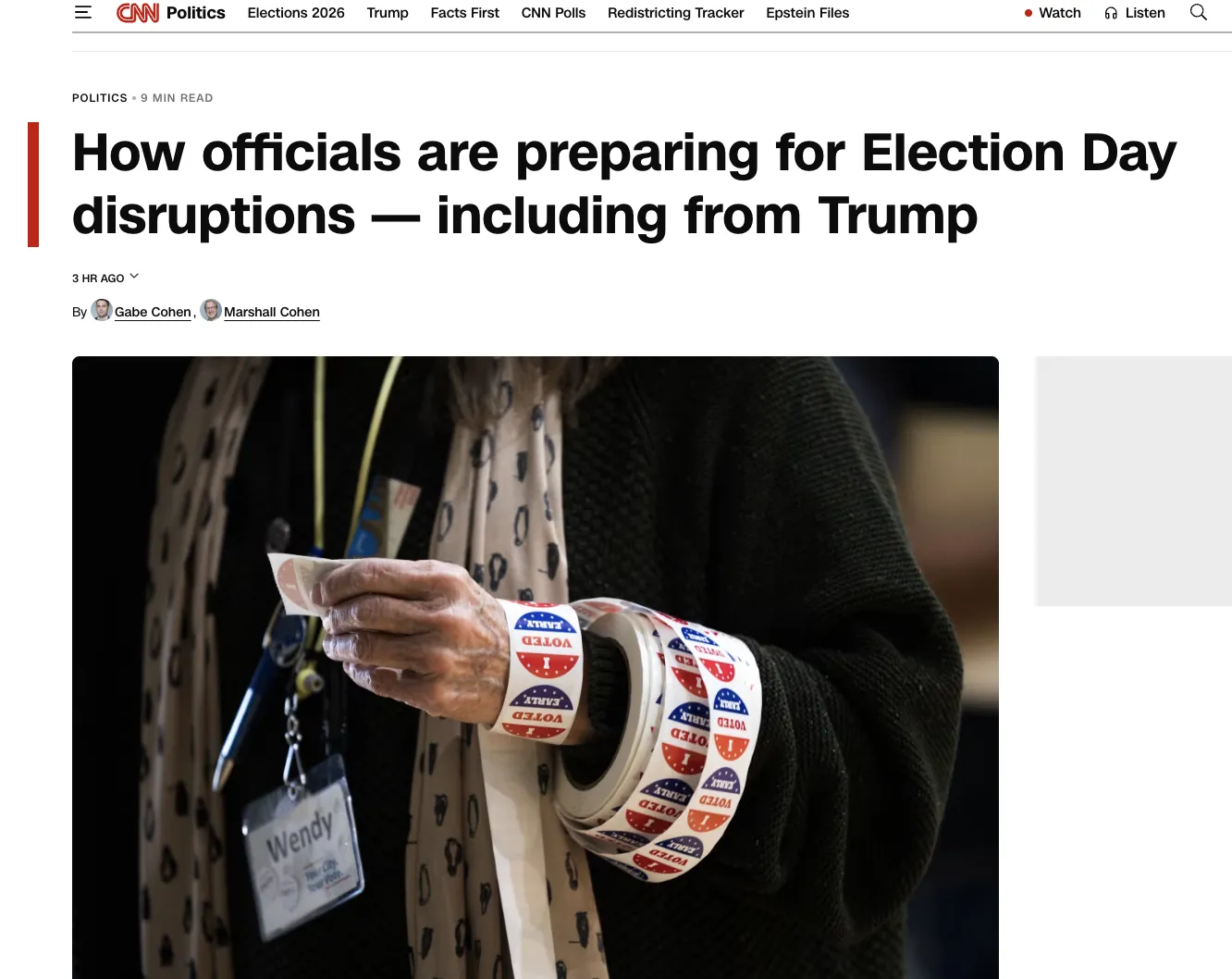
Ahead of the U.S. midterm congressional elections, local authorities are preparing not only for the usual logistical challenges but also for possible interference by the federal government. Officials fear that the Donald Trump administration and its allies may try to influence the voting, the counting of ballots, or the announcement of results. As a result, states are stepping up security, training poll workers, and planning in advance for emergencies.
Preparations for the U.S. midterm elections have been underway for several months. Election commissions are training staff, tightening security measures, and preparing for potential legal disputes. At the same time, officials this year are concerned not only about the risk of external interference but also about possible actions by their own federal government. “Lately, we’ve had to consider truly dire scenarios—both from external forces and from foreign actors. But the most important thing is that we have to be prepared,” said Thomas Galvin, a member of the Maricopa County Board of Supervisors in Arizona.
According to him, contingency planning has always been part of election preparations. However, the current situation is forcing local authorities to consider risks that did not exist before. Minnesota Secretary of State Steve Simon, a Democrat, stated that, for the first time, the possibility of interference by the U.S. federal government has appeared among the threats. “Unfortunately, a new danger on our list—one that has never been there before—is the possibility that our own federal government will try to interfere in the election in some way, either directly or indirectly,” he told CNN.
What U.S. Officials Fear
Officials have been discussing for several months what such interference might look like. Possible scenarios include a last-minute presidential executive order, the seizure of ballots, the presence of federal agents at polling places, or attempts to cast doubt on the election results. Donald Trump and his allies continue to allege widespread voting by non-U.S. citizens and election fraud. These allegations also pertain to early voting, which is already underway in some states.
In addition, administration officials have threatened to hold election officials accountable if they fail to properly secure the voting process or allow non-U.S. citizens to participate. Meanwhile, lawsuits have been filed in California seeking to limit the counting of disputed ballots. In Alaska, challenges have been raised regarding the procedures for certifying election results.
Such actions are causing concern even among members of the Republican Party. Matt Crane, executive director of the Colorado County Clerks Association, emphasized that allegations of fraud are often based on misinformation or incomplete information. “All of this is incredibly disappointing. We will continue to work hard to ensure that Tuesday’s election proceeds properly and that people can trust this process,” Crane said.
Can federal agencies intervene in the voting?
Some election officials are preparing for even more extreme scenarios. These include attempts to disrupt polling places, seize ballots or election equipment, challenge the results, or harass election workers. So far, the Trump administration’s attempts to influence the electoral process have mainly taken place through the courts and official letters. In these communications, election officials were urged to set aside certain ballots in order to verify the identities of the people who submitted them. However, local administrators are refusing to comply with such demands.
Early in-person voting is already underway in many states, and in some, it has been going on for several weeks. According to CNN, there have been no reports so far of large-scale interference by the federal government that would seriously disrupt voting. However, officials do not rule out that the situation could change closer to Election Day or afterward.
Minnesota is preparing for the worst-case scenario
Fears have intensified after Trump once again criticized the electoral process in Minnesota. In a post on the social media platform Truth Social, he stated that the Republican candidate could only lose if there were fraud during the ballot counting process. “The federal government will be watching this closely,” the president wrote.
For Minnesota’s leadership, this statement served as further confirmation that they need to prepare in advance for potential interference. Over the course of the year, state officials participated twice in closed-door meetings with colleagues from other regions. There, they ran through worst-case scenarios and discussed how to respond if federal authorities attempted to influence the electoral process. “It’s like we’re practicing our moves against an imaginary opponent. We don’t know if this attack will happen or when it might occur. We hope it won’t happen at all. But it would be irresponsible not to plan for the worst-case scenario,” explained Steve Simon.
Why Officials Fear the Aftermath of the Election
A particular concern is that the greatest pressure may begin after voting has ended. This refers to potential legal challenges, allegations of fraud, and attempts to cast doubt on the vote count.
Matt Crane fears that rhetoric about allegedly unfair elections could intensify pressure on election commission staff. According to him, the spread of disinformation also creates a risk of attacks on officials and the institutions where election bodies operate. “What will the administration say to cast a shadow over the entire process? And as this rhetoric intensifies, we’re always concerned that, along with the spread of misinformation, violence against election officials and institutions will also increase,” he said.
Thus, U.S. states are preparing not only for technical issues during voting. Local authorities are trying to determine in advance how to protect the electoral process from potential political pressure, interference in vote counting, and attempts to challenge the results, according to CNN.
In the U.S., on the eve of the midterm congressional elections, the University of Michigan’s consumer sentiment index hovered near a record low. High prices are a key issue for voters, and many of them link inflation to President Donald Trump’s economic policies, particularly tariffs and the war in Iran, according to the Cyprus Mail.
U.S. President Donald Trump has promised to provide a payment of more than $5,000 to every adult American if the Republican Party wins the midterm elections for the House of Representatives and the Senate. According to Der Spiegel’s estimates, such payments would cost the U.S. government more than $1 trillion and are politically and financially unrealistic.




