
For the first time in Australian history, a woman will lead the army — Reuters
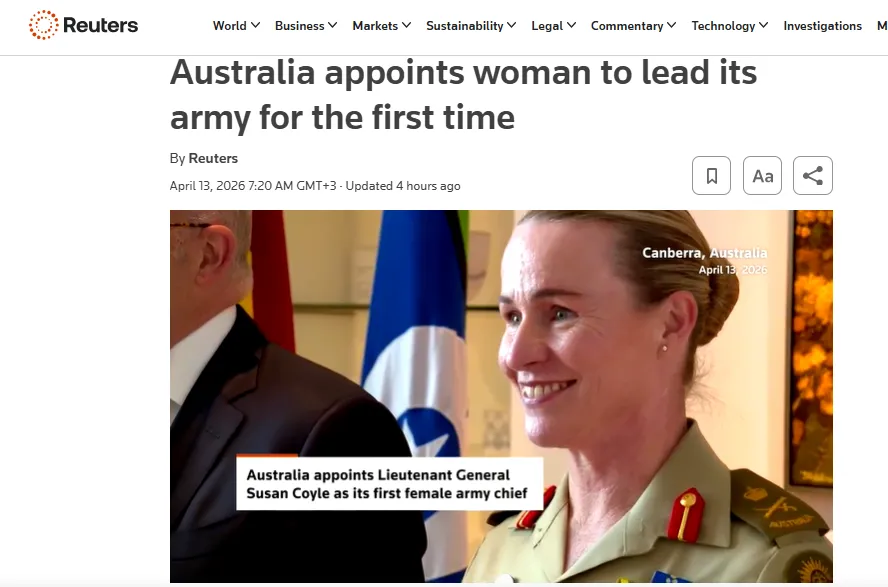
On April 13, the Australian government announced that, for the first time in history, the country’s Army will be led by a woman—Lieutenant General Susan Coyle.
This was reported by Reuters.
Coyle, who currently serves as Chief of Joint Capabilities, will become commander of the Australian Army in July. She will replace Lieutenant General Simon Stewart.
“Starting in July, for the first time in its 125-year history, the Australian Army will have a woman serving as Army Commander,” said Prime Minister Anthony Albanese.
It is noted that Coyle’s appointment comes amid the Australian Defence Force’s (ADF) efforts to increase the number of female officers in its ranks. The country’s armed forces are facing a wave of allegations of systematic sexual harassment and discrimination.
Australian Defense Minister Richard Marles called Coyle’s appointment as head of the army “a deeply historic moment.”
“Susan’s achievement will be of great significance to the women currently serving in the Australian Defence Force and to those women who plan to serve there in the future,” Marles emphasized.
It is reported that 55-year-old Coyle joined the military in 1987 and has held a number of senior command positions. Marles noted that she will be the first woman to lead any branch of the military.
Women currently make up about 21% of the ADF’s personnel and 18.5% of its leadership. The ADF has set a goal of increasing the proportion of women in the overall force to 25% by 2030.
In October 2025, a class-action lawsuit was filed against the Australian Defence Force, accusing the ADF of failing to protect thousands of female officers from systematic sexual harassment, abuse, and discrimination.
As a reminder, Princess Amaliahas begun her service in the Royal Netherlands Air Force.
Meanwhile, the German government has canceled social assistance for certain Ukrainian refugees.
Bulgaria, the Czech Republic, Estonia, Croatia, Austria, and Poland plan to appeal to the European Union with a proposal to reduce the intake of migrants due to complicated migration circumstances.


