
The Theory of Parallel Realities: The NACP Sees a Mansion, Verbytsky Sees Friendship
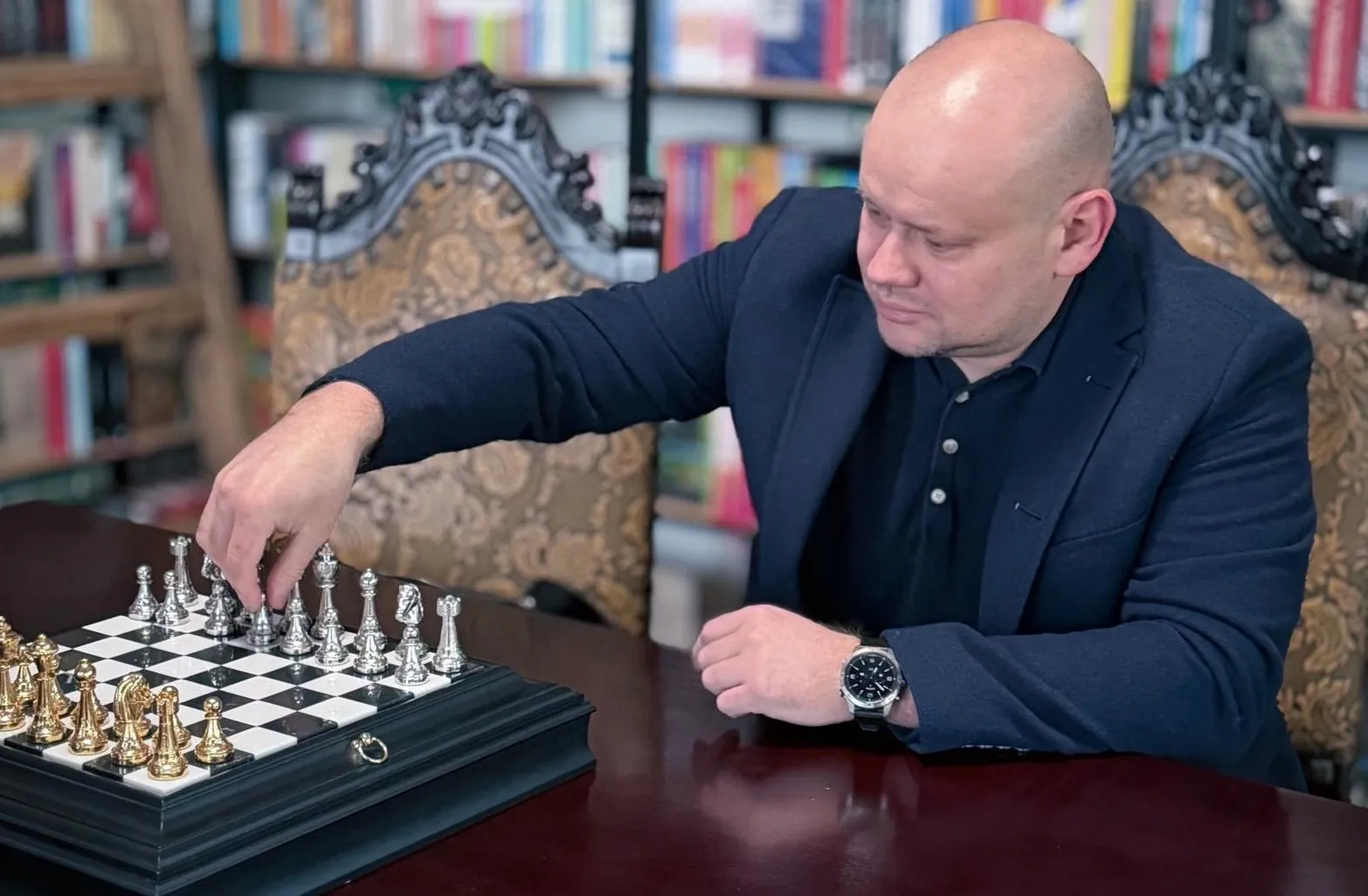
Controversial former Deputy Prosecutor General Dmytro Verbytskyi, whom the National Anti-Corruption Bureau of Ukraine (NABU) suspects of illicit enrichment, launched a campaign of self-exoneration through online media.
This self-exoneration effort was preceded by a loss in the Kyiv Administrative Court, where Verbytsky had filed a lawsuit against the National Agency for Corruption Prevention (NAZK), seeking a ruling that the NAZK’s findings were “null and void” and a ban on investigating his personal affairs. But the judges gave Verbytsky a categorical “no”: the NACP has every right to account not only for the prosecutor’s own money but also for property he registers in the names of his mistresses, nephews, or mother.
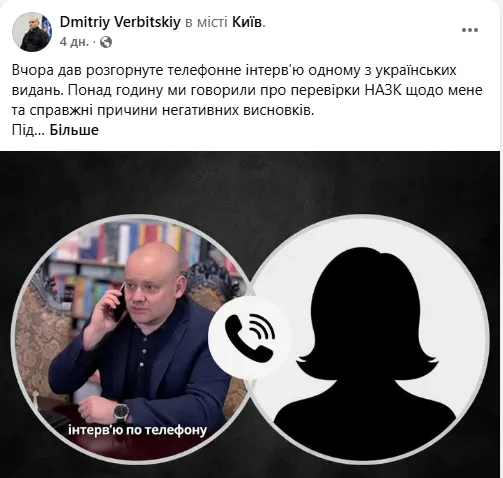
Stunned by this “total injustice,” the former prosecutor arranged for a self-justifying interview, and beforehand announced it on his Facebook page, taking the opportunity to call on other journalists, saying, “I’m ready—finally ask me about the estates and the illegal millions in my declaration.” Although the most logical course of action would have been to contact directly the very media outlets that had exposed the top official’s illicit enrichment.
Everyone is to blame. Even the calculator
But Verbytsky set out to provide explanations to a completely different set of media outlets and got so carried away that he nearly pushed legal scholarship to the brink of a major overhaul. Criminal procedure and anti-corruption legislation aren’t enough. The art of staying “just on the sidelines”—that’s where the former prosecutor’s true talent lies.
First, there was an emotional Facebook post. Then came a lengthy phone interview. From it, we learned that Ukraine’s main problem lies not in corruption, not in offshore accounts, and not even in the defendants in criminal cases. The main problem is that the NACP doesn’t know how to use a calculator.
Verbytsky himself puts it in almost tragic terms:
“Is this a basic inability to balance debits and credits, or is it deliberate?” After hearing this, you feel like immediately summoning not NABU detectives but an eighth-grade math teacher for questioning.
However, the further the conversation goes, the clearer it becomes: what we’re seeing isn’t just an attempt to defend oneself. It’s an attempt to create an alternative reality in which any inconvenient questions are explained away as either a media conspiracy or the incompetence of everyone around. And the scale of this incompetence is staggering: journalists are making mistakes, the NACP is making mistakes, the court is making mistakes, anti-corruption agencies are making mistakes—perhaps even arithmetic itself is making a mistake.
A supermind. Only Verbytsky knows how it all works
And there’s only one person in the country who fully understands how to properly count apartments, houses, Porsches, and Turkish real estate. Dmytro Verbytskyi himself.
Captain of the High Seas: The White Cap Has Sailed Off Into the Fog
This story takes on a special twist when the former Deputy Prosecutor General moves on to explaining the origin of his family’s wealth. Here, the interview begins to resemble something between the memoirs of a sea dog and the script for a TV series about Odessa rentiers.
“My father was a captain of a long-distance vessel. He earned $10,000 a month.”
The reader then learns that his father spent eight months at a time at sea, so he was a non-resident and didn’t pay taxes in Ukraine. The family, as Verbytsky explains, “was always wealthy.” His mother ran a business. Cars were imported from the U.S. Apartments were sold at “peak prices.” However, there are no documents. Because!
“My mother threw those documents away.”
And here, Ukrainian anti-corruption practices reach an entirely new level of existential trust. Government agencies, apparently, would simply have to take the family archive—which was tragically lost during a cleaning—at face value.
The residential complex is questionable
The story involving Turkish real estate is particularly intriguing. According to Verbytskyi, the NACP and journalists simply confused “the wrong residential complex.” In other words, the apartment existed, but it wasn’t that expensive. And anyway, all they had to do was “just call the developer.”
At some point, one gets the impression that the main mistake made by Ukrainian law enforcement officials was not failing to conduct expert examinations, but their reluctance to act as sales managers for Turkish real estate.
Against this backdrop, the following statement sounds particularly poignant:
“I wasn’t hiding anything.”
True, a little later it becomes clear: “I have the right to keep the address confidential.” And this is, perhaps, one of the most accurate metaphors of the entire interview: nothing is hidden; it’s just that some details are impossible to see.
Porsche Etiquette
The real gem of the interview is undoubtedly Khrystyna Ilnytska’s Porsche.
It is here that Dmytro Verbytskyi, perhaps without even realizing it, articulates one of the most subtle legal constructs of recent years.
“What I’m being accused of isn’t ‘using’ the car, but simply driving it.”
I’d like to have this sentence cast in bronze immediately. It turns out there’s an almost metaphysical difference between “driving a car” and “using a car.” A person can sit behind the wheel of a Porsche, drive around town, and be caught on surveillance cameras—yet have absolutely no connection to the car.
Because!
“She unlocks the car, and I just get behind the wheel. That’s the rule of etiquette.”
Ukrainian jurisprudence won’t recover from this level of gallantry for a long time. This concept looks particularly touching against the backdrop of another line of defense:
“There has never been a single instance where I personally took her car and drove off on my own.”
In other words, driving on one’s own would obviously be considered a certain form of relationship with the vehicle. But as long as the owner is sitting next to me—it’s just a gentleman’s gesture.
A friend’s house, a friend’s money, and a very complicated friendship
No less subtle is the story involving the house in “Konik.” Here, Verbytsky effectively proposes that society accept yet another interesting premise: living permanently in an expensive house does not imply any connection to that house.
Because:
- the house belongs to a friend;
- the friend’s money was with the friend’s father;
- the friend’s father had power of attorney;
- the NACP twisted everything;
- and Verbytsky himself simply rented the apartment out of fear for his own life following the Kolomoyskyi case.
At a certain point, the interview begins to resemble a mind game, where the main task is to distance oneself as much as possible from everything around him.
The house isn’t mine. The car isn’t mine. The apartment in Turkey isn’t the one. The millions belong to my family. The documents were thrown away. The journalists—they got it wrong. The NACP—they fabricated it. The NABU—they’re dragging their feet. The court—it’s a mere formality.
And only one thing remains unchanged: Dmytro Verbytskyi himself is absolutely convinced that he is right.
A man who doesn’t make excuses
There’s even a certain aesthetic to this. After all, the classic Ukrainian figure embroiled in a corruption scandal is usually nervous, flustered, or disappears from the public eye. Verbytsky, however, chose a different path—an aggressive philosophy of total innocence—and even joined a political party. He doesn’t just refute the allegations. He explains the world. A world in which luxury real estate is the result of an incorrect exchange rate; a Porsche is a manifestation of masculine etiquette; and any journalistic investigation is part of a large-scale conspiracy by those implicated in criminal proceedings.
And the longer these explanations go on, the more one wants to ask just one question. Perhaps the problem really isn’t about the property. Perhaps the problem is that Ukrainian reality simply isn’t ready yet for this level of legal quantum mechanics?
A Dissertation Against Corruption and Renting from a Friend: The Notorious Dmytro Verbytskyi Explains How He’s Evading Mobilization and the Courts
Instead of facing trial, the controversial former official is now calmly sipping coffee and building a political career, complaining to the cameras of investigative journalists: “I don’t live a lavish life, but I don’t live poorly either.” What’s more, it turns out that his luxurious home in the capital is simply an act of incredible friendly generosity. Commenting on the pittance he pays to rent a house in an elite cottage community, Verbytskyy looks journalists straight in the eye and assures them: “I’m renting it from a friend. Well, this isn’t a perk; these are average market rates for renting houses, uh, in this region. And this has been verified, uh, by NAZK officials.”
While the National Anti-Corruption Bureau of Ukraine (NABU) and the National Agency for Corruption Prevention (NAZK) seem to be trying to find their way to court for the third year in a row, the former law enforcement official has found a foolproof way to avoid mobilization—he’s become a graduate student and is working on his dissertation. The topic of this academic work by a man with millions in unexplained assets is simply mockingly perfect: “anti-corruption legislation.” Asserting that “I’ve been studying my whole life,” the former prosecutor—who is practically a professor already—has already outlined his plans for the future: “I want to continue working at a university and pass on my knowledge.” And there’s certainly plenty to pass on—for example, a unique scheme for officially earning about $2,000 at the prosecutor’s office while receiving “birthday gifts” from relatives.
“Well, they helped out—they gave me gifts for my birthday, and that was my savings… Well, my mother could have given me $5,000,” the future luminary of science declares without a hint of embarrassment.
When the conversation turns to the origin of his family’s wealth, the classic, rock-solid legend of Ukrainian bureaucracy about wealthy relatives comes into play.
“My father was a captain on a long-haul ship. I think you understand how much a long-haul ship captain earns. Well, starting at $10,000 a month,” Verbytsky boasts. But for some reason, he refused to brag about his new Audi SQ8 worth 100 thousand greenbacks on camera, instantly switching to a tone of aggressive defense:
“Look, this car is registered in my name. You can look it up online. If you want, I’ll come to your studio, I’ll give you an interview, I’ll show you the documents. Show me the questions you want to ask. I’ll answer them. I’ll show you the documents. Conduct the interview objectively. I don’t like provocations like the one you’re pulling right now.” Verbytskyi now plans to scale up all this “anti-corruption” success in the world of big-time politics—he has taken the helm of the district branch of Yulia Tymoshenko’s party. However, even here the logic has gone out the window, because, in the words of the newly minted party member himself: “As of today, whether to go into politics or not, I’m not yet—let’s say—fully ready to go into politics. I am currently a party member and serve as the head of the branch in the Khadzhibeyevsky District. No, I do not sponsor the party.”
Under what exact conditions “Batkivshchyna” took in such a toxic figure remains an open question. For now, Dmytro Anatoliyovych feels so confident and immune from consequences that, instead of sitting in the dock, he’s attacking law enforcement officials himself: “I am currently in a legal battle with the NACP, since the NACP clearly stated in a publication that they found evidence of illicit enrichment on my part, that they identified the elements of a crime, and that all of this was acquired on my instructions.”
The former prosecutor actively flaunts his legal battles on Facebook, personally racking up hundreds of reposts under his own posts to create the illusion of support. However, the public finds this far from funny, as behind the facade of these absurd justifications and partisan manipulations, a sad reality is clearly evident: the Verbytsky case may simply be deliberately and artificially stalled behind the scenes by anti-corruption agencies.
The UA.News editorial team continues to monitor developments in the case involving the former prosecutor and his associates. Unlike Verbytskyi’s family archives, the documents in the journalists’ possession remain intact.


