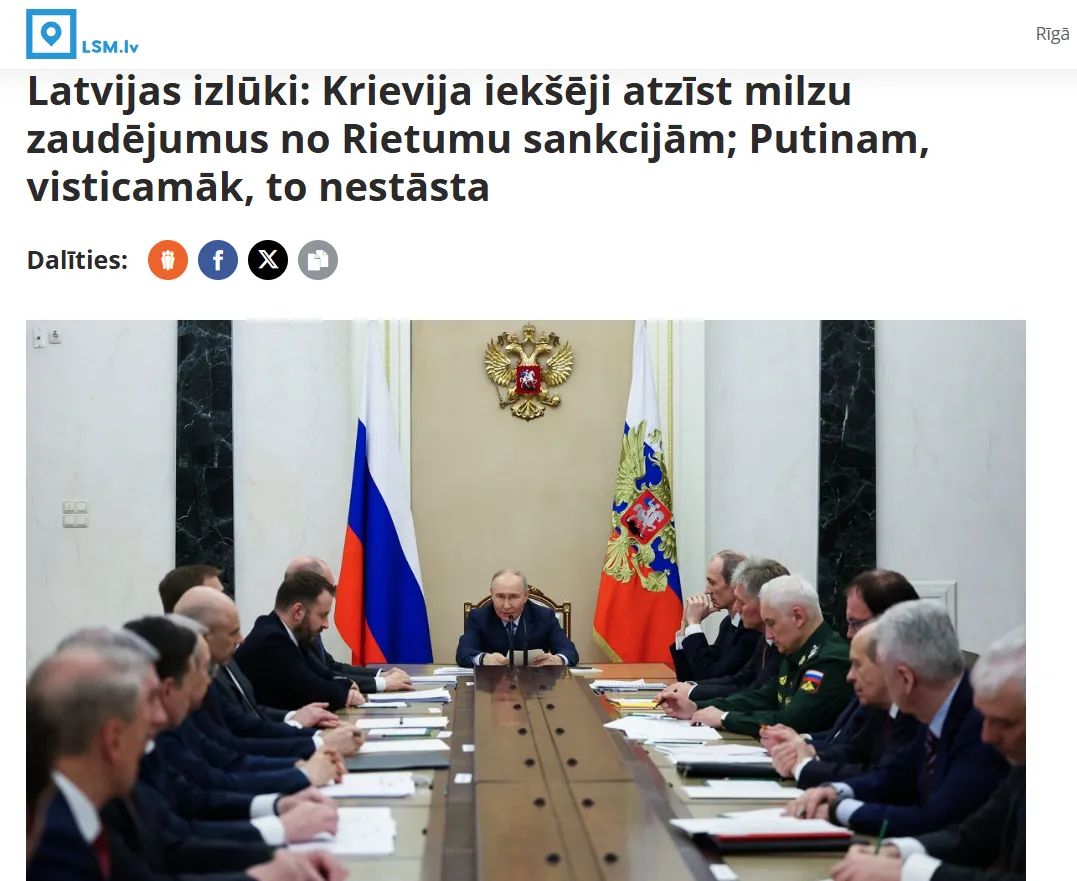
Despite Russia’s public claims of having successfully adapted to Western sanctions, officials within the country acknowledge that the restrictions are causing—and will continue to cause—significant economic damage. This is stated in an assessment by Latvia’s Constitution Protection Bureau (SAB).
The agency notes that the actual scale of the sanctions’ impact may differ significantly from the Russian government’s official position.
This is reported by LSM.
The SAB has published a report titled “Damage Inflicted on Russia by Western Sanctions,” which examines how the impact of sanctions on the country’s economy is actually assessed within Russia itself.
As SAB Director Egils Zvedris told reporters, this information was obtained through intelligence gathered through operational channels.
"Sanctions are having an impact. And, looking to the future, they will have a significant impact on the development of the Russian economy," he said.
At the same time, the agency head acknowledged that sanctions will not be the means to quickly and effectively change Russia’s aggressive stance toward Western countries.
“But sanctions are the means by which we can weaken Russia’s economic capabilities and thereby also reduce the threat that Russia poses to Western countries,” Zvedris added.
Although the Russian regime typically avoids speaking openly about problems and challenges, intelligence indicates that Russian authorities are conducting internal assessments of the actual and potential losses caused by Western sanctions. Russian authorities typically conduct such assessments by evaluating trends across various sectors of the economy, noted SAB.
Some of these calculations confirm that sanctions have already directly caused Russia significant losses.
Since invading Ukraine, Russia has lost approximately $130 billion (roughly $32.5 billion per year)—an amount the country has been forced to spend to circumvent sanctions and purchase goods that it could previously buy more cheaply from Western nations before the war.
Russia is also particularly concerned about the pressure Western countries are exerting on Russia’s trading partners—secondary sanctions, tariffs, and other restrictions that prevent Russia from redirecting its trade to alternative markets.
According to SAB, most representatives of the Russian regime, including high-ranking officials, understand that the war against Ukraine and the sanctions are causing serious damage to the economy and negatively impacting the country’s development prospects.
At the same time, information about the state of the economy within Russian institutions is shaped based on official propaganda narratives to make their work appear more effective.
The report also notes that Russian dictator Vladimir Putin is most likely receiving distorted information about the state of the country’s economy.
In this distorted picture presented to Putin, the emphasis is on “successful development,” while problems and risks are downplayed.
This likely reinforces his belief that economic losses are secondary compared to the goal of establishing control over Ukraine. Even when facing serious economic difficulties, Putin, according to the SAB’s assessment, will not be willing to change his aggressive foreign policy course.
Russia has reinforced security at Putin’s residence in Valdai with two rings of air defense systems.
Putin classified nearly half of his decrees in 2025
Putin announced an Easter truce