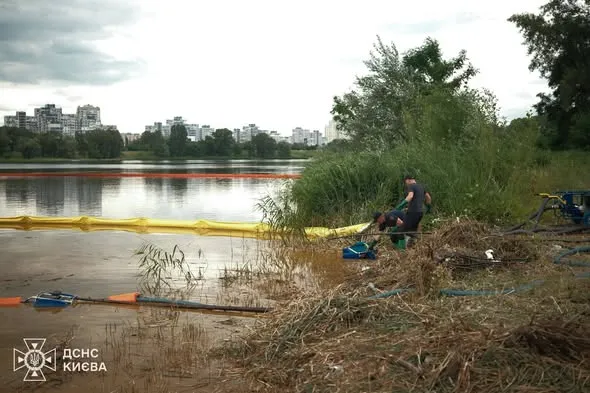
In Kyiv, efforts are continuing for the sixth day to clean up the aftermath of Russian shelling, which caused a large-scale oil spill in Lake Kyrylivske. Rescue workers have already collected more than 133 cubic meters of the pollutant and are continuing to clean up the lake.
Following the Russian attack on the night of July 2, a large oil slick formed on the lake’s surface. Currently, the contaminated area covers more than 20,600 square meters, and the thickness of the oil film reaches up to 2 centimeters in some places. To prevent the oil from spreading further, rescue workers have installed special booms on the water. In total, they deployed 550 meters of floating boom barriers and an additional 70 meters of sorbent booms, which absorb the contamination.
In addition, specialists blocked the channel between Lake Kyrylivskyi and Lake Yordanskiy to prevent oil products from entering other bodies of water. During the cleanup, rescue workers have already collected 133 cubic meters of oil products. In the last 24 hours alone, another 18 cubic meters of pollution were removed.
Fifty-five employees of the State Emergency Service of Ukraine, 18 pieces of equipment, two boats, and three trailers are working at the site. Scientists and faculty members from the National University of Civil Protection of Ukraine and Lviv State University of Life Safety have also joined the cleanup efforts.
The State Emergency Service notes that the situation remains under control, and efforts to clean up the lake are continuing nonstop. Rescue workers continue to collect oil residues from the water’s surface and are doing everything possible to minimize damage to the ecosystem following the Russian attack. This was reported by the State Emergency Service of Ukraine.
As a reminder, on Tuesday, June 30, Kyiv and the Kyiv region were affected by thick smog. Residents of the capital are reportingastrong smell of burning, reduced visibility, and a scratchy throat.
As of June 29, air quality in the Kyiv region waswithin normal limits, despite numerous fires in the Chernobyl Exclusion Zone. No increase in background radiation levels has been recorded in the region either.