
Weekly Event Highlights at the National Philharmonic of Ukraine: April 28–May 3

The National Philharmonic of Ukraine has released its schedule of events for the coming week, from April 28 to May 3.
Column Hall
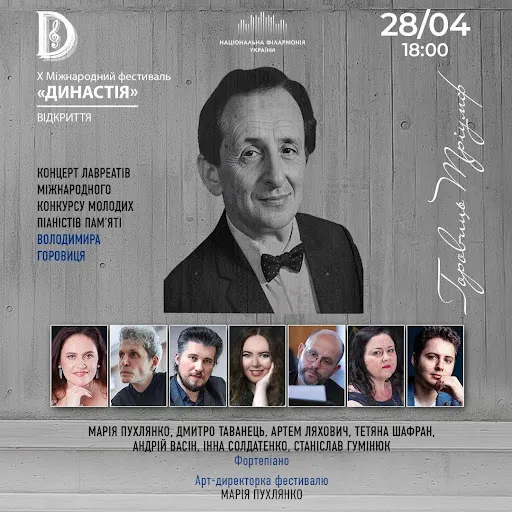
April 28: 10th INTERNATIONAL FESTIVAL “DYNASTY.” GOROVITZ TRIUMPH. OPENING. The Dynasty International Festival was founded by Maria Pukhlyanko in 2012 in Kyiv; over the years, musicians from the United States, France, Israel, Spain, Denmark, China, and other countries have participated in this artistic event. The festival integrates several large-scale projects: “The Art of Playing with an Orchestra,” “Music and Dance of the Baroque Era,” and the UKE-PIANO International Competition for Young Pianists, which will take place live for the fourth time during the war in Ukraine.
This year’s festival will take place within the walls of the National Philharmonic of Ukraine, bearing the names of Vladimir Horowitz and Mykola Lysenko—iconic figures in Ukrainian culture!
The festival’s opening—"Horowitz Day"—will feature three events at different locations within the Philharmonic: "Horowitz Rendezvous" in the foyer, "Regina Horowitz. Kharkiv” in the Music Salon, and “Horowitz Triumph” in the M. Lysenko Column Hall, which will host a concert by the laureates of the International Competition for Young Pianists in Memory of Vladimir Horowitz.
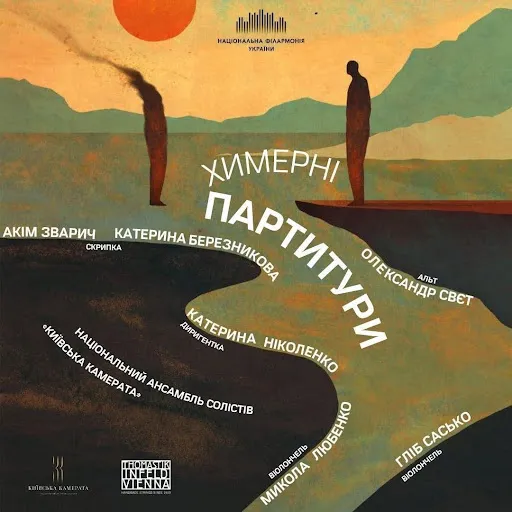
April 30: FANTASTIC SCORES. “One note is enough, if it sounds beautiful”—these words by Arvo Pärt could serve as an epigraph for the evening titled “Fantastic Scores.” For what is whimsy, if not the ability to hear the infinite in a single sound, a whole world in a single stroke of the bow?
Here, each composer creates their own universe from seemingly familiar notes. Gustav Holst transforms an old jig into a soaring flight. In a duet for two violins, Steve Reich discovers the hypnotic beauty of repetition. Paul Hindemith proves through his mournful music that the perfect note lives precisely in the silence of grief. And Genevieve Stronska writes a soundtrack for a film that does not exist—because music is capable of creating images where no one has filmed them.
In the second section, Pärt’s quote itself finds its fullest embodiment. His “Fratres” is the search for that one, ideal note that stops time. It resonates in dialogue with Vazha Azarashvili’s passionate concerto and Giovanni Sollima’s fiery “Violoncelles, vibrez!”, where two cellos make the space vibrate.
“Whimsical Scores” is an evening where every note has special meaning. And even a single note—if it sounds beautiful—is worth an entire concert!
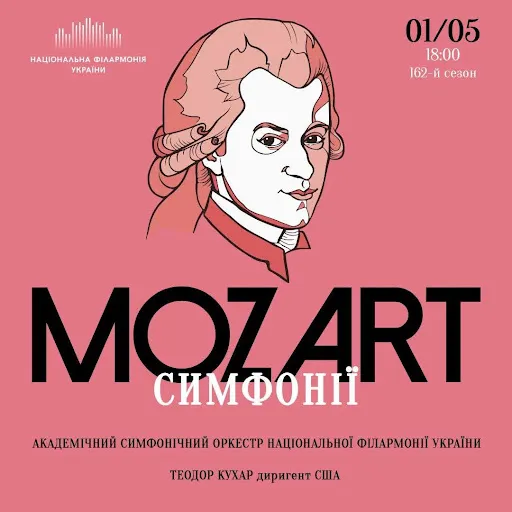
May 1: MOZART. SYMPHONIES. In the summer of 1788, over an incredibly short period, Wolfgang Amadeus Mozart composed his last three symphonies: Nos. 39, 40, and 41. These masterpieces, which were not commissioned, were born practically in a single breath “for the soul,” becoming the highest manifestation of his genius. In this music, Mozart emerges as an unsurpassed psychologist, a master of the subtlest human emotions, whose hand seemed to be guided by Providence itself.
Symphony No. 39 in E-flat major opens this cycle. It radiates light, nobility, and majestic tranquility. The omission of oboes in favor of the soft sound of clarinets lends it a special warmth and velvety timbre. This is music in harmony with the surrounding world, where the solemn opening gives way to the radiant joy of existence.
The central place in the triad is occupied by Symphony No. 40 in G minor—a work known to everyone today. The use of a restless minor key, which was extremely rare in Mozart’s symphonies, makes it tense and confessional. It impresses with the filigree perfection of every detail, yet behind this perfection lies a deep emotional vulnerability. It is in this symphony that Mozart transcends the boundaries of restrained classicism, foreshadowing the psychological depth and sensuality of the Romantic era. No wonder musicologist Alfred Einstein remarked: “This is not just music; it is a fatal inevitability. Mozart’s G minor is the voice of fate, from which there is no escape.”
The cycle concludes with the grandiose Symphony No. 41. It sounds like a divine revelation, where human suffering and anxieties dissolve into the perfect order of the universe. If Symphony No. 40 is the voice of the heart, then “Jupiter,” as it was later named, is the grandeur of the mind, uniting the earthly with the sacred.
Together, these three symphonies traverse a long journey from earthly light to heavenly grandeur. This is music that transcended its time and remains an eternal benchmark of what human genius is capable of.
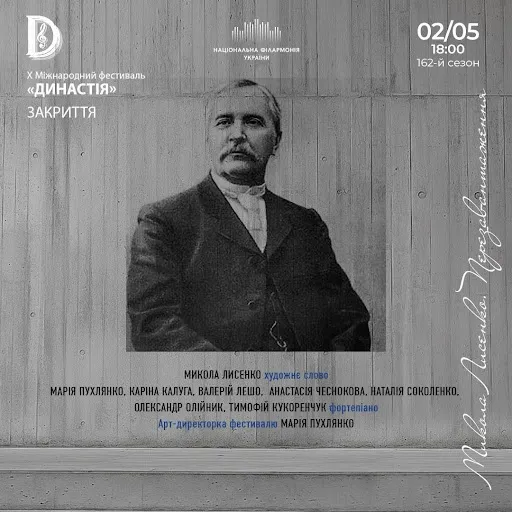
May 2: Mykola Lysenko. Reboot. The “Dynasty” International Festival was founded by Maria Pukhlyanko in 2012 in Kyiv; over the years, musicians from the U.S., France, Israel, Spain, Denmark, China, and other countries have participated in this artistic event. The festival integrates several large-scale projects: “The Art of Playing with an Orchestra,” “Music and Dance of the Baroque Era,” and the UKE-PIANO International Competition for Young Pianists, which will take place live for the fourth time during the war in Ukraine.
The festival’s closing event—“Lysenko Day”—will feature three events: the presentation of a two-volume multimedia edition of piano music in the Music Salon, the exhibition “Lysenko in Leipzig,” and the concert “Lysenko. Almost Adults” in the foyer, and the concert “Mykola Lysenko. Reboot” in the M. Lysenko Column Hall.
The concert “Mykola Lysenko. Reboot” is dedicated to Mykola Lysenko’s piano legacy and combines music with spoken word, revealing the artist’s multifaceted world through his creative work and personal stories. The program’s concept features a unique “spatial” dramaturgy of the composer’s stylistic development—which is why several grand pianos will be placed on stage simultaneously, each representing a distinct stage of his career. Performed by winners of international competitions, Lysenko’s piano music will unfold as a living evolution of the composer’s style: from early intonations to mature artistic generalizations.
A special component of the evening will be the spoken word: the great-great-grandson of the outstanding composer, Mykola Lysenko, will immerse the audience in the atmosphere of the era through letters and memories that reveal his personality from a new and unexpected perspective.
The project, led by Maria Pukhlyanko, combines musical performance, historical context, and family memory, creating a holistic artistic experience and a new understanding of Lysenko’s role in the history of Ukrainian culture.
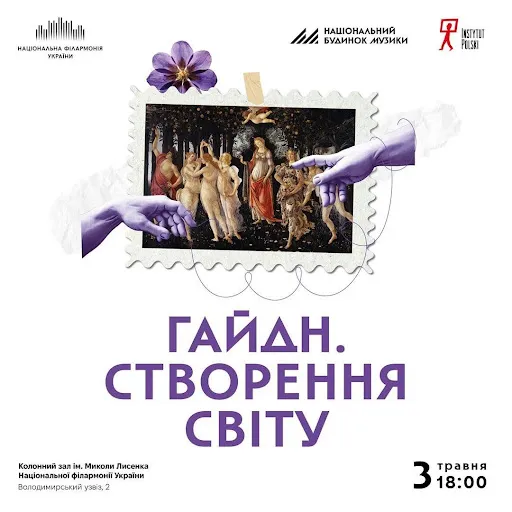
May 3: HAIDN. THE CREATION OF THE WORLD. In 1791–1792, Joseph Haydn visited London for the first time and attended a performance of Handel’s oratorios. It was *Israel in Egypt*, with its grand choruses and magnificent orchestral effects—the buzzing of flies, the leaping of frogs, the thunder of hail—that impressed him most. After that, Haydn set himself the goal of writing something equally grand.
At the same time, the impresario Johann Peter Salomon, who had organized Haydn’s visits to London, gave him a text that had been among Handel’s estate after his death. Haydn took this treasure with him to Vienna and began planning a work that would become the culmination of his long career. The libretto draws simultaneously on the Book of Genesis, the Psalms, and John Milton’s epic poem *Paradise Lost*. There is another telling detail: Handel never actually set to work on this text—the libretto proved too voluminous, as it would have stretched the music to four hours.
Working on the oratorio was a deeply personal experience for Haydn. He admitted that in his most inspired moments, he begged God to give him the strength to complete the work. One of his first biographers described his faith “not as gloomy and suffering, but rather as joyful and reconciled”—and it is precisely this feeling that permeates the oratorio.
The premiere at the Schwarzenberg Palace in Vienna in April 1798 was a resounding triumph, so spectacular that even the Catholic Church, which had initially banned the oratorio as “too secular,” could not stop its performances from spreading throughout Europe.
Every one of Haydn’s scores ended with the inscription Laus Deo—“Glory to God”—or Soli Deo Gloria—“Glory to God Alone.” In “The Creation,” these words seem to sum up the composer’s entire creative journey. In response to a letter from 1802 expressing admiration for “The Creation,” Haydn wrote: “Often, when I struggled with all manner of obstacles... a mysterious voice whispered to me: ‘There are so few happy and contented people in this world; sorrow and grief accompany them everywhere; perhaps your work will become a source from which those tormented by worries... may draw peace and comfort for a time.”
Haydn’s hopes were fully realized even during his lifetime. In our skeptical and uncertain times, we can still rejoice, perhaps with a touch of nostalgia, in Haydn’s unwavering optimism, expressed in one of the most enchanting and life-affirming musical works ever written.
The event is supported by the Polish Institute in Kyiv.
Music Salon
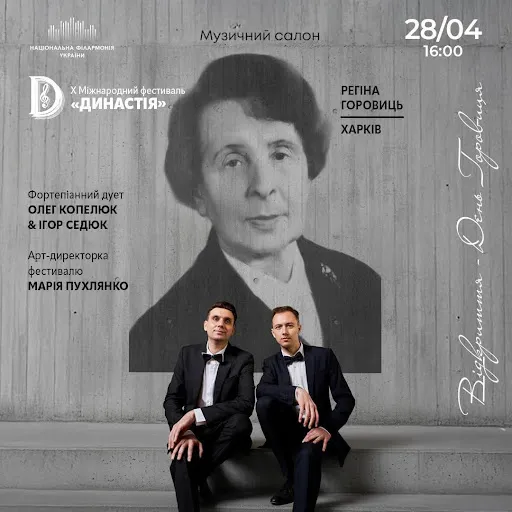
April 28 REGINA GOROVITSA. KHARKIV. 10TH INTERNATIONAL “DYNASTY” FESTIVAL. The “Dynasty” International Festival was founded by Maria Pukhlyanko in 2012 in Kyiv; over the years, musicians from the United States, France, Israel, Spain, Denmark, China, and other countries have participated in this artistic event. This year’s festival will take place within the walls of the National Philharmonic of Ukraine, featuring names iconic to Ukrainian culture: Vladimir Horowitz and Mykola Lysenko!
The festival’s opening—“Horowitz Day”—will feature three events at different locations within the Philharmonic: “Horowitz Rendezvous” in the foyer, “Regina Horowitz. Kharkiv” in the Music Salon, and “Horowitz Triumph” in the M. Lysenko Column Hall.
The program for the “Regina Horowitz. Kharkiv” concert features a performance by the piano duo of Igor Sedyuk and Oleg Kopelyuk (Ukraine). Since their founding in 2011, the musicians have proudly represented the Ukrainian piano school on European and global stages, winning numerous international competitions. This evening is dedicated to honoring the memory of the outstanding Regina Horovets—and today their music will be played for you.
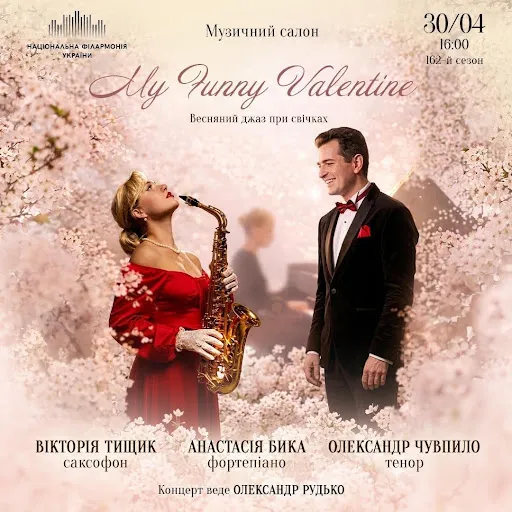
April 30: MY FUNNY VALENTINE Concert—about spring in its most romantic form, about that moment when feelings awaken along with the city, and music sounds softer than words.
The program features songs that have long been synonymous with love: Moon River, Strangers in the Night, When I Fall in Love, Fly Me to the Moon, S’Wonderful, The Shadow of Your Smile, My Funny Valentine... Music from Hollywood, jazz clubs, and evenings where two people are left alone with the melody.
My Funny Valentine is the perfect excuse for a date set to the music that sparks romance.
This is an evening for those in love.
And for those who are ready to open their hearts to spring once again.
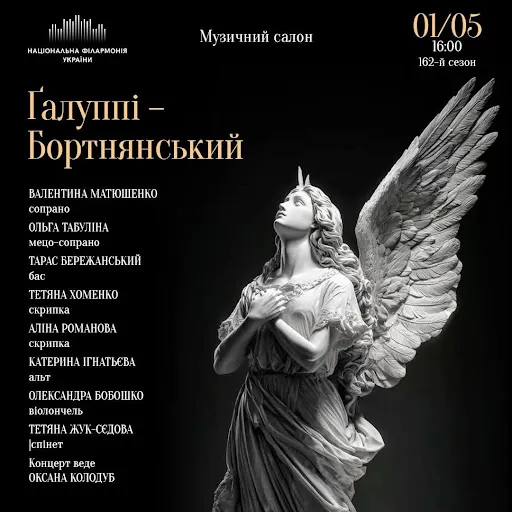
May 1: Galupi – Bortniansky. The “Galupi – Bortniansky” program is dedicated to the spiritual connection between two great 18th-century masters—the Italian Baldassare Galupi and his student, the Ukrainian Dmytro Bortniansky.
Galupi, known in Venice as “il Buranello,” combined the clarity of the Italian Enlightenment style with the depth of spiritual experience. His motets and psalms radiate the light of faith, balance, and harmony—traits that became the foundation for Bortniansky’s development as a composer. As a young student of Galuppi, Bortniansky mastered refined cantilena, a sense of proportion, and transparency of form. Upon returning to his homeland, he brought these qualities into the Ukrainian cultural sphere, creating a unique synthesis of Italian clarity and Eastern European spiritual depth.
The program features music that speaks the language of sincere faith: from the Venetian solemnity of Galupi to Bortniansky’s inner prayer; from “Confitebor tibi Domine” to “In convertendo Dominus.” Music filled with hope, light, and contemplation.
May 2: Presentation of Mykola Lysenko’s multimedia edition. The presentation of the multimedia edition—a two-volume collection of Mykola Lysenko’s piano music—will bring together the performing, academic, and publishing communities around a contemporary reinterpretation of Mykola Lysenko’s legacy. Participants in the event will include Mykola Lysenko—the composer’s great-great-grandson, conductor, and Honored Artist of Ukraine; Kateryna Soboleva—director of the “Musical Ukraine” publishing house—as well as Maria Pukhlyanko—head of the Department of Special Piano at the National Music Academy of Ukraine, Honored Artist of Ukraine, and artistic director of the “Dynasty” festival and the UKE-PIANO competition.
The event will also feature a guided tour of the exhibition “Mykola Lysenko in Leipzig,” prepared by researchers from the Mykola Lysenko House-Museum, which will allow for a deeper immersion into the European context of the artist’s formative years and creative development.
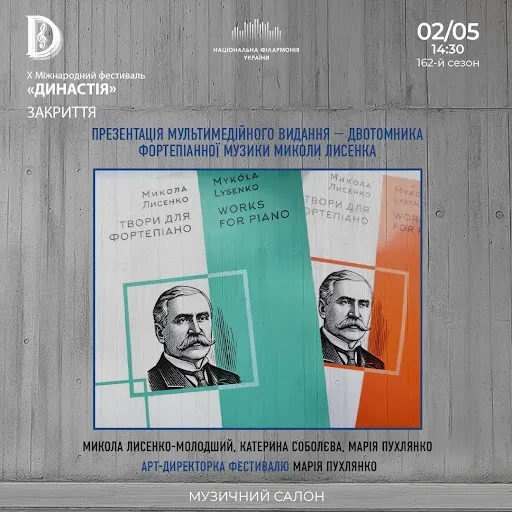
On May 3, Mozart’s Code is an event with special historical resonance, as 240 years ago, in May 1786, the premiere of the opera “The Marriage of Figaro” took place in Vienna—a work that forever changed the concept of musical theater.
In this concert, Wolfgang Amadeus Mozart’s music emerges as an eternal, living energy that has not lost its power over the centuries. Excerpts from “The Marriage of Figaro” will open up to the listener a world of subtle psychology, brilliant humor, and a deep understanding of human nature—a world that will never lose its enchanting appeal.
Alongside Mozart, the program will feature works by his friends and spiritual heirs—Joseph Haydn, Gioachino Rossini, Franz Schubert, Felix Mendelssohn, and Ludwig van Beethoven. Their music continues and reinterprets that very “code”—the harmony of form and freedom, clarity of thought and depth of feeling.
MOZART’S CODE is not only a tribute to this great anniversary but also an opportunity to experience how music from different eras speaks a single language—a language that unites, captivates, and reveals eternal meanings.
Musical Foyer
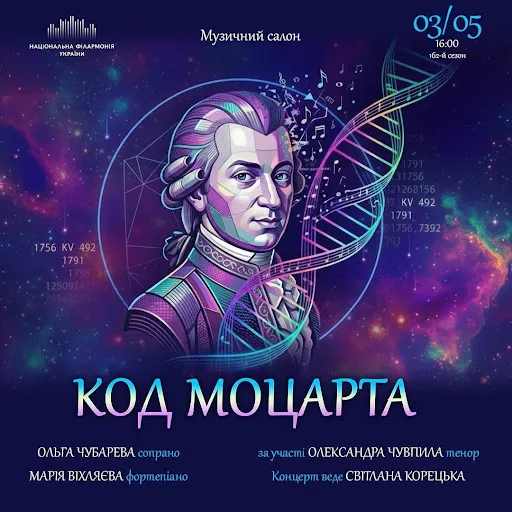
April 28: 10th INTERNATIONAL FESTIVAL “DYNASTY.” GOROVITZ-RANDEVOU. The “Dynasty” International Festival was founded by Maria Pukhlyanko in 2012 in Kyiv; over the years, musicians from the United States, France, Israel, Spain, Denmark, China, and other countries have participated in this artistic event. The festival integrates several large-scale projects: “The Art of Playing with an Orchestra,” “Music and Dance of the Baroque Era,” and the UKE-PIANO International Competition for Young Pianists, which will take place live for the fourth time during the war in Ukraine.
This year’s festival will take place within the walls of the National Philharmonic of Ukraine, bearing the names of Vladimir Horowitz and Mykola Lysenko—iconic figures in Ukrainian culture!
The festival’s opening—"Horowitz Day"—will feature three events at different locations within the Philharmonic: "Horowitz Rendezvous" in the foyer, "Regina Horowitz. Kharkiv” in the Music Salon, and “Horowitz Triumph” in the M. Lysenko Column Hall. Horowitz Rendezvous is a gathering of memories about the origins of the Vladimir Horowitz Memorial Competition for Young Pianists in Kyiv.
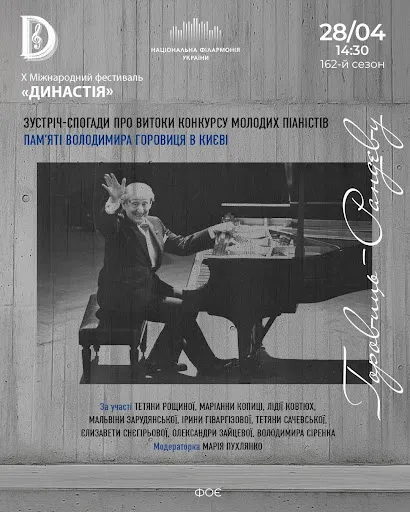
May 2: The 10th International “Dynasty” Festival. Closing: Lysenko. Almost Adults. The final chord of the anniversary festival, to be performed in the Music Foyer, is a special concert featuring those who are just beginning their great creative journey but already think and sound like adults.
The program features the music of Mykola Lysenko performed by young soloists—students of leading arts educational institutions: Kyiv Children’s Music School No. 10, the Mykola Lysenko Kyiv Children’s Music Lyceum, the Solomiya Krushelnytska Lviv Children’s Music Lyceum, and the Mykola Verykivsky Kyiv Children’s Music School No. 2.
This evening, Lysenko’s music will sound in a new way—through various instrumental “voices”: flutes, clarinets, violins, and xylophones. The young musicians will demonstrate that his music is alive, flexible, and open to the most diverse and intriguing interpretations.
A special highlight of the concert will be the performance of M. Lysenko’s one-act opera “Nocturne.” This is a chamber opera, yet fully “adult” in nature, with all parts performed by students of the M. Lysenko Kyiv State Music Lyceum. The young artists will take on not only vocal but also dramatic roles, creating a full-fledged stage story.
“Lysenko. Almost Adults”—where “almost” refers only to age, but on stage, they are already true artists.
Information resources of the National Philharmonic of Ukraine
https://www.facebook.com/philukr
https://www.instagram.com/kyivphilharmonic/
https://www.youtube.com/@philukr
https://www.tiktok.com/@go.to.phil
https://www.threads.com/@kyivphilharmonic
